










Can Ancient Wisdom Help Fight Modern Stress? Lessons from the Bhagavad Gita
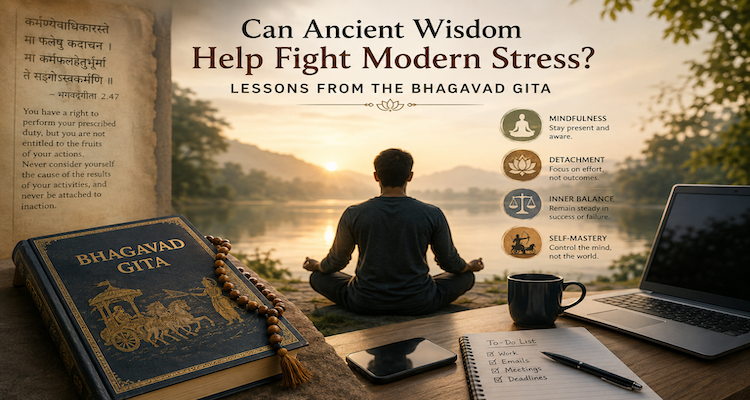
Stress often feels like a problem of excess: too many deadlines, messages, decisions, expectations and uncertainties competing for attention. Yet another part of the problem is psychological. People can become exhausted not only by what they have to do, but by trying to control outcomes they cannot fully control.
That tension makes the Bhagavad Gita unexpectedly relevant to a modern conversation about stress. The ancient Hindu philosophical text is not a clinical treatment manual, and its teachings should not be presented as a substitute for mental-health care. But some of its central ideas focused action, reduced attachment to outcomes, mental discipline and equanimity overlap in interesting ways with questions explored in psychology and stress research.
The most useful lesson may also be the simplest: reducing unnecessary mental struggle does not necessarily mean withdrawing from responsibility. It may mean learning to distinguish between the work that is yours to do and the results that remain partly outside your control.
Key Takeaways
- The Bhagavad Gita encourages focused action without excessive attachment to success or failure.
- Its idea of equanimity can be interpreted as emotional steadiness, not emotional suppression or indifference.
- The Gita’s approach to a wandering mind resembles the repeated refocusing central to many meditation practices.
- Research suggests meditation programs can help some people reduce aspects of psychological stress, though effects vary.
- Ancient philosophical wisdom can complement modern stress-management practices but should not replace professional care when it is needed.
- The Gita’s strongest modern insight may be its distinction between responsible effort and uncontrollable outcomes.
Stress Is Often Intensified by the Need to Control Results
One of the best-known passages in the Bhagavad Gita, Chapter 2, Verse 47, addresses action and its results. Translations differ in wording, but the central idea is widely rendered as a distinction between one’s responsibility to act and one’s inability to claim complete control over the fruits of that action.
Read carefully, this is not an argument for passivity.
The verse explicitly warns against attachment to inaction. The principle is closer to this: do the work that is yours to do, but do not build your entire emotional stability around an outcome influenced by countless variables.
That distinction has obvious modern applications.
A student can prepare thoroughly for an examination without controlling every question. A job candidate can submit a strong application without controlling the hiring decision. A business owner can improve a product without controlling every market response.
The practical mistake is not caring about outcomes. Outcomes matter. The mistake is confusing influence with total control.
An article in the European Heart Journal used this principle from the Gita to discuss burnout, framing it as a useful way to distinguish between the effort a person can control and the metrics or outcomes they cannot fully command. The authors emphasized that letting go of outcomes does not mean abandoning responsibility.
That distinction may be especially relevant in workplaces where performance is constantly measured but many determinants of success remain outside an individual’s control.
Equanimity Is Not the Same as Emotional Numbness
The Gita develops the idea further in Chapter 2, Verse 48, where action is associated with samatva, often translated as evenness, balance or equanimity. The text’s broader ideal is not a life without difficulty. It is the cultivation of steadiness amid changing circumstances.
This matters because “detachment” is frequently misunderstood.
In a modern context, detachment can sound like indifference: do not care, do not feel, do not become involved. That is not a particularly useful interpretation of the Gita’s emphasis on disciplined action. A person can care deeply about a project, relationship or responsibility while recognizing that emotional panic does not increase their control over every possible outcome.
The distinction is subtle but important:
- Indifference says the outcome does not matter.
- Healthy detachment, in this philosophical sense, says the outcome matters, but it will not be allowed to completely dictate one’s inner stability.
Modern psychology uses different concepts and theoretical frameworks, so these traditions should not simply be treated as identical. Still, the comparison reveals a useful shared problem: people often suffer twice first from the challenge itself and then from the mental struggle to eliminate uncertainty.
A Restless Mind Does Not Have to Be a Failed Mind
Another striking theme appears in the Gita’s discussion of meditation. Chapter 6, Verse 26 describes repeatedly bringing the restless and wandering mind back under discipline.
That principle challenges a common misconception about meditation: that successful practice requires an empty mind.
The verse instead begins with a more realistic observation. The mind wanders.
The task is not to guarantee that distracting thoughts never appear. The task is to notice the wandering and return attention deliberately.
This is one of the clearest points of contact between an ancient contemplative discipline and modern meditation practices. A review of meditation programs published in JAMA Internal Medicine found that mindfulness meditation programs showed small improvements in some negative dimensions of psychological stress, including anxiety and depression, although the authors also noted limitations in the evidence and did not present meditation as a universal solution.
Other reviews have also reported evidence that meditative therapies may help reduce anxiety symptoms, while emphasizing differences in study quality, populations and the outcomes measured.
The important editorial caution is that the Bhagavad Gita should not be retroactively described as a scientific manual for mindfulness therapy. The philosophical text and modern clinical interventions emerged from very different traditions and serve different purposes.
The more defensible conclusion is that they address some overlapping human experiences: distraction, emotional reactivity, uncertainty and the difficulty of directing attention.
From Philosophy to Practice: A More Useful Way to Read the Gita
The risk with ancient wisdom is turning it into a collection of motivational slogans.
The Gita becomes more useful when its principles are translated into questions rather than treated as magic formulas.
When stress rises, a person might ask:
What is actually within my control?
This can include preparation, effort, communication, boundaries and the choices made today.
It does not include every other person’s reaction, every future event or a guaranteed result.
Am I avoiding action because I fear an imperfect outcome?
The teaching associated with action without paralysis is relevant here. Excessive concern about failure can itself become a reason for inaction.
Am I trying to eliminate uncertainty before moving forward?
Modern life often rewards planning, but some uncertainty cannot be planned away. At some point, further mental rehearsal produces diminishing returns.
Can I return my attention instead of fighting every thought?
The Gita’s treatment of the wandering mind offers a practical insight: distraction does not automatically mean failure. Repeatedly returning attention is itself part of the discipline.
Am I treating success or failure as a verdict on my entire identity?
This may be one of the most psychologically relevant interpretations of detachment. A failed project can contain useful information without becoming proof that the person involved is a failure.
These questions do not solve clinical anxiety, trauma, depression or other mental-health conditions. But as a framework for examining everyday stress and performance pressure, they can encourage a more disciplined relationship with uncertainty.
The Overlooked Lesson: Detachment Can Make Better Action Possible
The Gita is sometimes reduced to a message about remaining calm. That misses an important tension in the text: calmness is repeatedly connected to action.
The goal is not simply to feel peaceful.
A person obsessed with a result may become less effective precisely because fear of the result distorts the work required to achieve it. A writer who constantly checks whether an article will succeed may write less effectively. A founder consumed by valuation may neglect customers. A student terrified of failure may spend more energy catastrophizing than studying.
This is where the Gita’s ancient philosophy becomes surprisingly practical.
Detachment from the result can create greater engagement with the process.
That is not because outcomes become irrelevant. It is because attention is redirected toward the next meaningful action.
The distinction resembles what contemporary discussions of burnout and performance sometimes describe as the difference between controllable behaviors and uncontrollable metrics. The vocabulary is modern, but the underlying tension is ancient: how do people act seriously in a world where they cannot guarantee the consequences of their actions?
Where Ancient Wisdom Has Limits
It would be irresponsible to suggest that reading the Bhagavad Gita can cure stress.
Stress is not a single phenomenon. It can arise from financial insecurity, caregiving responsibilities, unsafe workplaces, discrimination, illness, grief, trauma or excessive workloads. In many cases, the appropriate response involves changing external conditions, seeking social support or obtaining professional mental-health care not simply changing one’s attitude.
Meditation and contemplative practices also do not produce identical effects for everyone. Research findings vary, and systematic reviews have identified limitations in study design and consistency of outcomes.
There is also a cultural limitation worth acknowledging. The Bhagavad Gita is a sacred and philosophical text with a deep religious context. Extracting a few verses and presenting them as generic productivity advice can strip them of that context.
A responsible modern reading should therefore avoid two extremes: dismissing the text as irrelevant because it is ancient, or exaggerating it as a scientifically proven cure for modern psychological problems.
Its value may lie somewhere between those positions.
What the Bhagavad Gita Can Still Teach a Stressed Generation
The Gita cannot remove deadlines, economic uncertainty or personal loss. It cannot guarantee emotional well-being, and it should not replace evidence-based medical or psychological treatment.
But its central questions remain difficult to escape.
What is my responsibility in this situation?
What is beyond my control?
Can I act without becoming consumed by the result?
Can I notice when my mind has wandered and bring it back?
Can I experience success or failure without allowing either one to completely define me?
These are not uniquely ancient questions. They are enduring human questions.
That may explain why a philosophical dialogue rooted in a crisis of duty and uncertainty can still speak to people confronting overloaded calendars, performance metrics and constant uncertainty. The language is different, the context is different, and modern science must remain the standard for medical claims. Yet the underlying insight remains useful: peace is not always found by gaining control over everything. Sometimes it begins by seeing more clearly what was never fully yours to control.
Conclusion
The modern appeal of the Bhagavad Gita is not that it offers a shortcut around stress. Its deeper contribution is a disciplined way of thinking about action under uncertainty.
Focus on the work you can do. Recognize the limits of your control. Return attention when the mind wanders. Care about outcomes without allowing every outcome to become a judgment on your worth.
For people navigating modern stress, that is not a cure-all. It is something more modest and potentially more durable: a philosophical framework for meeting uncertainty without surrendering either responsibility or inner balance.
This content is published for informational or entertainment purposes. Facts, opinions, or references may evolve over time, and readers are encouraged to verify details from reliable sources.