










The Bhagavad Gita’s Lessons on Success, Failure and Emotional Balance
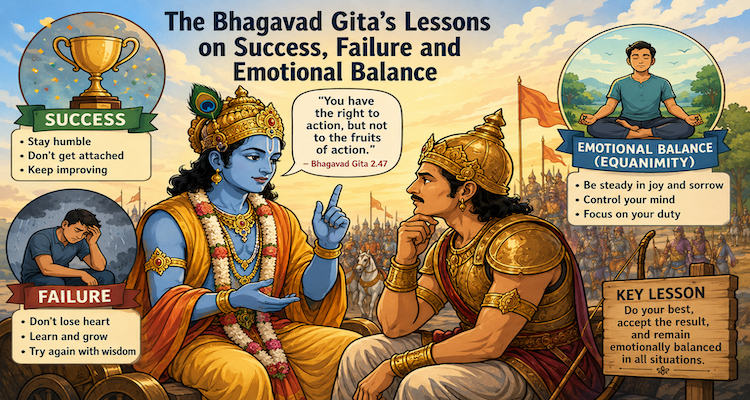
Success can create attachment. Failure can create despair. Much of human emotional turbulence comes not only from what happens to us, but from how tightly our sense of worth becomes tied to the outcome.
The Bhagavad Gita, one of the most influential philosophical texts of the Indian tradition, examines this problem through a dramatic conversation between the warrior Arjuna and Krishna on the battlefield of Kurukshetra. Yet its enduring relevance does not depend on treating life as a battlefield in a literal sense. Its deeper concern is a familiar human dilemma: how should a person act when the outcome is uncertain, the stakes are high, and emotions threaten to overwhelm judgment?
For modern readers, the Gita can be read as a philosophy of disciplined action. Its central ideas challenge two common assumptions: that success alone validates effort, and that emotional balance requires becoming emotionally indifferent. The text argues for something more demanding committed action without surrendering one’s inner stability to results that cannot be fully controlled.
Key Takeaways
- The Gita distinguishes committed action from attachment to the rewards of action.
- Success and failure become less psychologically destabilizing when effort is separated from personal worth.
- Emotional balance in the Gita does not mean suppressing feelings or becoming passive.
- The concept of samatva, or equanimity, encourages steadiness amid changing outcomes.
- The Gita’s philosophy remains relevant to modern work, ambition and performance pressure, though it should not be reduced to productivity advice.
- Its strongest lesson may be learning to control one’s response without pretending to control every result.
The Gita begins with a crisis of action
The Bhagavad Gita opens not with a celebration of confidence, but with Arjuna’s paralysis. Faced with the prospect of fighting relatives, teachers and friends, he experiences moral conflict and emotional distress. He questions whether the action before him can be justified and loses confidence in his ability to proceed.
This starting point matters. The Gita is often quoted for its teachings on duty and detachment, but those teachings emerge from a situation of profound uncertainty rather than easy certainty.
Krishna’s response develops across the text, addressing action, duty, knowledge, discipline and the nature of the self. One of its most widely discussed ideas appears in Chapter 2: a person has a claim to action, but not complete control over the fruits of action.
The idea is frequently simplified into “do not care about results.” That is a poor reading.
The Gita does not advocate careless effort. It repeatedly emphasizes discipline and appropriate action. The distinction is between working toward an outcome and becoming psychologically enslaved to that outcome.
A student may prepare seriously for an examination without being able to guarantee the final result. An entrepreneur can build a business without controlling the market. A professional can prepare carefully for an interview without controlling another person’s decision.
The lesson is not that outcomes are irrelevant. It is that they are never produced by individual effort alone.
Success is not the same as control
Modern culture often treats outcomes as evidence of total personal merit. Win, and the victory appears to prove competence. Lose, and failure can feel like evidence of inadequacy.
The Gita introduces a more complicated view.
Human beings can influence outcomes through preparation, skill, judgment and persistence. But outcomes also depend on circumstances, timing, other people and forces outside individual control. Treating success as entirely self-created and failure as entirely self-caused can therefore distort reality.
This distinction has practical consequences.
A person who measures self-worth exclusively through promotions, profits, rankings, examinations or public approval may become increasingly vulnerable to circumstances beyond personal control. Success can produce anxiety about losing what has been gained. Failure can become an identity rather than an event.
The Gita’s alternative is to focus attention on the quality of action.
That does not guarantee success. It changes the basis on which a person evaluates the effort. The relevant questions become:
- Was the action thoughtful?
- Was the effort sincere and disciplined?
- Were decisions consistent with one’s responsibilities and principles?
- What can be learned from the result?
- What remains within one’s control?
This approach does not remove disappointment. It can, however, prevent disappointment from becoming total psychological collapse.
“Equanimity” is not emotional numbness
Another important concept in the Gita is samatva, commonly translated as equanimity or even-mindedness. In Chapter 2, Krishna describes equanimity in relation to success and failure and connects it with disciplined action.
This can be misunderstood as a demand to feel nothing.
The text’s philosophical ideal is better understood as steadiness rather than emotional absence. A person can feel disappointment without allowing disappointment to dictate every decision. Success can bring satisfaction without producing arrogance or reckless attachment. Fear may arise without being permitted to take complete control.
That distinction is especially relevant in environments built around constant evaluation.
Modern professionals can receive performance metrics in real time. Students encounter rankings and competitive comparisons. Social platforms transform attention and approval into visible signals. Business founders can watch financial outcomes change quickly. In such settings, emotional life can become closely tied to external feedback.
The Gita offers a counterweight: external conditions change, and a stable inner life cannot depend entirely on their remaining favorable.
That is not an argument against ambition. It is an argument against making emotional survival dependent on perpetual success.
The overlooked tension: ambition without attachment
The Gita is sometimes presented as if detachment and ambition are opposites. They do not have to be.
A person can pursue difficult goals with extraordinary seriousness while remaining detached from the illusion that effort guarantees reward.
In fact, attachment can sometimes weaken performance rather than improve it.
When the mind becomes consumed by a desired result, attention can shift away from the work required in the present moment. A writer becomes preoccupied with whether an article will succeed rather than improving the article. An athlete becomes consumed by the scoreboard rather than the next action. A professional spends more energy fearing failure than preparing for the task.
The Gita’s emphasis on disciplined action offers a different psychological orientation: return attention to the work that can actually be done now.
This is not a promise of better results. The text is a philosophical and spiritual work, not a modern performance manual, and its teachings should not be presented as scientifically proven techniques for increasing productivity or guaranteeing emotional well-being.
Its value lies elsewhere. It provides a framework for thinking about a permanent human problem: how to act wholeheartedly when certainty is impossible.
What failure can teach when it is not treated as identity
Failure becomes especially difficult when people confuse an outcome with a complete judgment of the self.
The Gita’s emphasis on the impermanence of changing conditions can help create distance between the two.
A failed project is a failed project. It does not automatically prove that every future project will fail.
A lost job can be a serious setback. It does not define the entirety of a person’s ability or value.
A poor decision may require accountability and correction. Detachment should never become an excuse for avoiding responsibility.
This last point is crucial. “I am not attached to results” can be misused to avoid learning from mistakes. That would contradict the broader emphasis on disciplined and responsible action.
A healthier interpretation requires holding two ideas together:
Accept the result without denial. Learn from the result without becoming imprisoned by it.
That combination may be one of the Gita’s most practical contributions to contemporary life.
Failure should be examined. Evidence should be reviewed. Strategies should change when necessary. Apologies should be made when harm has been caused.
But self-punishment is not the same as responsibility.
The Gita’s philosophy encourages action again and again, even though every action carries uncertainty.
Emotional balance requires discernment, not withdrawal
One possible criticism of teachings about detachment is that they can encourage passivity. If one should not be attached to outcomes, why work hard to change anything?
The Gita itself does not resolve this question through passivity. Action is central to its philosophy. The problem, in its framework, is not action but attachment, confusion and unexamined motivation.
This distinction is important in contemporary life as well.
Emotional balance should not mean ignoring injustice, abandoning ambition, accepting poor conditions or refusing to care about other people. Detachment from a particular outcome is different from indifference to consequences.
A person may work to improve a situation precisely because the action is considered necessary, while accepting that the final outcome cannot be completely guaranteed.
This creates a demanding standard: care deeply about what you do without demanding absolute control over what follows.
That may sound simple, but it is difficult to practice.
A practical way to apply the Gita’s lessons
The Bhagavad Gita is a religious and philosophical text with multiple traditions of interpretation. Applying it to modern work or personal development should therefore be done with care. Still, several questions can translate its core tension between action and attachment into everyday reflection.
Before acting
Ask:
- What is actually within my control?
- What preparation is required?
- What responsibility am I trying to fulfill?
- Am I acting from considered judgment, fear or the need for approval?
While acting
Bring attention back to the task rather than repeatedly predicting the result.
This does not mean refusing to measure progress. Feedback matters. Planning matters. Adjustment matters. The point is to use information as guidance rather than allowing every signal to become a judgment about personal worth.
After the outcome
Whether the result is favorable or unfavorable, pause before turning it into a complete story about yourself.
If successful, ask what conditions, preparation and decisions contributed and avoid assuming success makes future failure impossible.
If unsuccessful, ask what can be learned, what was outside your control and what should change next.
This is where emotional balance becomes practical rather than abstract.
Why these ideas still resonate
The Bhagavad Gita has endured for centuries because its questions remain difficult rather than because it offers effortless answers.
People still struggle with uncertainty. They still fear failure, seek recognition, regret decisions and become attached to outcomes they cannot fully control.
What changes is the environment in which those struggles occur.
Today, the pressure may come through career competition, financial uncertainty, academic expectations, public visibility or constant comparison. The underlying tension is familiar: people are encouraged to pursue outcomes intensely while being told, often only after disappointment, that they should somehow remain emotionally unaffected.
The Gita offers a more coherent challenge.
Do not avoid action because the result is uncertain.
Do not assume effort gives you complete ownership of the result.
Do not let success convince you that everything is under control.
Do not let failure convince you that nothing can be repaired.
Conclusion
The Bhagavad Gita does not offer a formula for guaranteed success or a method for eliminating painful emotions. Its more difficult lesson is that meaningful action and uncertain outcomes must coexist.
Success deserves to be appreciated, but it should not become the sole foundation of identity. Failure deserves honest examination, but it should not become a permanent verdict on the person who experiences it.
The practical challenge is to remain engaged without becoming consumed: to prepare seriously, act responsibly, learn honestly and maintain enough inner distance from outcomes to begin again.
For readers navigating careers, competition, disappointment or the pressure to constantly prove themselves, that may be the Gita’s most durable lesson: control the quality of your effort where you can, accept uncertainty where you must, and do not hand your emotional balance entirely to the next result.
This content is published for informational or entertainment purposes. Facts, opinions, or references may evolve over time, and readers are encouraged to verify details from reliable sources.