










How Desire, Anger and Attachment Can Disturb the Human Mind
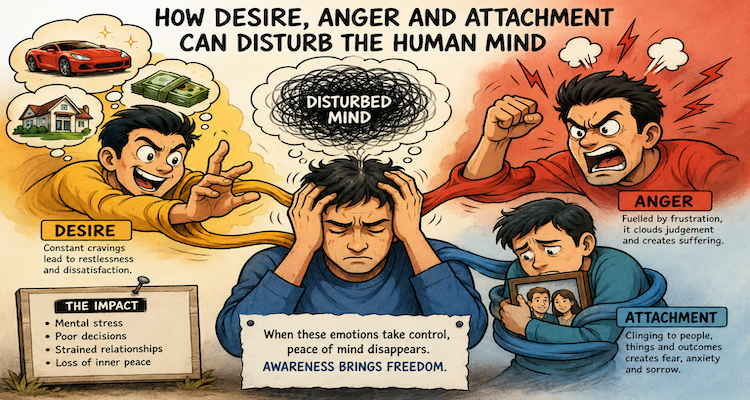
Human beings do not usually lose mental balance because desire, anger or attachment simply exist. These emotions and drives are part of ordinary life. The difficulty begins when they become powerful enough to narrow attention, distort judgment and make immediate emotional impulses more influential than reflection.
Modern psychology describes these processes through concepts such as emotional regulation, attentional bias, rumination, impulsivity and cognitive control. Ancient Indian philosophy, particularly the Bhagavad Gita, presents a strikingly similar concern through a moral and psychological sequence: intense attachment can feed desire; frustrated desire can contribute to anger; anger can disturb judgment; and disturbed judgment can lead to harmful decisions. The two traditions do not use the same scientific framework, but placing them in conversation reveals an enduring question: what happens when a feeling stops informing the mind and starts governing it?
Key Takeaways
- Desire can become disruptive when immediate reward consistently overrides longer-term goals and self-control.
- Anger can narrow attention and impair judgment, especially when it becomes intense, prolonged or repeatedly reinforced.
- Attachment is not inherently harmful, but excessive psychological dependence can make loss, rejection and uncertainty harder to regulate.
- Rumination can keep anger and other distressing emotions active long after the original trigger has passed.
- The Bhagavad Gita offers a philosophical model of escalating emotional disturbance that can be usefully compared with modern research on self-regulation.
When the Mind Begins to Serve the Emotion
The central insight is easy to miss: the problem is not desire, anger or attachment by themselves. The more consequential problem is loss of psychological flexibility.
A person may want success without becoming consumed by it. They may love another person without losing their identity. They may feel anger without becoming aggressive. Healthy functioning does not require emotional emptiness; it requires the ability to experience an emotion without automatically obeying it.
That distinction also helps connect the Bhagavad Gita with contemporary psychology.
In verses 2.62 and 2.63, the Gita describes a progression from sustained mental attention to attachment, desire, anger, confusion and impaired discrimination. Different translations vary in wording, and the verses belong to a philosophical and spiritual tradition rather than a modern scientific model. Still, the sequence is psychologically interesting because it treats emotional disturbance as a process, not a single event.
Modern research similarly suggests that difficult emotional states can be intensified or prolonged by how attention is deployed and how people regulate their responses. A recent meta-analysis of anger-regulation research identifies rumination as one process associated with the amplification of anger, while strategies such as reappraisal and distraction can play different roles in reducing or managing anger.
The comparison should not be overstated. The Gita is not a neuroscience textbook, and modern psychology does not scientifically validate every element of an ancient philosophical chain. But the two perspectives converge on an important practical observation: where attention repeatedly goes, emotion can gather force; once arousal becomes intense, reflective judgment may become harder to access.
Desire: When Wanting Becomes Mental Occupation
Desire is not automatically destructive. It motivates learning, ambition, relationships, creativity and survival. Without wanting anything, purposeful action would be difficult to explain.
The risk emerges when wanting becomes rigid.
Consider the difference between:
“I would like this.”
and:
“I must have this, and I cannot be at peace without it.”
The second position gives the desired outcome greater psychological power. Attention repeatedly returns to it. Obstacles become more frustrating. Failure may feel less like an ordinary disappointment and more like a threat to identity or self-worth.
This is where the Gita’s sequence offers a useful interpretive framework. The verses begin not simply with desire, but with sustained dwelling on an object of attention. Attachment and desire follow in the philosophical account.
That distinction matters in everyday life. The mind often strengthens a desire through repetition: checking for messages, replaying a perceived insult, repeatedly imagining a purchase, obsessing over a promotion or continually comparing one’s life with someone else’s.
The object may change. The mental mechanism is familiar: attention can become rehearsal.
The practical question, therefore, is not whether people should eliminate desire. A more useful question is whether they can step back from it long enough to ask:
- Is this something I value, or something I am becoming psychologically dependent on?
- What happens to my judgment when I do not get it?
- Has wanting become repetitive mental occupation?
- Am I making decisions based on long-term values or immediate emotional pressure?
These questions do not suppress ambition. They test whether ambition is still being directed by the person—or whether the person is increasingly being directed by the ambition.
Why Frustrated Desire Can Turn Into Anger
Anger is often treated as though it appears suddenly. Yet many episodes have a longer psychological history.
A goal is blocked. An expectation is violated. A person feels ignored, insulted, rejected or prevented from getting something they believe they deserve. Anger may then become part of the response.
The Gita explicitly connects desire with anger in its sequence: attachment gives rise to desire, and desire can be followed by anger.
Modern psychology describes anger through more complex models and does not reduce every angry response to frustrated desire. Perceived injustice, threat, humiliation and hostile interpretations can also matter. The evidence on emotion regulation, however, supports the broader idea that certain cognitive processes can intensify anger. Rumination repeatedly focusing on an anger-provoking event or thought can help maintain or amplify the emotional state.
This helps explain why the original trigger is not always the main problem.
A disagreement lasting five minutes can occupy the mind for hours. During that time, the person may mentally reconstruct the argument, imagine new confrontations and reinforce hostile interpretations. The anger is no longer responding only to what happened; it is being repeatedly reactivated.
That is an important distinction for readers who assume emotional control means never becoming angry.
It does not.
A healthier goal is to reduce the gap between feeling anger and acting under anger’s command.
Attachment Is Not the Same as Love
One of the easiest mistakes in discussions of detachment is to treat all attachment as unhealthy. Modern attachment research offers an important corrective.
Human attachment can provide security, support and emotional regulation. Research on adult attachment has found substantial links between attachment-related differences and the ways people regulate distress and respond to emotionally threatening situations. A systematic review published in 2023 reported consistent associations between attachment representations and patterns of emotion regulation, while also noting limitations and gaps in the available evidence.
The problem, then, is not caring deeply about another person.
The problem may arise when emotional security becomes so dependent on controlling another person, preventing separation or receiving constant reassurance that uncertainty becomes intolerable.
Research on insecure attachment describes patterns in which some individuals may become especially preoccupied with closeness and highly sensitive to possible rejection, while other forms of insecurity can involve emotional distancing and discomfort with dependence. These are patterns of attachment and emotion regulation, not simple labels that can diagnose a person from a single relationship behavior.
This distinction gives the ancient discussion of attachment a more nuanced modern reading.
Love can involve attachment. Attachment becomes psychologically destabilizing when a person loses the capacity to function, regulate emotion or maintain perspective in the face of uncertainty, distance or loss.
That is why detachment need not mean indifference.
A parent can care deeply for a child without controlling every decision. A partner can love someone without treating them as property. An ambitious professional can pursue success without allowing one failure to define their entire worth.
Healthy connection leaves room for both closeness and psychological independence.
The Most Dangerous Stage May Be the Loss of Perspective
The strongest part of the Gita’s sequence may be what comes after anger.
The text describes anger leading to confusion, followed by disturbance of memory and the loss of discriminating intelligence.
Taken literally as philosophy, this belongs to its own conceptual tradition. But as a modern analogy, it captures something recognizable: people in highly emotional states can temporarily lose access to the standards they would endorse when calm.
Someone who values a relationship sends a message intended to wound. Someone who values honesty lies to avoid humiliation. Someone who understands the consequences of an action behaves recklessly in a moment of rage.
The person may later ask: Why did I do that?
Angry rumination research is relevant here. A review of the proposed mechanisms behind angry rumination discusses its relationship with affective responding, executive control and self-control, while emphasizing that the underlying processes remain an area of continuing research.
The lesson is not that emotion destroys rationality in every instance. Human decision-making is far more complicated.
It is that high emotional activation can change what information receives attention and how effectively a person can pause before acting.
That makes timing important.
Trying to reason with oneself after an emotional escalation has reached its peak may be harder than intervening earlier when attention first becomes repetitive, when expectations first become rigid or when the body first signals rising anger.
The Overlooked Connection: Attention Is Often the First Link
Much advice about anger begins too late.
It tells people to calm down after they are already furious.
The sequence described in the Gita begins earlier: with sustained contemplation or dwelling on an object.
Modern anger research offers a useful parallel through rumination. Repeated attention to hostile or anger-related thoughts can contribute to maintaining and amplifying anger.
This suggests a practical editorial insight: emotional regulation is often partly an attention-management problem.
That does not mean people can simply decide never to think about a painful experience. Intrusive thoughts, grief, trauma and mental health conditions cannot be reduced to a matter of willpower.
But in ordinary moments of escalating frustration, it may be possible to notice the beginning of a loop:
Trigger → repeated mental replay → stronger emotional investment → impulsive urge → action → consequence
Interrupting the loop does not require pretending the emotion is absent. It may involve changing the conditions under which the emotion is being rehearsed.
For example:
- Delay a consequential response when emotionally activated.
- Put physical distance between yourself and an escalating conflict when possible and safe.
- Write down the underlying expectation: What did I believe should happen?
- Ask whether the mind is solving a problem or merely replaying it.
- Reconsider an initial interpretation of another person’s intention.
- Return to a decision after emotional intensity has decreased.
These are not universal treatments for anger or emotional distress. Persistent, severe or dangerous problems with anger, relationships or emotional control may require professional support. But for everyday self-regulation, the earlier point of intervention may be more useful than trying to suppress a fully developed emotional reaction.
Desire, Anger and Attachment in the Digital Environment
The ancient sequence becomes especially interesting when placed beside modern digital life.
Many technologies are designed to compete for attention. Notifications, social feedback, recommendation systems and endlessly refreshed content can repeatedly return a person to the same objects of desire, comparison or resentment.
It would be inaccurate to claim that technology alone causes attachment, anger or mental disturbance. Human emotions existed long before smartphones and social media, and the psychological effects of digital platforms vary substantially by person, context and use.
But digital environments can create conditions in which attention is repeatedly redirected toward emotionally charged material.
That matters because attention is not neutral. What receives repeated cognitive rehearsal can become more psychologically significant.
The modern question is therefore not simply, How much screen time is too much?
It may also be:
What emotional states are our habits repeatedly rehearsing?
A person may spend little time online yet repeatedly seek material that fuels resentment. Another may spend hours online without becoming emotionally destabilized. Duration alone cannot explain the psychological effect.
The content of attention, the personal context and the pattern of engagement may matter as much as the clock.
This is one area where the Gita’s philosophical model offers a surprisingly useful lens: the mind can be shaped not only by what it experiences, but by what it repeatedly returns to.
Detachment Does Not Mean Suppression
There is another important misconception.
Detachment is sometimes interpreted as emotional numbness. Psychology offers little reason to treat the absence of feeling as the universal ideal. Emotions provide information about goals, threats, relationships and social situations.
The challenge is flexibility.
A person can acknowledge:
“I want this.”
without concluding:
“My life is impossible without it.”
They can say:
“I am angry.”
without concluding:
“I must act now.”
They can say:
“I love this person.”
without concluding:
“I have no identity without them.”
This is where the deeper value of the comparison lies. Both the philosophical and psychological perspectives, in different ways, direct attention toward the relationship between inner experience and response.
The feeling may arise.
The next action remains a separate question.
What This Means for Everyday Mental Balance
Desire, anger and attachment become more disruptive when they shrink the range of responses available to a person.
A mind dominated by desire sees only acquisition.
A mind dominated by anger sees only the offence.
A mind dominated by attachment may see only the possibility of losing what it depends upon.
Mental balance begins to return when perspective expands.
That may mean remembering a longer-term goal during a short-term frustration. It may mean allowing a relationship to contain uncertainty without immediately demanding reassurance. It may mean recognizing that a powerful desire is still only one part of a larger life.
The Bhagavad Gita presents this as a chain that can culminate in the loss of discriminating judgment. Modern psychology does not endorse the text as a scientific mechanism, but research on emotion regulation, rumination and attachment supports the broader importance of how attention, emotional arousal and regulatory processes interact.
The enduring lesson is therefore less about eliminating desire, anger or attachment than about recognizing when they begin to take over the machinery of thought.
Conclusion
Desire can motivate. Anger can signal that something feels wrong. Attachment can create love, security and belonging.
None of these experiences automatically disturbs the human mind.
The danger lies in escalation: when attention becomes fixation, wanting becomes dependency, frustration becomes consuming anger and emotion becomes the sole authority behind action.
The most useful intervention may come earlier than most people expect not when the mind has already reached its breaking point, but when it first begins to circle endlessly around an object, an expectation, an insult or a fear of loss.
That is the enduring insight behind the ancient sequence and the modern research alike: mental freedom is not the absence of powerful emotions. It is the ability to experience them without surrendering judgment to them.
This content is published for informational or entertainment purposes. Facts, opinions, or references may evolve over time, and readers are encouraged to verify details from reliable sources.
Related News
- Can Ancient Wisdom Help Fight Modern Stress? Lessons from the Bhagavad Gita
- The Bhagavad Gita’s Lessons on Success, Failure and Emotional Balance
- What Is Dharma? Understanding Purpose Through the Teachings of the Bhagavad Gita
- How the Bhagavad Gita Explains the Difference Between the Mind and the Self