










Why School Rankings Can Distort the Decisions Families Make
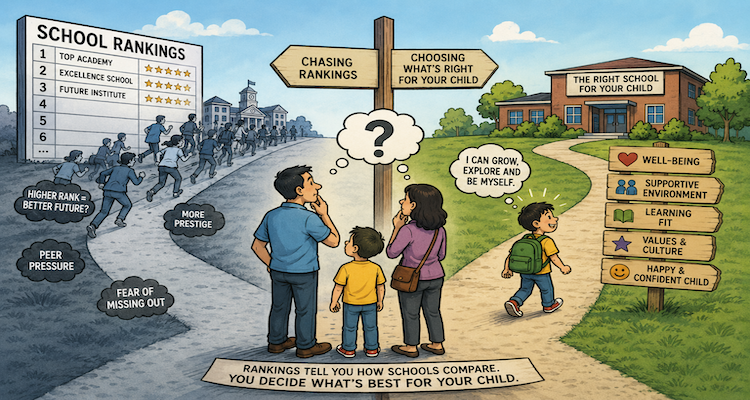
A school ranked near the top can look like an obvious choice. A school near the bottom can be dismissed before a family ever asks what happens inside its classrooms. That is the central problem with school rankings: a complicated educational experience gets compressed into a number, letter, percentile or position on a list.
Rankings can be useful. They can help families narrow a large set of options and identify schools worth investigating. Research also shows that parents respond to school-quality information, and that better information can influence which schools they choose. But the same evidence points to a more important distinction: information can improve school choice without making a single ranking a reliable measure of which school is best for a particular child.
The problem is not that rankings are necessarily wrong. It is that families can easily ask a much bigger question of them than the underlying data can answer.
Key Takeaways
- A school ranking is a measurement of selected outcomes, not a complete judgment of educational quality.
- Test scores can reveal important differences between schools but do not capture every outcome families may value.
- Research finds that school effects on test scores can differ from effects on longer-term student outcomes.
- Families may mistake student composition for school effectiveness when interpreting highly ranked schools.
- Rankings are most useful as a starting point for investigation rather than a final decision rule.
What a School Ranking Actually Measures
The first question families should ask is deceptively simple: What does this ranking measure?
There is no universal definition of a “good school.” Different ranking systems select different indicators, assign different weights and use different comparison groups.
GreatSchools, for example, currently describes its overall rating as a 1–10 comparison of schools within the same state. Its methodology can incorporate student progress, college readiness and other measures depending on the school and available data. College-readiness measures can include graduation rates, college entrance exams and participation in advanced coursework.
That matters because changing the measurement changes the ranking.
A system that emphasizes standardized-test performance will produce a different ordering from one that emphasizes student growth. A ranking emphasizing college readiness may favor schools with strong graduation and advanced-course indicators. Another system could give greater weight to school climate, student support or other measures.
So when a family sees that one school is ranked “better” than another, the ranking does not answer an objective question called Which school is better? It answers a narrower question: Which school performs better according to this particular measurement system?
That distinction is easy to lose when a complicated methodology is represented by a single number.
The Number Can Hide the Students Behind It
School performance data also describe the students who attend a school, not only what the school itself does.
This creates one of the most important interpretation problems in school comparisons.
A school with unusually high test scores may genuinely provide excellent instruction. But its results can also reflect differences in the students entering the school, their prior achievement, family resources, neighborhood conditions and other factors outside the school’s direct control.
Researchers have therefore tried to distinguish school effectiveness from simple differences in average student outcomes. A National Bureau of Economic Research study examining schools in Trinidad and Tobago found that schools’ causal effects on high-stakes test scores were only weakly related to their effects on outcomes including dropout, arrests, teen motherhood and formal labor-market participation. The authors concluded that evaluations based only on test scores can give a misleading picture of the broader benefits of school choice.
This does not mean test scores are meaningless. They remain valuable evidence about academic performance.
It means the interpretation needs to be more careful.
A high score tells a family something. It does not necessarily tell them everything they want to know.
The “Best School” May Depend on What the Family Values
Families rarely make school decisions using only one objective.
A parent may care about academic acceleration. Another may prioritize special-education services. A family with a child who loves science may care about laboratory courses and advanced STEM opportunities. Another may place greater weight on arts programs, athletics, transportation, school climate, student support or the child’s social environment.
Even academic success itself can be measured in different ways.
A school could produce modest changes in standardized-test scores while producing stronger effects on graduation, college attendance or other long-term outcomes. Research from Barbados, for example, found that sought-after schools did not, on average, improve students’ short-run test scores in the study examined, while the same research identified longer-term differences in postsecondary completion and adult well-being.
Again, this is not evidence that test scores should be ignored. It is evidence that a ranking built around one slice of educational performance can miss outcomes that families ultimately care about.
That is why the most useful question is often not “What is this school’s rank?” but “What does this school appear to do well, and is that relevant to my child?”
Rankings Can Create a Feedback Loop
There is another consequence that receives less attention: rankings do not merely describe choices. They can influence them.
Research on school choice has repeatedly found that parents respond to information about school performance. In experiments involving public-school choice in Charlotte-Mecklenburg, providing families with simplified information about school test scores increased the likelihood that they would choose higher-scoring schools.
That is a legitimate benefit of information. Families cannot make informed choices about schools they know little about.
But it also means that a highly visible ranking can influence demand.
Research on parental preferences has found that families consider characteristics such as academic performance and proximity, with preferences varying across households. In New York City’s high-school choice system, researchers found that parents preferred schools with higher-achieving peers and that these schools also produced larger improvements in some student outcomes.
The implication is not that rankings create bad choices. Rather, the information environment can become part of the education market itself.
A school that receives a strong rating may attract more attention and applications. A lower-rated school may have to overcome an initial perception before families investigate what it actually offers.
That makes the quality and design of the information particularly important.
A Ranking Can Encourage Families to Stop Searching Too Early
The biggest practical risk may be psychological rather than statistical.
A number is easy to process.
A family comparing dozens of schools may have limited time. A 9/10 rating looks immediately easier to interpret than pages of graduation data, student-growth information, course offerings, attendance figures, discipline statistics, school demographics and program descriptions.
That convenience can turn a ranking from a screening tool into a decision rule.
But school-choice research suggests that families can face substantial information constraints. A 2024 NBER working paper by Derek Neal and Joseph Root argues that participants in centralized school-assignment systems may not know enough about all available options to form fully informed preference rankings.
More recent research in Chile similarly found evidence of limited awareness, misperceptions about school attributes and inaccurate beliefs about schools families had not investigated closely.
This is where the ranking can become misleading even when the underlying data are accurate.
The problem is not necessarily false information.
It is incomplete information presented in a form that feels complete.
What Families Should Examine Beyond the Ranking
A better approach is to treat a ranking as the beginning of the investigation.
Once a school makes the shortlist, families can look at several dimensions separately.
Student growth
Average achievement tells you where students are performing. Growth measures can provide additional information about how student performance changes over time.
GreatSchools has increasingly incorporated growth information into its methodology, explicitly arguing that growth can provide a better indication of how much students learn than achievement alone.
Families should therefore ask whether a school is simply enrolling students who already perform strongly or whether students are also demonstrating meaningful academic progress.
Outcomes for different groups
An overall school average can conceal substantial differences among student groups.
The National Center for Education Statistics reports student outcomes by characteristics including socioeconomic status, disability status, English-learner status and other demographic categories in its national assessment reporting.
For families, this suggests a practical question: Does the school perform well for students like mine, or only in its overall average?
That question can be especially important when a child requires particular academic, accessibility or support services.
Course opportunities
Two schools with similar overall ratings can offer very different educational experiences.
Families can compare advanced courses, career and technical programs, arts opportunities, extracurricular activities, language programs, student-support services and other offerings that matter to their child.
For high schools, college-readiness data can provide useful context, but even these measures have limitations. GreatSchools notes, for example, that some college-success measures are point-in-time data and may not isolate the school’s contribution from factors outside school.
School climate and daily experience
A ranking may be a poor substitute for understanding what attending the school actually feels like.
Families can investigate attendance, suspension rates, student support, school culture and parent feedback where reliable information is available. In California, for example, GreatSchools presents several measures alongside its ratings, including chronic absenteeism, suspension rates, class size and parent reviews.
These indicators should not automatically be treated as definitive either. They are pieces of evidence that need context.
The Most Useful Ranking Is One You Know How to Question
There is an important balance here.
It would be wrong to conclude that school rankings are inherently harmful or useless. Research shows that giving families clearer information can improve school-choice decisions, and rankings can make a complicated search manageable.
The mistake is assuming that convenience equals completeness.
A ranking can help answer:
- Which schools deserve closer attention?
- Which schools appear strong on a particular outcome?
- Where are there substantial differences in measured performance?
- Which schools might be worth researching further?
It is much less capable of answering:
- Which school is best for my child?
- Why does one school perform better?
- How much of the difference comes from the school itself?
- Will the school’s strengths match my child’s needs?
- What will my child’s daily experience be like?
Those questions require more than a ranking.
They require context.
A Better Way to Use School Rankings
Families do not need to abandon rankings. They need to change the role rankings play in the decision.
A useful process is:
First, use the ranking to create a shortlist.
Do not automatically eliminate every school below an arbitrary threshold.
Second, inspect the methodology.
Find out which outcomes are included, how they are weighted and what comparison group is being used.
Third, separate achievement from growth.
A school’s current performance and its students’ progress are related but different pieces of information.
Fourth, examine subgroup outcomes.
Look for evidence about how the school serves different populations of students.
Fifth, compare opportunities and supports.
Look beyond test scores to courses, programs, student services and activities relevant to the child.
Sixth, verify the data with the school and public records.
Rankings can become outdated or change when underlying data and methodologies change. GreatSchools, for example, notes that its ratings are updated as new data become available and that different ratings may update at different times.
Finally, visit or speak with people when possible.
A ranking cannot tell a family whether the school feels like the right environment for a particular child.
This approach also changes the meaning of a low ranking. Instead of treating it as a verdict, a family can ask why the school ranks poorly and whether the weakness matters to them.
The Bigger Problem Is Not the Ranking It Is the Shortcut
School rankings exist because families face a genuine information problem. With thousands of possible schools and enormous amounts of educational data, a simple comparison tool can be useful.
But simplicity has a cost.
The more dimensions of education that are compressed into one number, the easier it becomes to forget what was left outside the calculation.
The strongest evidence therefore points toward a middle position: families need better information, not necessarily more rankings. Research shows that information can meaningfully change school choices, while other research demonstrates that test scores and other easily ranked measures do not capture every dimension of school effectiveness.
For parents, the practical lesson is straightforward. A ranking can tell you where to look. It should not tell you where to stop looking.
Conclusion
Choosing a school is a decision about a child, not a competition between numbers.
A ranking can reveal useful differences in academic performance, growth or college-readiness indicators. It can help families navigate an overwhelming set of choices and identify schools deserving closer attention. But the evidence also shows why a single measure cannot stand in for the full educational experience.
The better question is therefore not “Which school is ranked highest?”
It is “What does this ranking measure, what does it leave out, and how well does the evidence match what my child actually needs?”
That shift turns rankings from final judgments into what they are most useful for: a starting point for better questions.
The information presented in this article is based on publicly available sources, reports, and factual material available at the time of publication. While efforts are made to ensure accuracy, details may change as new information emerges. The content is provided for general informational purposes only, and readers are advised to verify facts independently where necessary.