





The Forgotten Hindu Temple in Pakistan That Survived Centuries but Not 1992
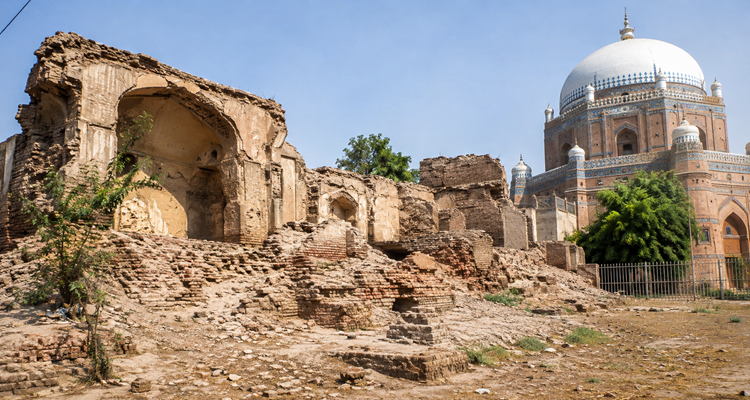
In the historic city of Multan, the ruins of Prahladpuri Temple tell a story of Hindu devotion, the origins of Holi in religious tradition, centuries of changing rulers, and the communal violence that destroyed a sacred landmark in 1992.
The site is known as Prahladpuri Temple, a place dedicated to Lord Narasimha, an incarnation of Vishnu, and associated in Hindu tradition with Prahlad, the young devotee whose story is closely connected to the festival of Holi.
For generations, the temple was part of Multan’s religious landscape. Its history passed through periods of political upheaval, changes in religious patronage, and the partition of British India.
But in December 1992, following the demolition of the Babri Mosque in Ayodhya, India, a mob attacked and destroyed the temple.
Its surviving ruins became a reminder of how quickly religious heritage can be lost when violence crosses communal and national boundaries.
Where Is Prahladpuri Temple?
Prahladpuri Temple is situated on the historic Multan Fort mound, also known as Qila Kohna Qasim Bagh, in Punjab, Pakistan.
The temple stands immediately beside the shrine of the celebrated Sufi saint Bahauddin Zakariya, whose mausoleum is among Multan’s most recognizable religious landmarks.
The proximity of these two sacred places is particularly significant. It reflects the layered religious history of a city that has been important to Hindu, Muslim, and other communities across different periods.
Pakistan’s Department of Archaeology and Museums identifies Prahladpuri as a historic temple dedicated to Narasimha. Its official record also notes an important distinction: although the site’s religious associations are much older, the ruined temple building dates to the colonial period and was constructed over earlier structures whose origins remain uncertain.
That distinction matters. The antiquity of a sacred tradition does not automatically establish the age of every surviving wall or architectural feature.
The Temple Connected to the Birth of Holi
Prahladpuri’s importance extends beyond its architecture.
According to Hindu tradition, the temple is associated with the story of Prahlad, the son of the powerful king Hiranyakashipu.
The king demanded obedience and opposed his son’s devotion to Vishnu. Prahlad, however, remained steadfast in his faith.
In the traditional account, Hiranyakashipu’s sister Holika attempted to destroy Prahlad by entering a fire with him. Although Holika expected to survive, she perished while Prahlad was protected.
The story symbolizes the triumph of devotion and righteousness over arrogance and cruelty. It is remembered during Holika Dahan, the ritual bonfire observed around the festival of Holi.
Local Hindu tradition places these events in ancient Multan and associates Prahlad with the establishment of a shrine dedicated to Narasimha.
This is why Prahladpuri is sometimes described as the birthplace of Holi.
However, the claim that Holi historically began at this exact location is a religious and regional tradition, not an archaeologically established fact. Holi has a complex history, with customs and religious interpretations that developed across different parts of the Indian subcontinent.
The temple’s association with the festival nevertheless gives it considerable spiritual importance. Its loss affected not only a historic building but also a place connected to generations of religious memory.
A Sacred Site That Endured Centuries of Change
Multan is among South Asia’s historically significant urban centres, known for its commercial connections, religious institutions, and changing political rulers.
Its religious landscape evolved through different periods of regional rule, including Hindu and Muslim dynasties, Sikh administration, British colonial government, and eventually the creation of Pakistan.
Prahladpuri’s history must be understood within this wider setting.
The temple is often described in local accounts as having origins thousands of years old. Some traditions attribute its foundation directly to Prahlad himself.
Those accounts convey the site’s religious significance, but they cannot be treated as a verified construction date.
The archaeological record is more cautious. Pakistan’s official monument inventory places the surviving temple structure within the colonial period, while acknowledging earlier remains beneath it.
A report on Pakistan’s urban heritage also identifies Prahladpuri among the monuments that survived the destruction associated with nineteenth-century military conflict at Multan Fort.
This makes its later fate especially striking: a sacred location that had endured major historical upheavals suffered catastrophic destruction during communal unrest in the late twentieth century.
How Partition Changed the Temple’s Future
The partition of British India in 1947 transformed Multan’s religious and demographic landscape.
As Pakistan and India emerged as independent states, millions of people crossed newly established borders amid widespread displacement and violence.
Many Hindu and Sikh residents left cities that became part of Pakistan, while Muslim migrants arrived from territories that became part of India.
The consequences extended beyond homes, businesses, and families.
Temples, gurdwaras, mosques, cemeteries, and other religious institutions were separated from communities that had maintained them.
Prahladpuri was among the Hindu sacred sites affected by these changes.
Accounts of the temple describe a gradual reduction in active worship and deterioration in its physical condition during the decades following Partition.
A 2019 report in Dawn also recorded an account from an Indian lawyer concerning the removal of the temple’s Narasimha image to India. The precise chronology of that relocation is not firmly established by the available reporting.
Over time, responsibility for the site came under Pakistan’s Evacuee Trust Property Board, the government body responsible for various religious properties left behind during Partition.
The temple remained a recognizable part of Multan’s historic landscape, even as its original worshipping community became much smaller.
December 1992: The Violence That Destroyed Prahladpuri
On December 6, 1992, a large crowd of Hindu activists demolished the sixteenth-century Babri Mosque in Ayodhya, India.
The demolition followed a long-running religious and political dispute over the site. It triggered widespread communal violence in India and provoked angry reactions beyond its borders.
Pakistan experienced attacks on Hindu temples in the days that followed.
Contemporary reporting by United Press International documented deadly unrest and attacks on religious properties in several Pakistani cities in December 1992.
Prahladpuri Temple in Multan became one of the targets.
According to reports subsequently published by Dawn, a mob demolished the temple in retaliation for the destruction of the Babri Mosque.
The attack devastated the structure and left the sacred site in ruins.
The precise sequence of the assault, the number of people involved, and the extent of damage to individual architectural elements are not comprehensively established in the sources consulted.
What is clear is that the temple’s destruction formed part of a wider episode of communal retaliation.
A mosque had been demolished in India. In response, Hindu places of worship in Pakistan were attacked, although their worshippers bore no responsibility for the events in Ayodhya.
The tragedy illustrates a recurring danger of communal violence: people and sacred places become targets because of their religious identity rather than their actions.
Neither the destruction of Babri Mosque nor the retaliatory attacks on Hindu temples can be justified by the religious identity of those responsible for the other act.
What Happened to the Temple After 1992?
The destruction of Prahladpuri did not end the debate over its future.
In December 2006, Dawn reported that the historic temple remained in ruins, with surviving fragments scattered across the site. The newspaper questioned why the authorities responsible for religious properties had failed to restore it.
Almost a decade later, there appeared to be an opportunity for change.
In May 2015, Siddiqul Farooq, then chairman of the Evacuee Trust Property Board, announced plans to reconstruct Prahladpuri Temple at its original location.
The announcement was significant because it acknowledged the temple’s historic and religious importance.
But restoration proved more complicated than making a public commitment.
By April 2019, Dawn reported that reconstruction had still not begun. An official attributed the delay to the absence of the necessary funds, despite earlier proposals and financial commitments.
The 2021 Restoration Effort and Its Obstacles
In 2021, Prahladpuri again attracted official attention.
A commission established under the authority of Pakistan’s Supreme Court visited the temple to examine its condition and prospects for rehabilitation.
The Supreme Court subsequently directed authorities to address the site’s restoration and the possibility of celebrating Holi there.
Yet the proposal encountered resistance.
According to Dawn, a local district intelligence committee had previously expressed concern that restoration could create tensions and endanger minority communities.
This revealed a difficult problem.
The purpose of restoration was to preserve religious heritage and support minority rights. But concerns about possible opposition were themselves becoming obstacles to protecting the site.
In February 2021, Pakistan’s Associated Press reported that a local peace committee comprising religious scholars, civil society representatives, and government officials had agreed to pursue initiatives supporting the temple’s restoration.
These efforts demonstrated that the debate was not simply a confrontation between religious communities. There were also local voices advocating preservation and interfaith cooperation.
Does Prahladpuri Temple Still Exist Today?
The temple’s historic location survives, but the original building remains largely destroyed.
An October 2026 heritage guide describes Prahladpuri as an unrestored ruin on the Multan Fort mound, with surviving structural remains but no active temple worship.
The guide also reports that earlier restoration commitments had not resulted in reconstruction.
That assessment is consistent with the documented history of repeated restoration proposals, although the site’s exact physical condition in November 2026 has not been independently verified through a recent official inspection.
Pakistan’s Department of Archaeology and Museums continues to identify Prahladpuri as a historic monument and records its protected status under Punjab heritage legislation.
The difference between legal recognition and physical preservation is important.
A monument may be officially protected yet remain vulnerable to neglect, deterioration, or disputes over its use.
Why Prahladpuri Matters Beyond Religion
The significance of Prahladpuri Temple is not limited to one faith or one historical event.
Its story raises several questions about how societies remember their past.
First, religious heritage often survives through changing communities. Multan’s history cannot be understood solely through the identity of its present-day majority. Its Hindu sacred sites, Muslim shrines, and other historic landmarks collectively reveal how the city developed.
Second, the destruction of a religious building can erase more than architecture. A temple can preserve memories of festivals, family traditions, pilgrimages, artistic practices, and the lives of people who once gathered there.
Third, the survival of a monument does not guarantee its preservation. Prahladpuri’s history demonstrates that neglect, loss of access, and delayed restoration can threaten heritage even after the immediate violence has ended.
The temple’s location beside the shrine of Bahauddin Zakariya offers another perspective.
Two sacred sites associated with different religious traditions occupied the same historic landscape for generations.
Their proximity is a reminder that South Asian history contains not only episodes of religious conflict but also long periods of coexistence, cultural exchange, and shared urban life.
Preserving that history does not require communities to agree on religious beliefs. It requires recognizing that the past belongs to more than one group.
Can Prahladpuri Temple Be Restored?
The available evidence suggests that reconstruction is technically conceivable, but a responsible restoration project would require more than rebuilding walls.
Any serious effort would need to establish which architectural elements are original, document surviving materials, assess structural stability, and determine how the site could be used and maintained.
It would also need to involve the relevant heritage authorities and representatives of the Hindu community.
There is an important distinction between restoring a historic monument and constructing a modern replica of a lost building.
Where original material survives, conservation can preserve authentic evidence of the past. Where documentation is incomplete, reconstruction may require interpretation.
An appropriate project would make those differences clear rather than presenting newly built features as unquestionably ancient.
The goal should be to preserve the site’s historical integrity while allowing its religious and cultural significance to be understood by future generations.
A Temple Destroyed, a History Not Entirely Lost
Prahladpuri Temple’s story does not begin in 1992, even though that year marked its most devastating modern chapter.
It begins with a sacred tradition associated with Prahlad and Narasimha, continues through the changing history of Multan, and reaches into the upheavals of Partition and the communal violence that followed the destruction of Babri Mosque.
The surviving ruins are evidence of loss, but they are also evidence that the site’s history has not disappeared entirely.
Documents, photographs, archaeological records, religious traditions, and the memories of communities still provide ways to understand what once stood there.
The most important lesson of Prahladpuri may be that historical preservation is not only about protecting buildings from destruction.
It is also about ensuring that the stories connected to those buildings are not forgotten.
A sacred place can lose its walls. Whether it loses its place in history depends on what future generations choose to remember and preserve.
This content is published for informational or entertainment purposes. Facts, opinions, or references may evolve over time, and readers are encouraged to verify details from reliable sources.
Related News
- Why Some Sacred Rituals Begin by Destroying What Took Days to Create
- Why Sacred Places Can Feel Different Even When Nothing Around You Has Changed
- Why Mark Zuckerberg Visited Kainchi Dham: The Neem Karoli Baba Connection Behind a Silicon Valley Story
- Kainchi Dham: How a Himalayan Ashram Became a Global Spiritual Landmark