






The Photograph That Turned Into a Family Mystery
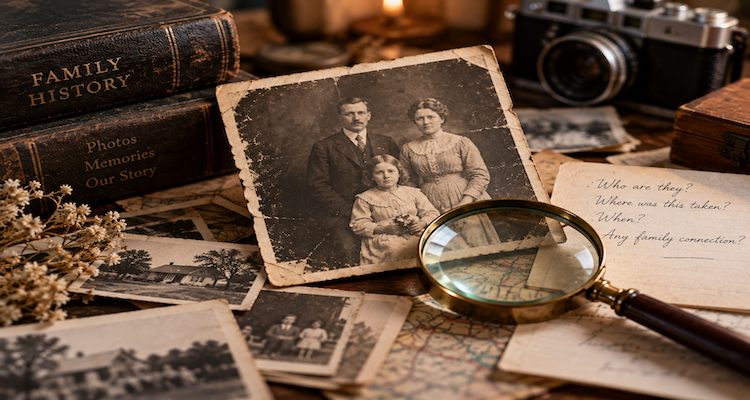
An old photograph can begin as an ordinary family keepsake and end as a historical investigation. A face may look familiar, but the name may be forgotten. A house may appear recognizable, yet no one remembers where it stood. Sometimes the only clues are a photographer’s imprint, a handwritten note, a piece of clothing, a vehicle, or the order in which several pictures were stored.
That is what makes unidentified family photographs so compelling: they are not simply pictures without captions. They can be fragments of family history whose meaning has been separated from the image.
The Library of Congress describes family photographs as records that can provide clues for genealogical research, while the National Archives recommends preserving photographs carefully because their physical condition can affect what future researchers are able to learn.
Key Takeaways
- An unidentified photograph can contain historical clues even when nobody recognizes the people in it.
- The back of a photograph, its photographer and its surrounding album context can be as important as the image itself.
- Clothing can help establish a date, but it should be combined with independent evidence rather than treated as proof.
- Old photographs are strongest as evidence when combined with family records, directories, newspapers and archival collections.
- Modern image tools can help reveal details, but identification still requires human verification and documentary evidence.
- Preserving the original photograph and its context should come before restoration, cropping or writing on it.
When a Family Photograph Becomes a Mystery
Imagine opening an old family album and finding a photograph that nobody can identify.
There are three people standing outside a house. One resembles a relative, but nobody can say who. The photograph has no obvious date. The house looks familiar, although it may no longer exist. On the back is a faded photographer’s name and an address.
It would be easy to treat the photograph as an interesting curiosity.
A family historian sees something different: a collection of clues.
The Library of Congress advises researchers to evaluate photographs much like other genealogical documents, comparing what appears in the image with original records and considering whether the people, place and date are consistent.
That distinction matters. A photograph can suggest an identity without proving it.
The person who “looks exactly like Great-Grandfather” may turn out to be his brother, cousin, neighbor or someone completely unrelated.
The mystery therefore begins not with the question “Who does this person look like?”, but with “What can this photograph actually tell us?”
The Back of the Photograph May Hold the First Clue
One of the easiest mistakes is to examine only the front.
The reverse side may contain handwriting, dates, studio information, addresses, inscriptions or other marks. The surrounding album can also provide context that disappears if photographs are removed and rearranged.
FamilySearch’s guidance on unidentified photographs similarly recommends examining how photographs were grouped, looking for repeated handwriting, identifying photographers and comparing people, locations and objects across related images.
This creates an important research principle:
Do not separate the photograph from its context before you understand the context.
If an unidentified portrait was stored beside photographs of three known relatives, that arrangement does not prove a relationship—but it becomes a useful research lead.
The same applies to envelopes, albums, captions and collections inherited from particular branches of a family.
Dating the Photograph Before Naming the Person
Trying to identify a person before estimating when the photograph was taken can produce a misleading search.
Photography itself provides clues.
The physical format of an image, the paper or mounting, studio markings and photographic process can help establish a period. Clothing, hairstyles, uniforms, buildings, vehicles and objects in the background can then provide additional evidence.
The Huntington Historical Society recommends identifying the type of photograph, examining inscriptions and researching the photographer or studio as part of the process of determining who, when and where.
The New York Public Library’s Photographers’ Identities Catalog is another particularly useful example. Its database contains information about photographers and studios, including names, locations and dates, and can help researchers investigate studio addresses printed on historical photographs.
That can turn a vague clue into a narrower research question.
For example:
Unknown photograph → photographer’s name → studio address → period of operation → probable date range → family records from that period.
The result is much stronger than simply guessing from fashion.
Clothing Is Evidence, Not a Verdict
Clothing can be remarkably useful.
A particular collar, sleeve shape, hat, hairstyle or uniform may help distinguish one period from another. But clothing rarely provides an exact date by itself.
A person might wear an older style. Formal clothing could be used for a special occasion. Regional or occupational differences could make an otherwise familiar fashion clue misleading.
That is why photographs should be dated using several independent clues.
The Library of Congress specifically recommends evaluating photographs through multiple forms of evidence rather than relying on a single visual interpretation.
This approach also helps prevent one of the biggest dangers in family-photo research: becoming attached to an attractive theory before the evidence supports it.
The House in the Background May Matter More Than the Face
Sometimes the most important person in a photograph is not the person at the center of it.
It may be the house behind them.
A distinctive porch, window arrangement, shop sign, street number, church tower, railway structure or landscape can provide a geographical clue. Other family photographs may show the same building from another angle.
The Library of Congress recommends using photographs alongside local histories and other records, while its family-history guidance encourages researchers to use libraries, newspapers, yearbooks and historical resources connected with places where ancestors lived.
This changes the research question.
Instead of asking:
“Who is this?”
a researcher might first ask:
“Where was this photograph taken?”
Once the location is established, the list of possible people can become much smaller.
When Genealogy Turns the Photograph Into a Family Story
The strongest discoveries often happen when the photograph is connected with documentary records.
Suppose an image appears to date from the early twentieth century. A family tree may contain several relatives of approximately the right age. Census records, directories, marriage records, newspaper archives or other historical documents can then help establish who actually lived in the suspected location during that period.
The photograph becomes one piece of a larger evidence chain.
That is important because photographs can preserve details that written records omit. At the same time, photographs can also be misidentified. A caption written decades later is not automatically more reliable than the photograph itself.
The Library of Congress explicitly advises researchers to evaluate captions and photographs critically, seek original records and weigh the evidence before reaching conclusions.
The goal is therefore not simply to find a name.
It is to build a defensible explanation for why that name belongs to that photograph.
Where Modern Technology Can Help
Digitization has changed the process considerably.
A photograph can now be scanned, enlarged and compared with thousands of digitized records without requiring the researcher to travel to an archive. Image-editing tools can make faded writing or background details easier to inspect, provided the original remains preserved.
AI-based tools can also assist with tasks such as transcription, image enhancement, visual comparison and searching for potentially related material.
But there is an important boundary.
An AI-generated match is a lead, not automatically an identification.
A system may recognize visual similarities while lacking the historical context needed to determine whether two people are actually the same person. A convincing resemblance can therefore accelerate research while still producing a false conclusion.
The evidence chain remains essential: photograph, date, location, provenance, documentary records and corroborating material.
Technology can help investigators search faster. It does not remove the need to investigate.
Preserve the Photograph Before Trying to Solve It
There is another part of the mystery that is easy to overlook: the photograph itself is evidence.
The U.S. National Archives recommends careful handling, appropriate storage and preservation practices for family photographs. Its guidance also warns against damaging photographs through inappropriate marking or handling.
The Library of Congress likewise notes that identifying photographic materials and processes can be important when determining appropriate storage and handling.
A sensible workflow is therefore:
- Photograph or scan the front and back.
- Preserve the original file without editing it.
- Record where the photograph came from.
- Record names of previous owners if known.
- Photograph the album page or surrounding collection.
- Transcribe every visible inscription.
- Estimate a date using multiple clues.
- Research the photographer and location.
- Compare the photograph with family and historical records.
- Keep confirmed identities separate from possibilities.
That final step is especially important.
A research note saying confirmed, probable, possible and unknown is more useful than a confident name based only on resemblance.
The Mystery May Be More Valuable Than the Answer
There is a temptation to think that the photograph has succeeded only when the unknown face receives a name.
But the investigation can reveal much more.
A photographer’s address may show where a family lived. A building may reveal a neighborhood that disappeared. A uniform may provide evidence of an occupation. A group photograph may establish relationships between people whose names survive only in written records.
The photograph can become a doorway into a period of family history that was previously invisible.
And sometimes the final answer remains uncertain.
That is not failure.
Historical research often produces degrees of confidence rather than perfect certainty. A carefully documented possibility can be more valuable than a definitive but unsupported identification.
Conclusion
An old photograph becomes a family mystery when memory can no longer explain what the image preserves.
Solving that mystery is less about recognizing a face than learning to read the evidence surrounding it: the photographer, the paper, the clothing, the building, the handwriting, the album, the location and the records connected to the people who may have been there.
Modern technology can make the search faster, but the fundamental method remains remarkably human: observe carefully, ask better questions, compare independent evidence and remain willing to change the theory.
The most valuable discovery may not be simply learning who was in the photograph.
It may be discovering the story that the family had forgotten.
This content is published for informational or entertainment purposes. Facts, opinions, or references may evolve over time, and readers are encouraged to verify details from reliable sources.