









Why Old Photographs With Unknown People Can Feel More Disturbing Than Horror Images
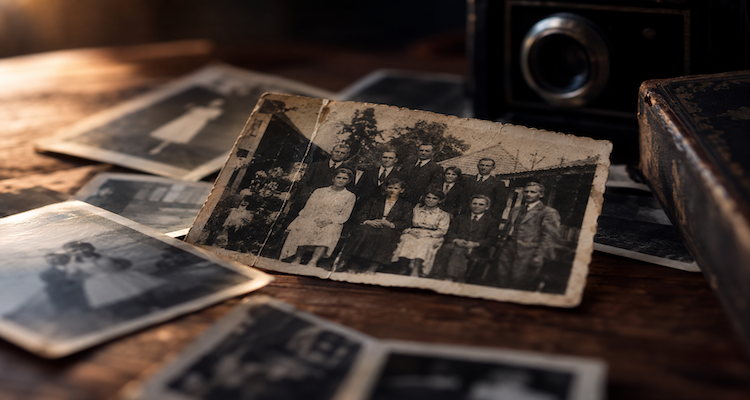
A horror image usually tells you what it wants you to feel. There may be a monster, a distorted face, blood, darkness or some other unmistakable signal of danger. An old photograph of ordinary people does something very different: it leaves the story unfinished.
A group of strangers standing outside a house. A child looking directly at the camera. A wedding photograph with no names attached. A family portrait found in an antique shop or buried in an online archive. Nothing obviously frightening may be happening, yet the image can produce an unexpectedly strong feeling of unease.
Psychology offers several clues about why. Research on face perception shows that familiarity changes how people process and recognize faces, while studies of memory demonstrate that faces can produce a powerful sense of familiarity even when the person cannot be identified. Research on autobiographical memory also shows that photographs can act as powerful cues for emotional and personal memories.
The result is an intriguing psychological tension: the photograph looks like evidence of a real human life, but the viewer has almost none of the information needed to understand that life.
Key Takeaways
- Unknown faces provide fewer familiar cues, leaving viewers with less certainty about who they are seeing.
- An old photograph can imply a complete human story without revealing what happened before or after the image.
- Familiarity strongly influences how faces are perceived, remembered and interpreted.
- Emotional responses to photographs can become stronger when an image activates memory, context or personal associations.
- The eerie feeling of an old photograph should not automatically be explained as an “uncanny valley” effect.
- Much of the discomfort comes from ambiguity: the photograph documents something real while withholding its meaning.
The photograph proves that someone was there
One reason old photographs can feel different from conventional horror is their relationship with reality.
A horror image is generally understood as an artificial representation. Even when it looks realistic, the viewer normally knows that it was created to frighten, entertain or tell a fictional story.
An old photograph carries a different psychological message.
Someone actually stood in front of the camera.
The people had bodies, relationships, routines and lives outside the frame. They may have been laughing, worrying about money, raising children, preparing for an ordinary day or simply waiting for the photographer to finish.
But the photograph freezes only one fraction of that existence.
That creates an unusual information gap. The viewer can see evidence of a person’s existence without knowing anything about the person.
This distinction matters because human perception is highly sensitive to faces and social information. Research has repeatedly shown that familiar and unfamiliar faces are not processed in exactly the same way. Familiar faces generally benefit from richer representations built through repeated experience, while unfamiliar faces present greater identification challenges.
With an old photograph, the viewer may therefore be looking at several faces while having almost no social information about any of them.
The photograph is full of people but psychologically empty of relationships.
That can feel strange.
The unsettling power of an unknown face
There is an important difference between seeing an unfamiliar face and seeing a face that feels almost familiar.
Psychologists have studied a phenomenon sometimes described as the “butcher-on-the-bus” experience: a person looks familiar even though you cannot remember who they are or where you encountered them.
Research has demonstrated that a sense of familiarity can occur without full recollection of the person or the circumstances associated with them.
Old photographs can create a related but more ambiguous experience.
A stranger may look vaguely recognizable because human faces contain patterns that we constantly compare with faces stored in memory. The viewer might think:
Have I seen this person before?
Usually the answer is no.
But the feeling can remain.
That mismatch recognition-like familiarity without actual identification can be psychologically uncomfortable because the brain has generated a signal without supplying a satisfying explanation.
Why age makes the image feel stranger
The age of the photograph adds another layer.
An old image often contains visual clues that immediately place it in another period: clothing, hairstyles, cars, architecture, film grain, photographic damage, faded colors or black-and-white tones.
These details establish temporal distance.
The people are physically visible, but their world is inaccessible.
This can produce a peculiar form of psychological separation. The viewer is looking at something concrete from a world that no longer exists in exactly the same form.
Research on autobiographical memory helps explain why photographs can be unusually powerful emotional cues. A systematic review found evidence that autobiographical-photo interventions can influence well-being, quality of life, personal identity and cognitive functioning, although the review focused primarily on autobiographical photographs rather than unidentified historical images.
That distinction is important.
A photograph of one’s own childhood may retrieve a specific memory.
A photograph of an unknown family cannot retrieve that same personal memory. Instead, it can invite the viewer to construct possibilities.
And possibilities are often more unsettling than facts.
The mind starts writing the missing story
Consider a photograph showing five people standing in front of a house.
Nothing is obviously wrong.
Yet questions immediately appear.
Who are they?
Why were they photographed?
Who took the picture?
What happened to them?
Was this an ordinary afternoon?
Did the people remain close?
Is the house still standing?
Why was the photograph preserved?
The image itself does not answer these questions.
The viewer supplies possibilities.
This is where an ordinary photograph can become psychologically richer and sometimes more disturbing than an explicit horror image.
Horror usually provides the threat.
An ambiguous photograph provides the absence of an explanation.
The viewer has to decide what the image means.
That does not mean the mind necessarily invents something frightening. A person may instead experience nostalgia, curiosity, sadness or tenderness. The emotional response depends heavily on the photograph and the viewer’s own associations.
Research on autobiographical memory emphasizes that memories and emotions influence one another and that remembering is reconstructive rather than a simple replay of stored information.
An unidentified photograph therefore becomes an unusually open psychological canvas.
Why this is different from the uncanny valley
It is tempting to describe every eerie photograph as an example of the uncanny valley.
That would be too simplistic.
The uncanny valley concerns situations in which something appears increasingly human but contains characteristics that produce an unsettling response, particularly in artificial or anthropomorphic representations. Research has investigated the phenomenon in virtual faces, robots and digitally created human-like characters.
Some studies have linked eeriness to reduced familiarity and inconsistencies in realism. One influential line of research found that when human-like characters become less familiar because of inconsistent realism, they can produce colder and eerier responses.
But an ordinary historical photograph of a real person is not automatically an uncanny-valley stimulus.
The face may be completely normal.
The photograph may be technically imperfect.
Nothing may be artificially human-like.
Its eeriness can instead come from context, ambiguity, unfamiliarity and implied history.
That distinction is worth preserving because “uncanny valley” has become a convenient explanation for almost anything that feels strange. Scientific evidence does not justify using it as a universal label for unsettling imagery.
The strange power of context
The surrounding circumstances of a face can also affect what we remember about it.
Research examining face memory has found that emotional context can influence what information people later remember about a face. Faces encountered in emotionally relevant contexts were associated with greater memory for semantic and episodic details than faces encountered in neutral contexts.
This offers a useful way of understanding old photographs.
The photograph may provide only limited context, but the viewer can perceive many contextual signals: the expression, body language, setting, clothing, relationships between people and even the apparent condition of the photograph itself.
A damaged photograph can therefore feel more mysterious than a perfectly preserved portrait not because the damage proves anything unusual happened, but because missing visual information gives the viewer fewer clues.
The less information available, the more room there is for interpretation.
Why horror can sometimes feel easier to process
This may explain the surprising comparison with horror.
A conventional horror image can be frightening, but it is often emotionally straightforward.
The viewer sees a threat and recognizes the intended emotional category.
An unknown historical photograph can be emotionally ambiguous.
Is it sad?
Beautiful?
Nostalgic?
Lonely?
Unsettling?
Important?
Ordinary?
The viewer may not know.
That uncertainty can keep the image psychologically active for longer.
A monster in a horror film has a defined role.
A stranger in an old photograph does not.
The stranger might have been someone’s parent, child, friend, colleague or spouse. The photograph may have been one of hundreds of ordinary moments in a life that mattered enormously to the people who lived it.
The viewer simply has no way to know.
There is also a paradox of familiarity
Photographs are familiar objects.
Faces are familiar visual stimuli.
Human social situations are familiar.
Yet an old photograph can combine all three with unfamiliar content.
That creates a peculiar contrast: everything in the picture looks understandable, but the meaning of the picture remains inaccessible.
Research on face perception supports the importance of familiarity. Familiarization improves the ability to individuate faces, while unfamiliar faces are generally more difficult to recognize reliably.
This helps explain why a photograph containing strangers can feel visually crowded but psychologically distant.
The viewer sees individual humans without possessing the relationships that make those humans meaningful.
The image may be disturbing because it is ordinary
Perhaps the most interesting feature of these photographs is that nothing extraordinary has to happen.
There does not need to be a hidden ghost.
There does not need to be a mysterious death.
There does not need to be a supernatural explanation.
In fact, adding a supernatural explanation can sometimes make the image less interesting.
The deeper unease comes from something much more ordinary: every person in the photograph once experienced the present moment as their own present.
They did not know they were “the past.”
They did not know how their lives would unfold.
They did not know that decades later, someone might find their photograph and stare at their faces without knowing their names.
That realization creates a form of temporal distance that conventional horror does not necessarily provide.
Why the feeling should not be mistaken for evidence
There is an important editorial and psychological caution here.
Feeling that a photograph is eerie does not mean the photograph contains evidence of something disturbing.
A strange expression may simply be the result of the instant at which the camera captured the face.
A blurred figure may be a technical artifact.
An empty space may simply be empty.
A damaged negative may have deteriorated naturally.
And an unfamiliar face can look unusual simply because the viewer has never encountered that person before.
The emotional reaction is real, but the interpretation may not be.
That distinction is especially important in the age of social media, where mysterious historical photographs are frequently presented with dramatic captions and unsupported stories.
The photograph may be authentic while the story attached to it is not.
The deeper reason old photographs linger
The most unsettling old photographs are often not the ones containing obvious horror.
They are the ones that leave the viewer suspended between knowledge and ignorance.
We know these people existed.
We know the camera captured a real moment.
We can see their faces.
But we do not know what they were thinking, what happened immediately afterward, what their relationships were like, or what became of them.
That gap between visible evidence and missing meaning is powerful.
It also explains why an ordinary historical photograph can provoke an emotional response without requiring anything supernatural.
The image does not have to contain a monster.
It only has to remind us that every stranger has a story we cannot see.
And perhaps that is what makes certain old photographs more disturbing than horror images: horror gives the imagination something to fear, while an unexplained photograph gives the imagination an entire human life to reconstruct.
Conclusion
Old photographs of unknown people are not scientifically established as inherently more disturbing than horror images. The response varies from person to person, and the evidence does not support a single explanation.
But several established psychological findings provide a useful framework for understanding the experience. Familiarity changes face processing; emotional context can influence memory; photographs can act as powerful memory cues; and unfamiliar or ambiguously human visual stimuli can sometimes produce feelings of eeriness.
What makes the old photograph distinctive is the combination.
It shows something real, but tells us very little about what it means.
That is enough to make an ordinary group of strangers feel strangely close—and impossibly far away at the same time.
This content is published for informational or entertainment purposes. Facts, opinions, or references may evolve over time, and readers are encouraged to verify details from reliable sources.