







Why “Healthy” People Are Paying More Attention to Recovery
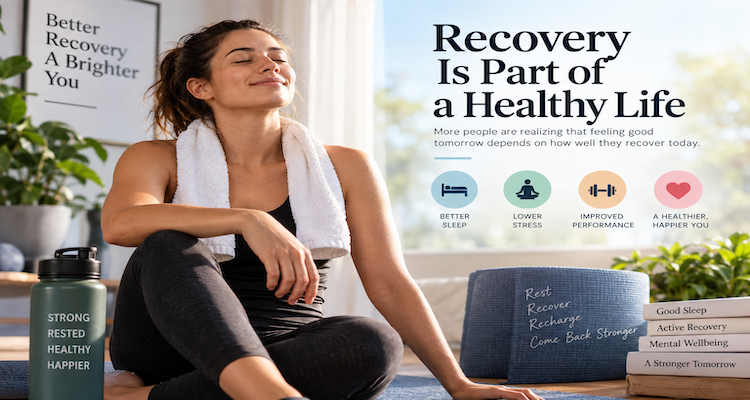
For years, health advice has largely focused on doing more: exercise more often, walk more steps, lift heavier, eat better and stay consistent. A quieter shift is now taking place. People who already exercise regularly and pay attention to nutrition are increasingly asking a different question: How well is my body recovering from all that activity?
Recovery is no longer limited to professional athletes. Sleep, rest, training load, nutrition and perceived fatigue are becoming part of how ordinary active adults think about maintaining health and performance. Wearable devices have accelerated that interest by turning sleep duration, heart-rate patterns and other physiological measurements into daily feedback.
But there is an important distinction between measuring recovery and actually recovering. A device can provide useful information, but its score is not a medical diagnosis, and recent research shows that consumer wearables can disagree substantially with more established methods of assessing sleep.
Key Takeaways
- Recovery is increasingly being treated as part of fitness rather than the opposite of exercise.
- Sleep remains one of the most important foundations of physical and mental recovery.
- More exercise is not automatically better when the body is not given adequate time and resources to adapt.
- Wearables can reveal patterns, but their recovery and sleep measurements have important limitations.
- Nutrition, rest, training load and subjective fatigue should be considered together rather than reduced to one score.
- Paying attention to recovery does not mean becoming less active; it means making activity more sustainable.
The Shift From “More” to “Better”
Modern fitness culture has often rewarded visible effort: longer workouts, heavier weights, more steps and increasingly ambitious targets.
That approach can be useful up to a point. The CDC recommends that adults get at least 150 minutes of moderate-intensity physical activity each week, along with muscle-strengthening activity on at least two days. Physical activity itself provides substantial health benefits, including improvements in sleep, cardiovascular health and mental health.
But training is only one part of adaptation.
Exercise places stress on the body. The body then needs resources and time to respond to that stress. Sleep, adequate food, hydration and periods of lower activity are part of that process.
That creates a more useful way to think about fitness:
Training provides the stimulus. Recovery helps the body respond to it.
For someone exercising casually, this may simply mean recognizing when a hard workout should be followed by easier movement. For someone training frequently, recovery becomes more complicated because several sources of stress can overlap.
A demanding workout may coincide with poor sleep, a stressful workday, insufficient food or several consecutive days of high activity.
The workout may not be the problem by itself. The combination may be.
Sleep Has Become the Recovery Metric People Cannot Ignore
Among all the things associated with recovery, sleep occupies an unusual position because it is both measurable and fundamental to everyday functioning.
The American Academy of Sleep Medicine and Sleep Research Society recommend that healthy adults regularly sleep at least seven hours per night to promote optimal health.
Yet insufficient sleep remains common. A CDC National Center for Health Statistics report found that 30.5% of U.S. adults slept less than seven hours on average in 2024.
That helps explain why recovery has become a practical concern beyond gyms and sports.
Someone may eat well and exercise consistently but still feel depleted if sleep is consistently inadequate. The CDC also notes that sleep supports the body’s repair processes and recommends maintaining a regular sleep schedule.
The important point is that recovery is not necessarily about finding a sophisticated recovery technique.
Sometimes the most valuable recovery intervention is simply getting enough sleep consistently.
Wearables Are Changing How People Think About Recovery
Smartwatches, rings and fitness bands have made recovery more visible.
Instead of relying exclusively on how tired someone feels, users can now see measurements and trends involving sleep, heart rate and physical activity. Some products combine multiple measurements into a single readiness or recovery score.
That can be useful because patterns are difficult to remember.
For example, a person might notice that several nights of shorter sleep coincide with lower energy during workouts. Another person may see that intense training several days in succession corresponds with changes in their usual physiological measurements.
The value is not necessarily the individual number. It is the trend.
But this is where healthy skepticism becomes important.
A 2026 systematic review of consumer wearable sleep measurements found that commercial devices showed poor-to-moderate agreement with validated subjective assessments of sleep quality. The researchers concluded that wearable data should complement rather than replace validated assessments.
Another 2026 systematic review and meta-analysis comparing wearables with polysomnography the reference method for detailed sleep assessment found substantial variability between devices. Wearables generally provided useful estimates of broad sleep measures but were not reliable substitutes for clinical testing or detailed sleep-stage characterization.
So a recovery score should be treated as information, not a verdict.
Why One “Recovery Score” Can Be Misleading
Recovery is not a single biological variable.
Someone can sleep eight hours and still feel exhausted. Another person might sleep slightly less than usual but feel perfectly capable of an easy workout.
Stress, illness, work demands, nutrition, training history and individual differences can all influence how a person feels and performs.
That makes it risky to reduce recovery to a single green, yellow or red indicator.
A better approach is to look for agreement among several signals:
- How did you sleep?
- How do you feel physically?
- How difficult does your usual workout feel?
- Has your performance changed?
- Have you accumulated several demanding days?
- Are you eating and drinking adequately?
- Is unusual fatigue persisting?
When several indicators point in the same direction, the information becomes more useful.
When a device says “poor recovery” but the person feels normal and performs normally, the appropriate response is not necessarily to cancel the day’s activity.
Likewise, feeling motivated does not automatically mean the body is fully recovered.
Recovery Does Not Mean Doing Nothing
One misconception about recovery is that it means complete inactivity.
For many people, recovery can involve adjusting intensity rather than stopping movement altogether.
An easier walk, mobility work, a lower-intensity training session or simply reducing the volume of a workout can allow someone to remain active while reducing overall training stress.
This fits with public-health guidance that encourages regular physical activity rather than an all-or-nothing approach. The CDC emphasizes that some activity is better than none and recommends spreading activity across the week.
The right question therefore isn’t always:
“Should I exercise today?”
It can be:
“What level of activity makes sense today?”
That is a more flexible approach to long-term fitness.
Nutrition Is Part of the Recovery Equation
Exercise creates physical demands that have to be supported by adequate nutrition.
Sports nutrition guidance has long recognized the relationship between nutrition, exercise performance and recovery. An American College of Sports Medicine position paper notes that adequate energy and appropriate macronutrient intake including carbohydrate and protein during periods of high physical activity support replenishment and tissue repair.
This matters even outside competitive sport.
Someone increasing exercise while simultaneously eating substantially less may experience fatigue for reasons that have little to do with motivation or fitness.
Recovery therefore cannot be separated completely from nutrition.
The practical lesson is not that everyone needs supplements, specialized diets or elaborate post-workout routines. It is that regular physical activity requires adequate fuel and that increasingly demanding training creates greater nutritional considerations.
The Bigger Change Is Behavioral
Perhaps the most interesting part of the recovery trend is not the technology.
It is the change in mindset.
For years, being disciplined was often associated with pushing through discomfort. Recovery introduces another definition of discipline: knowing when to reduce the load so that the routine can continue.
That distinction matters because sustainable health is different from short-term performance.
A person who exercises intensely for three weeks and then stops because of exhaustion has achieved something different from someone who maintains a manageable routine for years.
The second approach may look less dramatic, but it is often more compatible with everyday life.
Recovery also encourages people to look at health as a system rather than a collection of isolated targets. Exercise, sleep, food, stress and daily activity interact.
That is a more realistic picture of health than any single fitness score can provide.
How to Use Recovery Information Without Becoming Obsessed With It
People interested in recovery do not need to turn every morning into a physiological investigation.
A simple approach can be more useful:
1. Establish your normal pattern.
Look at trends rather than reacting to one unusual night or one low score.
2. Prioritize sleep.
Consistent sleep is more important than chasing a perfect wearable score.
3. Match training to the day.
A difficult workout is not automatically the right choice every time you feel motivated.
4. Pay attention to persistent changes.
Repeated unusual fatigue, declining performance or ongoing sleep problems deserve more attention than a single bad day.
5. Treat wearable measurements as estimates.
They can help identify patterns, but they do not replace clinical evaluation when a health problem is suspected.
6. Avoid turning recovery into another performance competition.
The goal is not to achieve a perfect recovery score every morning. The goal is to remain healthy enough to live and train consistently.
When Recovery Becomes a Health Issue
There is an important boundary between normal tiredness and persistent symptoms.
Occasional fatigue after demanding activity is expected. But unexplained or persistent exhaustion, significant changes in sleep, dizziness, pain, breathing problems, unusual exercise intolerance or other concerning symptoms should not simply be attributed to “poor recovery.”
Wearables can sometimes encourage people to pay closer attention to their bodies, but they cannot determine the cause of a medical problem on their own.
That distinction becomes particularly important as health technology becomes more sophisticated. More data can improve awareness, but more data does not automatically mean better diagnosis.
Conclusion
The growing attention to recovery reflects a useful evolution in the way people think about health.
Being healthy is not simply about accumulating workouts. It is also about whether the body has the sleep, nutrition, rest and manageable workload needed to sustain those habits.
Technology has made recovery easier to observe, but it has not made the underlying biology simple. Wearable scores can identify patterns, yet current evidence shows that many consumer measurements remain imperfect.
The most valuable recovery strategy may therefore be surprisingly low-tech: listen to patterns, protect sleep, fuel activity appropriately, vary training demands and give the body enough time to adapt.
For people already doing many of the “right” things, recovery is not another target to chase. It may be the part of the routine that makes the rest sustainable.
This article is intended for general awareness and educational purposes only. It should not be considered medical advice. Readers are encouraged to consult qualified healthcare professionals for personal health decisions.