









The Technology We No Longer Notice Is Quietly Running Our Lives
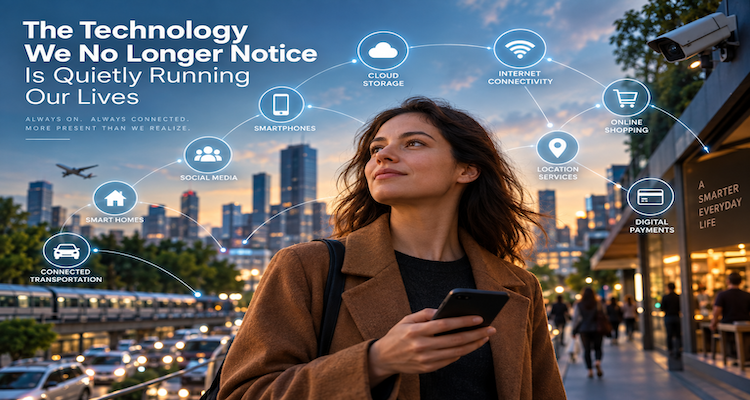
Technology is easiest to notice when it is new. A new phone, an AI assistant or a futuristic device attracts attention because it changes what we can see and do. But some of the most important technologies in everyday life have become almost invisible.
A location appears automatically on a map. A website opens after a tap. A payment is authorized in seconds. A video starts without anyone thinking about the servers delivering it. A smartwatch records activity, a navigation app calculates a route and a cloud service synchronizes files across devices.
None of these experiences feels particularly remarkable anymore.
That is precisely what makes them worth examining.
Modern life increasingly depends on layers of digital infrastructure that have moved from being technological products to being background utilities. The International Telecommunication Union estimated that 5.5 billion people were using the Internet in 2024, representing 68% of the world’s population. At the same time, 2.6 billion people remained offline, showing that the invisible digital infrastructure supporting connected life is still far from universal.
The more successful these systems become, the less we think about them. But their growing importance raises a bigger question: what happens when the technology we barely notice becomes essential to how society operates?
Key Takeaways
- Cloud computing has turned remote computing infrastructure into an everyday utility behind countless digital services.
- GPS provides more than location; its precise timing supports communications, financial systems and critical infrastructure.
- Connected devices make technology part of homes and routines while creating additional privacy and security responsibilities.
- The digital world has a physical footprint, including data centers, electricity demand, networks and specialized hardware.
- Dependence on invisible infrastructure can make disruptions more consequential because people may not know what systems they rely on.
- Digital convenience remains uneven because billions of people still lack reliable Internet access.
The Cloud Became the Computer We Don’t See
For many people, “the cloud” sounds like an abstract place somewhere on the Internet. In reality, it is a model for delivering computing resources including servers, storage, networks and applications on demand.
The U.S. National Institute of Standards and Technology defines cloud computing as network access to a shared pool of configurable computing resources that can be rapidly provisioned and released. Its model includes characteristics such as resource pooling, broad network access and rapid elasticity.
The significance is less about the terminology than the change in behavior.
People no longer need to know where their files are physically stored to access them. Businesses can deploy software without owning every server required to operate it. Applications can expand their computing resources as demand changes.
The infrastructure has effectively moved behind the interface.
That creates extraordinary convenience, but it also changes how people think about computing. A service may look like a simple app on a screen while depending on networks, data centers, storage systems, authentication services and software running somewhere else.
The simpler the interface becomes, the easier it is to forget how complicated the system underneath actually is.
GPS Is Also a Clock in the Background
GPS is usually associated with maps and navigation. That is only part of its role.
GPS provides positioning, navigation and timing services. Government information about the system notes that precise GPS timing is used to synchronize communications systems, power grids and financial networks. Financial institutions can also use GPS timing to create consistent timestamps for transactions.
That makes GPS an especially revealing example of invisible technology.
A driver may think of GPS as the blue dot on a smartphone. A financial institution may think about precise timestamps. A communications network may use the system to synchronize equipment. These are very different applications built around the same underlying infrastructure.
The technology becomes almost invisible because it works without requiring conscious participation.
This is a recurring pattern in modern technology: the most important infrastructure often disappears behind the service it enables.
Smart Devices Turn Ordinary Objects Into Networked Systems
The same transformation is happening inside homes.
A thermostat can communicate with an app. A security camera can stream video remotely. A television can connect to online services. A wearable device can collect and transmit information. A voice assistant can interact with other connected products.
The U.S. Federal Trade Commission has long highlighted both the benefits and risks associated with connected devices. Such devices can make homes more convenient and automate tasks, but their connectivity also introduces privacy and security considerations.
The important shift is that technology is no longer confined to obviously technological objects.
A connected light bulb is still a light bulb. A smart thermostat is still a thermostat. But once an everyday object can communicate over a network, it becomes part of a larger digital ecosystem.
That creates a practical responsibility for consumers.
The FTC recommends measures such as changing default passwords, enabling available security protections, keeping devices updated and disconnecting devices that are no longer used.
The lesson is simple: when ordinary objects become computers, ordinary objects also inherit some of the problems associated with computers.
The Internet Is Becoming Infrastructure, Not Just a Destination
There was a time when going online felt like entering a separate digital space.
Today, that distinction is increasingly difficult to maintain.
People use Internet-connected systems to communicate, work, shop, navigate, study, entertain themselves and manage services. Businesses use digital systems for operations and customer interactions. Governments increasingly provide information and services through online channels.
The scale is enormous. ITU data shows that global Internet use has risen dramatically, but also that access remains unequal. In 2024, Internet usage was estimated at 93% in high-income countries compared with 27% in low-income countries.
This matters because the phrase “digital society” can hide an important contradiction.
For people with reliable connectivity, technology can feel almost omnipresent. For people without it, many of the same opportunities remain difficult to access.
The technology that seems invisible to one person may still be inaccessible infrastructure to another.
AI Is Making the Invisible Layer Even Larger
Artificial intelligence adds another layer to this transformation.
When a person asks an AI system to summarize information, generate an image or help write code, the visible interaction may be a small text box and a response. Behind that interface are models, computing hardware, networking infrastructure, storage and large-scale data-center operations.
This is where the relationship between digital convenience and physical infrastructure becomes particularly important.
The U.S. Department of Energy reported in 2024 that U.S. data centers consumed approximately 176 terawatt-hours of electricity in 2023, equivalent to about 4.4% of total U.S. electricity consumption. The department’s analysis projected that data-center electricity use could reach roughly 325–580 TWh by 2028, or approximately 6.7–12% of U.S. electricity consumption.
More recent analysis from the International Energy Agency found that global data-center electricity demand increased by 17% in 2025 and projected that total data-center electricity consumption could double by 2030, while electricity use from AI-focused data centers could rise even faster. The IEA also noted that efficiency per AI task is improving rapidly, creating a tension between more efficient computing and growing demand for AI services.
This is one of the most important changes in how we should think about technology.
Digital services may look weightless, but they are not.
Every online search, streamed video, cloud backup or AI interaction ultimately depends on physical infrastructure consuming resources somewhere.
Convenience Can Hide Dependence
The success of invisible technology creates a paradox.
When systems work well, people stop thinking about them. That is a sign of good engineering, but it can also make dependence harder to recognize.
Consider what is packed into an ordinary smartphone experience: network connectivity, cloud services, location systems, software platforms, authentication, data storage and electricity.
A failure in one layer may affect services that appear unrelated to the user.
This does not mean that society should fear technology or abandon digital services. It means that technological resilience deserves more attention as dependence grows.
The question is no longer simply whether a device is useful.
It is also: what infrastructure does this device depend on, and what happens if that infrastructure becomes unavailable?
The Technology We Notice May Be the Least Important Part
Consumers naturally focus on visible technology the phone, laptop, camera, application or AI interface.
But the more revealing story is underneath.
Cloud computing made remote computing feel local. GPS made highly precise positioning and timing feel ordinary. Connected devices turned household objects into network participants. Internet infrastructure transformed online access from a specialized activity into an everyday expectation. AI is now building another computational layer on top of that foundation.
The result is a technological environment that increasingly works in the background.
That may be the defining characteristic of mature technology: the best-known part is the interface, while the most consequential part is the infrastructure nobody sees.
Understanding that infrastructure changes how we think about privacy, security, energy, resilience and even digital inequality.
Technology does not have to announce itself to shape everyday life. In many cases, its greatest achievement is that we no longer notice it at all.
Conclusion
The most influential technology of the coming years may not always be the product that attracts the most attention. It may be the infrastructure quietly supporting millions of ordinary decisions and interactions.
The cloud, GPS, connected devices, networks and data centers rarely appear in the foreground of daily life. Yet they increasingly determine what can happen in that foreground.
That is why technological literacy should extend beyond knowing how to use an app or buy a device. It should include understanding the systems beneath them.
Because once technology becomes invisible, dependence can become invisible too.
The information presented in this article is based on publicly available sources, reports, and factual material available at the time of publication. While efforts are made to ensure accuracy, details may change as new information emerges. The content is provided for general informational purposes only, and readers are advised to verify facts independently where necessary.