



When Daily Life Loses Its Rhythm: How Circadian Disruption Can Affect Health
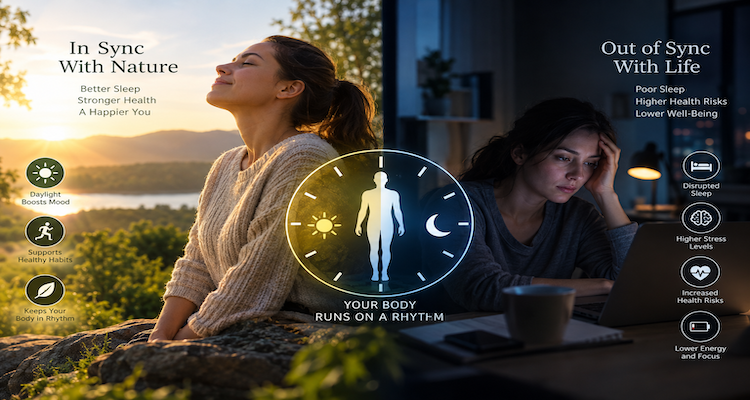
Human biology does not operate on a blank 24-hour schedule. Sleep, alertness, hormone release, body temperature, metabolism and many other processes rise and fall according to internal biological clocks that are synchronized, in part, by the cycle of light and darkness.
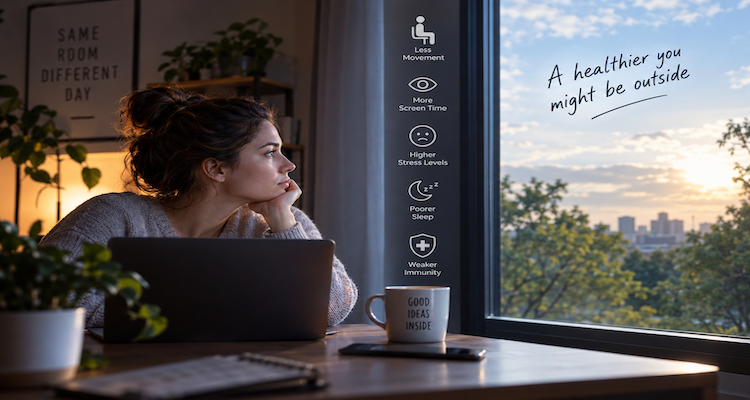
Modern life can weaken those signals. Electric lighting extends activity into the night. Screens can keep the brain exposed to light when darkness would normally dominate. Irregular work schedules, late meals, long periods indoors and changing sleep times can create a mismatch between biological time and social time.
Scientists call this circadian misalignment. It does not mean that everyone needs to wake at sunrise or follow an identical daily routine. People naturally differ in their chronotype their preferred timing of sleep and activity. The concern is persistent or substantial disruption between internal biological timing and external schedules.
That distinction matters because the evidence increasingly suggests that timing itself can influence health, alongside familiar factors such as diet, exercise and sleep duration.
Key Takeaways
- Circadian rhythms coordinate sleep, metabolism, hormones and other biological functions across roughly 24-hour cycles.
- Artificial light at night can alter the biological signals that help regulate sleep and circadian timing.
- Irregular sleep schedules and social jet lag are associated with several adverse health outcomes, although causation varies by condition.
- Meal timing also interacts with circadian biology, with nighttime eating receiving particular scientific attention.
- Night-shift work produces substantial circadian disruption and has been classified by IARC as probably carcinogenic to humans.
- Regular exposure to daylight, consistent sleep timing and appropriately timed daily activities can help support circadian alignment.
What Are Circadian Rhythms?
Circadian rhythms are biological cycles that repeat approximately every 24 hours. They are coordinated by an internal timing system that helps the body anticipate predictable environmental changes.
The central circadian clock is located in the brain’s suprachiasmatic nucleus, while clocks also exist in tissues throughout the body. Light is one of the strongest signals used to synchronize the central clock with the external environment.
The system does much more than determine when someone feels sleepy. Circadian timing is involved in sleep and wakefulness, hormone regulation, body temperature, metabolism, alertness and aspects of immune and cardiovascular function.
The relationship with light is particularly important. Research reviewed by the National Heart, Lung, and Blood Institute indicates that the timing, intensity, duration and characteristics of light exposure can influence circadian physiology, sleep and wellbeing.
That means the problem is not simply that people stay awake late. The biological system is receiving environmental signals at times that may conflict with the signals it evolved to interpret.
The Modern Problem Is Not Simply “Staying Up Late”
There is an important difference between being a naturally later sleeper and repeatedly forcing the body to operate against its preferred timing.
Some people are naturally inclined toward earlier sleep and waking, while others have a later chronotype. These differences are normal. Problems can arise when social obligations repeatedly require someone to wake substantially earlier than their biological tendency, or when work, entertainment and technology continually push activity later.
This phenomenon is often described as social jet lag.
Social jet lag refers to the difference between a person’s biological timing and the schedule imposed by work, school or other social obligations. It can become especially visible when people sleep and wake at one time during the working week and shift substantially later on free days.
Research on social jet lag remains an evolving field, and many studies are observational. That means an association between social jet lag and a health outcome does not automatically prove that social jet lag caused the condition.
Nevertheless, the consistency of interest across sleep, metabolic and mental-health research makes circadian timing an increasingly important area of investigation.
Sleep Becomes One of the First Places the Disruption Appears
Sleep is tightly connected to the circadian system, but the two concepts are not identical.
Sleep duration describes how much someone sleeps. Circadian timing describes when the body is biologically prepared for sleep and wakefulness.
A person can therefore experience both insufficient sleep and circadian misalignment, but they are not interchangeable.
Research reviewing sleep timing and regularity in adults has found that later sleep timing, greater variability in sleep schedules and social jet lag are generally associated with less favorable health outcomes. However, the strength and quality of evidence differ between outcomes, and researchers have cautioned that the available evidence does not establish a universal “perfect” bedtime.
The practical implication is less about finding a magic sleep hour and more about reducing unnecessary instability.
A schedule that changes dramatically from one day to the next can make it harder for the body’s timing system to anticipate when sleep, activity and other physiological processes should occur.
Light Is One of the Strongest Signals the Body Receives
Light is arguably the most powerful environmental cue for the human circadian system.
During daylight, exposure to light helps synchronize the biological clock with the external day. At night, darkness supports the biological conditions associated with sleep.
Modern indoor environments can reverse or flatten that pattern. A person may spend much of the daytime under relatively low indoor illumination and then encounter substantial artificial light late at night.
The scientific concern is not limited to smartphone screens. Household lighting, televisions, computers, workplace lighting and outdoor illumination can all contribute to the modern light environment.
Research summarized by NIH-supported experts has emphasized that the timing and intensity of light matter. Light exposure during the day and appropriately reduced exposure during the biological night can support healthier circadian signaling.
This does not mean every person must eliminate evening screen use. The broader principle is to give the biological clock a clearer distinction between day and night.
Food Has Its Own Timing Problem
The circadian system also interacts with metabolism.
Researchers studying chrononutrition the relationship between food timing and biological rhythms have found that the body does not necessarily process food in exactly the same way at every hour of the day.
Human experimental research and reviews indicate that glucose regulation, insulin sensitivity, energy expenditure and other metabolic processes vary according to circadian timing.
Late-night eating has therefore become an important research topic. Studies associate eating during the biological night with several unfavorable metabolic changes, although the evidence is not strong enough to conclude that any late meal independently causes obesity or diabetes.
Diet quality, calorie intake, sleep, physical activity, work schedules and socioeconomic factors can all influence the same outcomes.
This is one reason the strongest interpretation is not “never eat after a certain hour.” Instead, the research points toward a broader relationship between when people eat, when they sleep and when their bodies are biologically prepared to be active.
Night-Shift Work Creates a Particularly Difficult Circadian Environment
Some people cannot simply choose a more regular schedule.
Healthcare workers, transport workers, emergency personnel, manufacturing employees, security staff and many others may need to work through the night.
Night-shift work is therefore an important real-world example of circadian disruption.
The International Agency for Research on Cancer, part of the World Health Organization, evaluated night-shift work involving circadian disruption and classified it as probably carcinogenic to humans (Group 2A). The classification was based on limited evidence for cancer in humans, sufficient evidence in experimental animals and strong mechanistic evidence.
The classification should not be interpreted as meaning that every person who works nights will develop cancer. It describes a hazard assessment at the population and exposure level.
Night work can also interfere with sleep, metabolic timing and normal exposure to light and darkness, making it a complex occupational-health issue rather than simply a question of personal sleep habits.
Mental Health Is Another Area Under Investigation
Circadian timing also interacts with mood and psychological wellbeing.
Light exposure affects brain systems involved in sleep, alertness and mood, while irregular schedules can disturb sleep and daily behavioral patterns.
A 2025 systematic review and meta-analysis examining social jet lag and mental-health outcomes added to this evidence base, but the researchers’ findings need to be interpreted alongside the limitations of the underlying studies.
Mental health is influenced by many interconnected factors. Poor sleep, stress, working conditions, social isolation, physical activity and existing psychological difficulties can all affect both daily schedules and mental wellbeing.
Circadian disruption should therefore not be presented as a single explanation for depression, anxiety or other mental-health conditions.
Instead, the emerging evidence suggests that biological timing is one part of a much larger system linking sleep, behavior and health.
The Body Does Not Need a Perfect Schedule
There is a risk of turning circadian science into another lifestyle rulebook.
Human beings are adaptable. People travel across time zones, work different schedules, care for children, observe religious practices, socialize at night and live in different climates and latitudes.
The goal is not to recreate an idealized prehistoric lifestyle.
A more useful interpretation is that the body benefits from reasonably coherent timing signals.
Those signals include:
- Regular exposure to daylight, particularly during the daytime.
- A reasonably consistent sleep and wake schedule.
- Darkness or substantially reduced light exposure during the intended sleep period.
- Regular physical activity.
- Meal patterns that are not constantly shifted into the biological night.
- Schedules that allow sufficient sleep rather than repeatedly trading sleep for late-night activity.
For people with diagnosed circadian rhythm disorders, shift-work problems or persistent sleep difficulties, individualized medical advice may be appropriate. Treatments can include behavioral scheduling, carefully timed light exposure and, in some circumstances, medication such as melatonin under professional guidance.
What “Living With Natural Rhythms” Really Means
The phrase “natural daily rhythms” can sound as though modern life has made humans fundamentally unnatural.
The science is more precise.
Human biology evolved in an environment dominated by predictable cycles of light and darkness. Modern society has introduced an unprecedented degree of flexibility into those cycles. Electricity allows activity at almost any hour, food is available around the clock, and work and communication can continue throughout the night.
These changes provide enormous social and economic benefits. They also create new biological challenges.
The important question is therefore not whether people should abandon modern life. It is whether modern schedules can provide the biological system with enough consistent signals to distinguish day from night and activity from rest.
That is a more practical question and one that does not require everyone to follow exactly the same routine.
A More Useful Way to Think About Daily Health
Circadian health is best understood as a coordination problem.
Sleep should generally occur at a time compatible with the body’s biological night. Light should provide a strong daytime signal without unnecessarily extending bright exposure into the intended sleep period. Food timing can interact with metabolic rhythms. Physical activity provides another time-sensitive behavioral signal.
When these systems generally point in the same direction, the body receives a coherent pattern.
When they repeatedly point in different directions bright light late at night, irregular sleep, daytime sleeping, nighttime eating and constantly changing schedules the biological system has to continually adjust.
Researchers are still determining how much disruption is harmful, which patterns matter most, and how individual chronotype changes the equation. There is no single schedule that has been demonstrated to be ideal for every person.
But the evidence has made one principle increasingly difficult to ignore: timing is part of health.
Conclusion
Modern health advice often focuses on what we eat, how much we exercise and how many hours we sleep. Circadian research adds another dimension: when these behaviors occur can matter too.
A healthy daily rhythm does not require waking before sunrise, eating at a prescribed hour or abandoning evening activities. It means maintaining enough consistency between light, darkness, sleep, activity and food timing for the body’s internal clocks to remain reasonably synchronized with the environment.
For people able to change their routines, simple steps more daytime light, less bright light late at night, steadier sleep timing and more consistent daily patterns can strengthen the signals that regulate circadian timing.
For shift workers and people with unavoidable irregular schedules, the challenge is more complicated and deserves workplace and medical solutions rather than simplistic lifestyle advice.
The broader lesson is straightforward: the body does not experience time merely as numbers on a clock. It experiences time through recurring biological signals. When those signals become persistently confused, health can be affected.
This article is intended for general awareness and educational purposes only. It should not be considered medical advice. Readers are encouraged to consult qualified healthcare professionals for personal health decisions.