






Why Animals Are Learning to Live With Cities Instead of Escaping Them
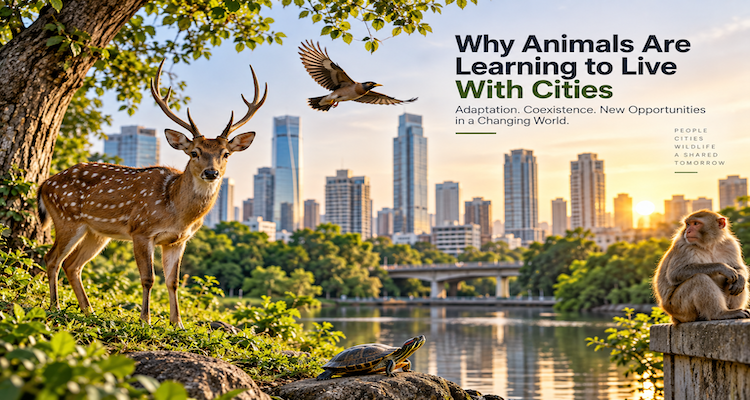
Cities were once viewed mainly as hostile places for wildlife: landscapes of concrete, traffic, artificial light, noise and fragmented habitat. Yet a growing body of research shows a more complicated picture. Some wild animals are not simply being pushed to the edges of urban areas. They are changing how they move, feed, communicate, rest and interact with other species and, in some cases, those changes can persist across generations.
The distinction matters. An animal living in a city is not necessarily “adapted” in the evolutionary sense. Some species are responding flexibly within their own lifetimes; others appear to be experiencing population-level changes shaped by natural or cultural selection. A 2026 global meta-analysis covering 81 studies found widespread differences between urban and non-urban animal populations in behaviours including boldness, aggression, activity and exploration.
The bigger story is therefore not that wildlife has suddenly learned to love cities. It is that urban environments have become powerful ecological filters and some species are finding ways through them.
Key Takeaways
- Urban wildlife often survives by changing behaviour, timing, diet, movement and communication rather than abandoning cities.
- Recent research finds urban-associated behavioural differences across birds, mammals, reptiles, amphibians and insects.
- Chicago coyotes and red foxes demonstrate how animals can divide space and time to coexist in heavily developed landscapes.
- City noise can reshape animal communication, including learned bird songs, but not every behavioural difference represents evolution.
- Urban survival can come with costs, including altered diets, pollution exposure, habitat fragmentation and conflict with people.
- The way cities are designed can determine whether wildlife merely survives or has enough habitat to persist.
The City Has Become a New Ecological Environment
Urbanization removes and fragments natural habitat, but it does not create an ecological blank space.
Parks, cemeteries, gardens, drainage corridors, vacant land, rivers, roadside vegetation, rooftops and even building structures can form a patchwork of habitats. Food waste, bird feeders, ornamental plants and artificial water sources can introduce resources that did not exist in the same form before development.
This creates a process ecologists often describe as urban filtering. Some species disappear because they cannot tolerate the conditions. Others pass through the filter because they possess traits that allow them to exploit the new environment.
Research on mammals illustrates how variable this process can be. A study examining 190 mammal species regularly recorded in urban settlements worldwide found that there was no single formula for urban success. Larger litters, behavioural flexibility and dietary diversity were associated with urban adaptation in different groups, but the importance of these traits varied among taxonomic groups.
That finding challenges a simple idea of the “urban animal.”
There is no universal urban personality.
A fox, raccoon, coyote, bird or lizard may solve the same environmental problem in an entirely different way.
Animals Are Changing Their Schedules
One of the simplest ways to survive around humans is to avoid them.
Many animals do this by changing when they are active rather than abandoning an area altogether.
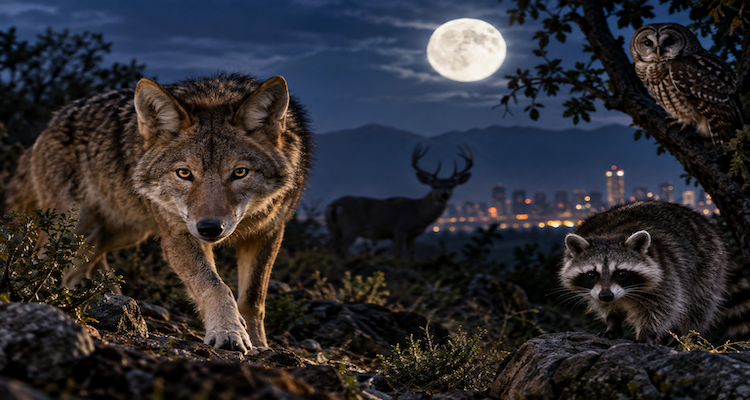
Research using more than 41,000 camera-trap nights across 10 U.S. metropolitan areas examined the daily activity patterns of eight common mammals, including coyotes, red foxes, raccoons, bobcats, skunks, opossums and white-tailed deer. The researchers found that mammals changed their activity patterns along urbanization gradients.
Chicago provides an especially useful example.
A study using camera traps at 110 sites examined coyotes and red foxes across an urbanization gradient. Rather than simply occupying separate landscapes, the two predators increasingly separated their activity in time in more urbanized areas. The researchers found evidence that temporal niche partitioning helped the species coexist where suitable habitat was limited.
In practical terms, this means an urban landscape can contain several overlapping wildlife schedules.
One species may become more active after dark. Another may shift activity toward quieter periods. A third may use a particular green space only when competitors or people are less likely to be there.
The city therefore becomes something like a timetable as well as a landscape.
Noise Is Changing the Way Animals Communicate
Urban noise presents a particularly revealing example because it forces animals to solve a problem humans rarely notice: how do you communicate when the background is permanently loud?
Traffic noise can mask animal vocalizations. For birds, that can interfere with territory defense, mate attraction and other forms of communication.
Studies have found that some urban birds alter the frequency or other characteristics of their songs. Research on blackbirds, for example, found that city birds preferentially used higher-frequency song elements that could be transmitted more effectively through low-frequency traffic noise.
But the scientific story is more nuanced than “city birds simply sing higher.”
Experiments have shown that some birds can alter their songs immediately when exposed to changing noise levels. House finches, for example, changed minimum song frequency as experimental noise increased and decreased.
Other research indicates that previous experience matters. Black-capped chickadees from noisy territories responded differently to experimental noise than birds from quieter territories, suggesting that familiarity with urban noise may influence their ability to adjust their vocalizations.
There is also evidence for something more enduring: learning across generations.
In an experiment with white-crowned sparrows, birds exposed to city-like noise while learning songs were more likely to learn less-masked, higher-frequency songs. The researchers described this as evidence for cultural selection in response to anthropogenic noise.
This is an important distinction.
An animal changing its behaviour during its lifetime is not necessarily evolution. A population changing over generations is a different biological process.
Urban wildlife research increasingly has to separate these mechanisms rather than treating every difference between city and rural animals as evidence of genetic adaptation.
The Animals That Succeed Are Not Necessarily the Strongest
Urban environments reward flexibility.
Species capable of eating different foods, using different shelters, changing activity patterns or tolerating human disturbance may have more opportunities to persist.
That helps explain why generalist species appear repeatedly in studies of urban wildlife.
But flexibility has limits.
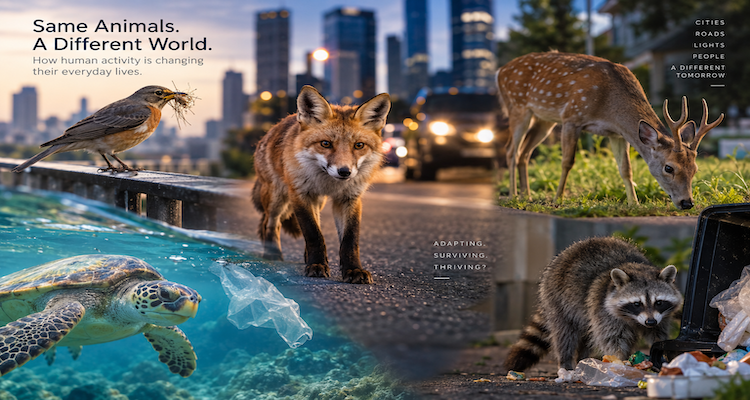
A city may provide abundant calories while providing poor nutrition. Artificial light may extend activity but disrupt natural rhythms. Roads can create movement barriers. Noise can interfere with communication. Buildings can provide shelter while simultaneously creating collision risks. Fragmented green spaces can offer habitat while isolating populations.
Urban survival, therefore, should not automatically be interpreted as urban well-being.
A species can remain present while experiencing ecological pressures that affect reproduction, health, movement or long-term population stability.
Research on urban birds, for example, has found that noise, artificial light, food availability and the amount of urban greenery can all influence bird communities, with effects differing according to species and environmental conditions.
Cities Can Become Wildlife Networks
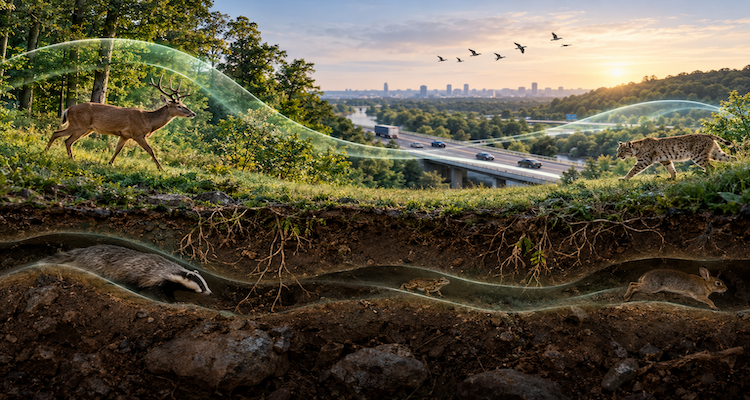
The most important shift in thinking may be from treating urban wildlife habitat as isolated “green spaces” to seeing cities as connected ecological networks.
A park by itself may be valuable. But a park connected to a river corridor, tree-lined streets, gardens, wetlands and other habitat patches can function very differently.
This is especially important for animals that need to move between resources.
Research on wildlife at the wildland-urban interface has shown that infrastructure and sensory pollution, including artificial night lighting, can affect animal behaviour and functional connectivity.
A city that contains many small habitat patches may therefore support wildlife differently from one with fewer but better-connected areas.
This changes the urban-planning question.
Instead of asking only, “How much green space does a city have?” planners increasingly need to consider where it is, what it contains and whether animals can move between it.
Not Every Animal Can Make the Adjustment
The success stories can create a misleading impression.
Urbanization remains a major pressure on biodiversity, and cities can eliminate or fragment habitat even while supporting selected species. The ability of some animals to exploit urban environments does not mean urbanization is broadly beneficial to wildlife.
The 2026 review Eco-evolutionary dynamics shaping biodiversity in the urban mosaic describes cities as potentially viable and sometimes high-quality habitats for some species, while emphasizing that urban environments are complex mosaics rather than uniformly suitable habitats.
This helps explain why two species living in the same neighborhood can have completely different outcomes.
One may find food, shelter and breeding sites.
Another may encounter too much traffic, insufficient habitat or levels of disturbance it cannot tolerate.
Even closely related species can respond differently.
The result is a process of ecological sorting: cities favour some biological strategies while making survival harder for others.
What Urban Wildlife Means for Humans
The relationship works in both directions.
Animals respond to the city, but humans also determine which responses are possible.
A wildlife-friendly city does not necessarily mean turning every neighborhood into a forest. It can involve relatively practical decisions: preserving connected vegetation, protecting waterways, reducing unnecessary nighttime lighting, managing waste, designing roads and crossings carefully, and maintaining habitats that provide food and shelter without creating dangerous dependence on human sources.
There is also a social dimension.
As animals become more comfortable using urban environments, encounters with people become more common. That can produce both fascination and conflict.
The recent dispute over Cape Town’s management of chacma baboons illustrates the difficulty. Authorities and conservationists have disagreed over how to respond to growing human-baboon conflict, with competing arguments about animal welfare, public safety, habitat pressure and the consequences of urban expansion.
The lesson is broader than that particular case.
Coexistence is not simply a question of whether animals can tolerate cities. It is also a question of whether cities can be designed and managed in ways that reduce unnecessary conflict.
The Bigger Scientific Question: Are Animals Adapting or Simply Coping?
This may be the most important distinction in the entire subject.
An animal can cope with an urban environment without becoming evolutionarily adapted to it.
Behavioural plasticity can allow an individual to change activity, movement or communication relatively quickly. Cultural transmission can spread learned behaviours. Natural selection can produce population-level evolutionary change over generations.
These processes can overlap, but they are not interchangeable.
A major review of urban ecology has long emphasized the need to distinguish between adaptation and “adaptedness,” because behavioural, physiological, developmental and evolutionary responses can operate through different mechanisms.
The latest global evidence makes that distinction even more relevant. The 2026 meta-analysis of urban-associated behavioural differences found patterns across five major animal groups, but the researchers’ approach itself reflects the complexity of determining whether behavioural differences represent consistent population-level responses rather than a single universal pathway to urban living.
So the headline question—why animals are learning to live with cities is slightly more complicated than it first appears.
Some are learning.
Some are adjusting.
Some populations are changing over generations.
And many species are still disappearing from places where urbanization removes more habitat than they can tolerate.
Conclusion
The emerging urban wildlife story is not one of animals defeating the city. It is a story of negotiation.
Wild animals are encountering an environment humans have built at extraordinary speed. Some respond by changing their schedules. Some alter their diets or movements. Some modify their communication. Others learn from previous experience, while certain population-level traits may reflect longer-term evolutionary or cultural change.
But adaptation has limits.
The fact that a fox crosses a suburban street at night or a bird changes its song does not mean the city has become harmless. It means the animal has found a way to operate within a difficult environment.
That distinction matters for the future of urban planning. Cities do not have to choose between human development and wildlife everywhere. They can influence whether urban landscapes become ecological dead ends, isolated islands or connected habitats in which people and wildlife have a better chance of sharing space.
The most revealing question may therefore no longer be whether animals can live in cities.
It is whether we can build cities that give more species a realistic place to live in them.
This content is published for informational or entertainment purposes. Facts, opinions, or references may evolve over time, and readers are encouraged to verify details from reliable sources.
Continue Exploring
- Spotted Hyena Seen in Egypt After 5,000 Years, Then Killed by Locals
- Mass Stranding of False Killer Whales in Tasmania Sparks Urgent Rescue Efforts
- What the Shiva Lingam Has Meant Across Centuries and Why Its Meaning Is Often Simplified
- The Person Who Disappeared From Everyone’s Life Without Actually Disappearing