






Why Shiva Lives in Contradictions—and Why That May Be the Point
Shiva is one of the most recognizable figures in Hindu religious thought, yet he is remarkably difficult to reduce to a single personality. He is the great ascetic who meditates in the Himalayas and the husband of Parvati. He is associated with cremation grounds, skulls and spirits, yet is also revered as a protector and a source of life. He can appear terrifying and compassionate, detached and deeply involved, masculine and feminine, destroyer and creator.
These are not simply inconsistencies accumulated over centuries. Shiva’s mythology repeatedly places opposing qualities beside one another. At the sixth-century Elephanta Caves, for example, Shiva appears in multiple forms that deliberately explore contrasting states active and passive, fierce and gentle, manifested and unmanifested. One of the most striking is Ardhanarishvara, the composite form of Shiva and Parvati as a single body.
That pattern suggests a useful way of approaching Shiva: perhaps the contradictions are not problems to be solved but tensions meant to be contemplated.
Key Takeaways
- Shiva repeatedly combines qualities that ordinary categories usually keep separate.
- His identity moves between ascetic withdrawal and family life rather than choosing only one.
- Ardhanarishvara presents masculine and feminine principles within a single divine form.
- His association with death is repeatedly connected with transformation, regeneration and liberation.
- Shiva’s many forms show why Hindu sacred imagery cannot always be understood through a single fixed definition.
The Ascetic Who Is Also a Householder
One of Shiva’s most enduring contradictions is his relationship with worldly life.
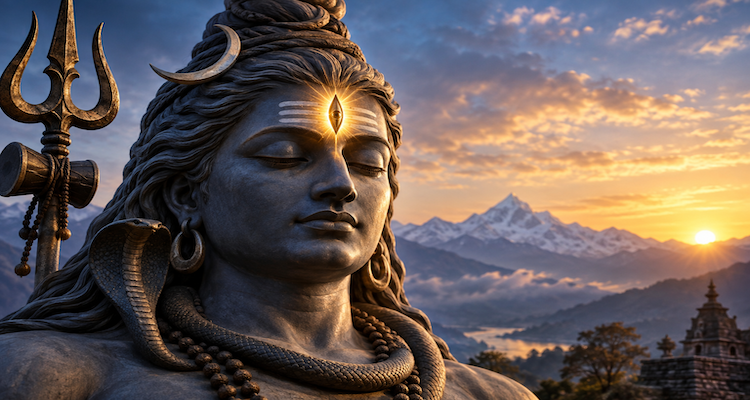
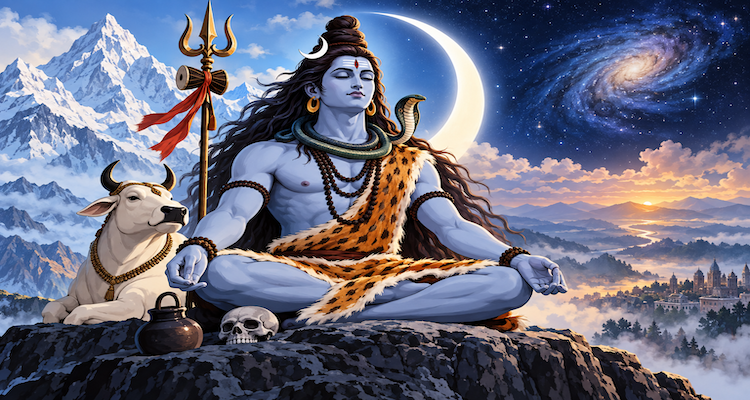
The image of Shiva as a yogi is familiar: matted hair, meditation, a powerful stillness and an existence seemingly removed from ordinary social ambitions. He is traditionally associated with asceticism and with the withdrawal of the senses and mind from worldly attachment.
Yet Shiva is also a husband and father.
His relationship with Parvati is central to numerous traditions, and together they form a divine household that includes Ganesha and Skanda in widely known narratives. This means that Shiva cannot simply be classified as the god who rejects family and society.
The tension matters because Indian religious traditions have long contained both household-centered and renunciatory ideals. Academic studies of Hindu asceticism have examined the interaction between these two orientations rather than treating them as completely separate worlds.
Shiva embodies that tension personally.
He can retreat into meditation, yet he can also participate in marriage, family and cosmic affairs. The contradiction is therefore not merely between two stories. It is built into the image of the deity.
One possible interpretation is that Shiva represents a spiritual ideal in which engagement and detachment are not necessarily permanent opposites. A person may have responsibilities without allowing those responsibilities to define the whole of existence.
That is an interpretation, not a single universally accepted doctrine but it helps explain why Shiva’s mythology remains unusually comfortable with incompatible-looking identities.
The God of Destruction Who Makes Renewal Possible
Calling Shiva a “destroyer” can also be misleading if the word is understood only in its everyday sense.
In many presentations of the Hindu Trimurti, Brahma is associated with creation, Vishnu with preservation and Shiva with destruction. But destruction in this context is connected with cosmic cycles rather than simply with annihilation for its own sake.
The Nataraja, or dancing Shiva, makes this especially visible.
The famous Chola-period image shows Shiva dancing within a ring of flames. The symbolism has been interpreted through the recurring processes of creation, destruction and transformation. The dance is not a picture of a universe simply ending; it evokes movement and cosmic process.
This changes the meaning of destruction.
A forest fire can destroy individual trees while transforming an ecosystem. The end of one form can create the conditions for another. Religious symbolism often works at this level rather than treating existence as a straight line from beginning to end.
Shiva therefore occupies an unusual position: destruction can be part of regeneration.
That is one reason the apparently negative image of the destroyer cannot adequately describe the deity.
Why Shiva Is Comfortable in the Cremation Ground
Few religious images are as striking as Shiva’s association with cremation grounds.
Traditional representations can place him among ashes, skulls, spirits and other imagery associated with death. Museum scholarship on Shiva’s iconography records this deliberately unsettling dimension alongside his identity as an ascetic and yogic deity.
The cremation ground is an important symbolic setting because it strips away many of the social distinctions people construct around themselves.
Wealth, status, beauty and possessions lose their ordinary meaning there.
Death becomes unavoidable.
Shiva’s presence in such a place can therefore be understood as confronting something that human beings frequently attempt to keep distant: mortality.
Scholarly work on Hindu ascetic traditions has also examined practices associated with cremation grounds and the deliberate crossing of boundaries involving death, impurity and conventional social expectations. These traditions should not be casually equated with ordinary Hindu practice, but they demonstrate how certain Shaiva traditions have used precisely those boundaries as sites of religious reflection.
The deeper symbolism is powerful: what society rejects or fears can become a place of spiritual investigation.
Shiva and Parvati: Two Become One
Perhaps the clearest visual expression of Shiva’s contradictions is Ardhanarishvara.
The name refers to a form in which Shiva and Parvati appear as one composite being, conventionally divided into male and female halves.
The sixth-century Elephanta Caves contain an important representation of this form. The image does not merely place a male deity next to a female deity. It physically combines them.
That distinction matters.
The sculpture challenges the assumption that masculine and feminine must always exist as completely separate categories. Instead, complementary principles are represented within a single divine body.
Modern readers may naturally connect this imagery with questions about gender identity, balance or psychological wholeness. Those modern interpretations can be useful, but they should not automatically be presented as the original meaning intended by every historical tradition.
Historically, Ardhanarishvara belongs to a much older religious and artistic vocabulary.
Its enduring power comes partly from the fact that the image refuses a simple either-or answer.
Shiva is not exclusively masculine.
The divine is represented as containing difference without requiring separation.
Fierce and Gentle at the Same Time
Shiva’s contradictions also appear in his emotional and visual character.
He can be portrayed as a fierce deity surrounded by frightening imagery, yet he is also shown as a calm meditator. He can appear as an overwhelming cosmic dancer and as a still yogi.
The Elephanta program is particularly revealing because its sculptures include several manifestations of Shiva rather than attempting to settle on one definitive appearance. Smarthistory notes the contrast between active and passive moods in the cave’s sculptural program, including forms that emphasize Shiva’s dynamic power and others that emphasize calmness or transcendence.
This is important because religious images are often assumed to provide fixed definitions.
Shiva demonstrates the opposite.
An image can reveal one dimension without exhausting the deity’s identity.
The same figure can therefore be approached as yogi, husband, dancer, cosmic force, protector, ascetic or terrifying presence.
The categories overlap.
The Poison That Becomes a Mark of Protection
Another famous Shiva narrative places destruction and protection almost directly beside one another.
In the story of the churning of the cosmic ocean, a deadly poison emerges and threatens the gods and other beings. Shiva consumes the poison, and his throat becomes associated with the characteristic blue coloration that gives rise to the name Nilakantha, or “Blue-Throated One.”
The symbolism is striking.
The poison is dangerous, but Shiva’s willingness to contain it protects the wider cosmos.
The story should not be treated as a scientific account of poison or as a literal explanation of physical phenomena. Its significance is mythological and religious.
But symbolically it introduces another recurring Shiva pattern: the capacity to hold something destructive without allowing it to destroy everything else.
That is a different kind of contradiction.
The figure associated with destruction becomes the one who absorbs danger.
Why “Contradiction” May Be the Wrong Word
There is an important limitation to the word “contradiction.”
Two ideas are contradictory when they cannot logically coexist in the same respect at the same time. Shiva’s mythology often operates differently.
A person can be a parent and an ascetic at different moments. Destruction can be part of regeneration. A deity can have multiple manifestations. A composite form can symbolize two principles within one body.
In other words, Shiva’s mythology often uses paradox and complementarity rather than simple logical contradiction.
This distinction makes the subject more interesting.
Instead of asking, “Which Shiva is the real Shiva?” a more productive question may be, “Why does the tradition preserve so many different Shivas?”
The historical answer is complicated. Shaivism developed through diverse traditions, texts, rituals, regional practices and artistic forms. Shiva’s identity was not created in one moment by one author. Different communities emphasized different aspects of the deity.
The result is a religious figure whose identity accumulated rather than narrowed.
The Sixth-Century Elephanta Caves Offer a Clue
The Elephanta Caves provide unusually strong evidence for thinking about Shiva through multiplicity.
The sixth-century cave complex contains several major representations of Shiva, including Sadashiva, Ardhanarishvara and Gangadhara. Rather than presenting one isolated definition, the sculptural program creates a visual environment in which different aspects of Shiva exist together.
Shiva and Parvati can appear united as Ardhanarishvara.
Shiva can also appear as the bearer of Ganga, controlling the descent of the river goddess through his matted hair.
Elsewhere, Shiva appears in other dramatic manifestations involving marriage, dance, warfare, asceticism and divine power.
The effect is almost philosophical.
The viewer is not given one answer.
The viewer is asked to move through several answers.
That may be one of the most important clues to understanding why Shiva has remained so culturally resilient.
What Shiva’s Contradictions Can Mean Today
It is tempting to turn religious symbolism immediately into modern self-help.
That would oversimplify it.
Still, Shiva’s imagery offers a useful way of thinking about human life because human beings themselves rarely fit into single categories.
A person can be ambitious and exhausted by ambition. Independent and deeply attached to family. Strong in one situation and vulnerable in another. Social in one context and solitary in another.
Modern life often encourages people to construct identities around fixed labels.
Shiva’s mythology repeatedly resists that impulse.
His symbolism suggests that opposing dimensions can coexist without one necessarily cancelling the other.
That does not mean every contradiction should be celebrated or that every opposing behavior is automatically wise. It means that complexity itself does not necessarily represent failure.
Sometimes complexity is the subject.
Why Shiva Continues to Resist a Single Definition
The enduring appeal of Shiva may have less to do with offering a neat definition and more to do with refusing one.
He is simultaneously associated with meditation and family, destruction and renewal, terrifying imagery and compassion, masculinity and femininity, wilderness and civilization, stillness and dance.
Different Shaiva traditions have interpreted these dimensions in different ways, and scholars continue to examine how Shiva’s mythology developed across texts, communities and historical periods.
That history cautions against reducing Shiva to a motivational symbol or a single modern slogan.
Yet it also explains why the deity remains so intellectually and spiritually compelling.
Shiva’s contradictions do not necessarily ask the believer or even the observer to choose one side.
They can instead invite contemplation of the relationship between the sides.
Perhaps that is the point.
Not that Shiva is contradictory in the ordinary sense, but that the divine is being represented as larger than the categories used to describe it.
Conclusion
Shiva’s complexity is not an accidental collection of strange stories. Across mythology, sculpture and religious traditions, opposing qualities repeatedly meet in the same figure.
The ascetic becomes a husband. The destroyer becomes a protector. The frightening deity becomes a source of refuge. The masculine and feminine appear within one body. The cremation ground becomes a place of spiritual confrontation. The cosmic dancer destroys and, through that destruction, participates in renewal.
These interpretations should not be mistaken for a single definitive explanation of Shiva. Hindu traditions are diverse, and different communities understand the deity in different ways.
But the recurring pattern is difficult to miss.
Shiva does not always resolve opposites.
He makes them visible.
And perhaps that is why an image of Shiva can remain meaningful across centuries: it does not demand that existence become simple before it can become sacred.
This content is published for informational or entertainment purposes. Facts, opinions, or references may evolve over time, and readers are encouraged to verify details from reliable sources.