







Discovering What the Earth Is Telling Us
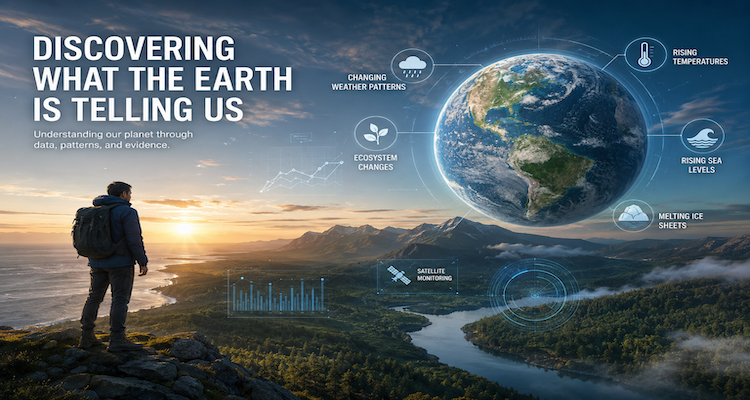
The Earth does not send warnings in words. It sends them through temperatures, ocean heat, changing ice, shifting water reserves, vegetation, atmospheric chemistry and the growing frequency or intensity of hazardous events.
What has changed is our ability to listen.
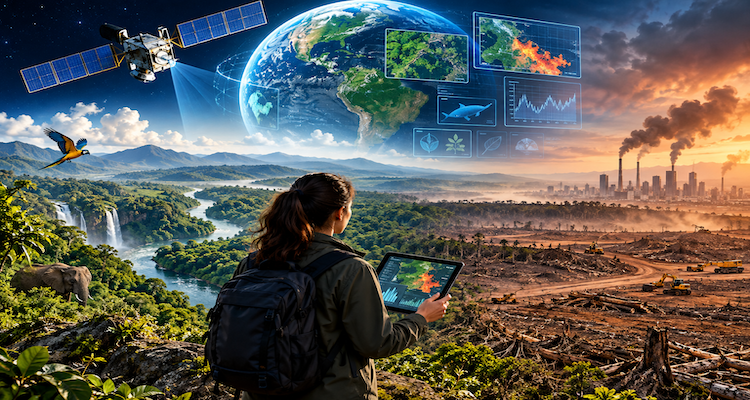
Satellites, ocean instruments, weather stations, aircraft, ground sensors and increasingly sophisticated models now allow scientists to observe the planet as an interconnected system rather than as a collection of isolated environmental problems. NASA describes this approach as Earth system science: understanding how the atmosphere, land, oceans, ice and living systems interact and change together.
That wider perspective matters because some of Earth’s most important signals are easy to miss when viewed separately. A warming ocean is connected to atmospheric conditions. Melting ice affects sea level. Changes in rainfall can alter groundwater. Vegetation responds to temperature, water availability and land-use change.
The latest global observations make the message increasingly difficult to dismiss as a collection of unrelated fluctuations. The World Meteorological Organization’s State of the Global Climate 2025, published in March 2026, found that 2015–2025 were the 11 warmest years in the observational record, while 2025 ranked as the second or third warmest year depending on the dataset.
Key Takeaways
- Earth’s strongest signals emerge when temperature, oceans, ice, water and ecosystems are studied as one connected system.
- Satellites can reveal changes that are difficult or impossible to measure consistently from the ground.
- Ocean heat, sea level and ice loss provide long-term signals that extend beyond individual weather events.
- Space-based measurements can expose changes in groundwater and freshwater storage beneath the Earth’s surface.
- Earth observation becomes most valuable when measurements are converted into decisions about water, food, infrastructure and disaster preparedness.
- The challenge is increasingly not whether we can observe Earth, but whether we act on what those observations reveal.
Earth Speaks Through Patterns, Not Single Events
A single hot day does not explain climate change. Neither does one storm, one drought or one unusually cold winter.
Scientists look for persistent patterns across time and space.
This is one reason long-term observation matters so much. NASA’s Earth Science Division combines observations from satellites, aircraft, balloons, ships and ground-based instruments to study atmospheric composition, land cover, vegetation, ocean conditions, ice and other components of the Earth system.
The resulting picture is more powerful than any individual measurement.
Consider temperature. WMO’s 2025 assessment found that the past 11 years were the 11 warmest years on record. The same assessment reported that ocean heat content reached a record level in 2025, while glacier melt continued and Arctic sea ice remained near historically low levels.
These are not interchangeable indicators. They measure different parts of the system. Their significance comes partly from seeing them together.
That is what “listening to Earth” really means in scientific terms: identifying signals that persist, testing them against independent observations and understanding how different parts of the planet respond to one another.
The Ocean May Be One of Earth’s Loudest Signals
Much of climate change is easier to notice in the atmosphere because air temperature is something people experience directly.
But the ocean stores enormous amounts of heat.
WMO reported that ocean heat content reached its highest level in the 66-year observational record in 2025. Its assessment also found that the rate of ocean warming during 2005–2025 was more than twice the rate observed from 1960–2005.
Sea level provides another long-term indicator. Satellite altimetry allows scientists to measure changes in ocean height across the globe. Copernicus notes that global mean sea-level rise is an important consequence of warming, while regional changes can differ substantially from the global average.
This distinction is important for people making decisions.
A global average is scientifically useful, but a coastal planner needs to know what is happening locally. A port operator needs information about coastal flooding. A city needs to understand how infrastructure could be affected. A farmer needs information about water availability.
The same Earth observation system can therefore serve both planetary science and very practical decisions.
Some of the Most Important Changes Are Hidden Underground
One of the most revealing examples comes from water.
Groundwater cannot simply be photographed from space. Yet NASA’s GRACE satellite missions have shown that changes in Earth’s gravity can reveal shifts in water stored beneath and across the surface. Scientists can use these measurements to track changes in groundwater, glaciers, soil moisture and large bodies of water.
That is a striking example of how Earth observation has evolved.
Instead of merely taking pictures, instruments can measure physical properties that indirectly reveal what is happening below the surface.
The implication is significant for water management. Aquifers can decline long before the consequences become obvious to everyone depending on them. Satellite observations do not replace wells and local measurements, but they provide a much broader view of changes that may otherwise be difficult to observe consistently.
NASA’s GRACE-C mission is planned as a continuation of this type of measurement, with the objective of tracking changes in the water cycle, glaciers, sea level and groundwater.
The lesson is broader than groundwater: sometimes Earth tells us something important through a measurement that initially seems unrelated to the problem we are trying to understand.
The Living Earth Is Part of the Measurement
Earth observation is not limited to temperature, storms and ice.
Plants, oceans and ecosystems also leave measurable signatures.
NASA’s Earth-observation programs monitor vegetation, land cover, ocean biology, wildfires, soil moisture, precipitation and other variables.
The PACE satellite mission adds another layer by observing microscopic marine life such as phytoplankton alongside atmospheric particles and clouds. In 2026, NASA described field collaborations designed to validate PACE observations and improve understanding of interconnected ocean and atmospheric processes.
This matters because ecosystems are not passive scenery surrounding the climate system. They participate in it.
Vegetation affects carbon and water cycles. Ocean biology influences marine ecosystems and interacts with atmospheric processes. Changes in land use can alter water availability and surface conditions.
Understanding these relationships can reveal changes that would be missed by looking at temperature alone.
From Observation to Early Warning
There is another reason listening to Earth matters: observation can save lives.
Weather and climate measurements become socially valuable when they lead to useful forecasts, warnings and decisions.
The WMO’s global observing system combines data from land- and space-based instruments to support weather forecasting, climate monitoring and environmental applications.
The connection between observation and public safety is particularly clear in early-warning systems.
WMO’s 2025 assessment reported that countries with more comprehensive multi-hazard early-warning capabilities have substantially lower disaster-related mortality than countries with limited capabilities. Yet coverage remains incomplete globally.
This reveals an important distinction.
Knowing what Earth is doing is not the same as responding effectively.
A satellite can detect a developing hazard. A forecast can estimate its likely path. But the information must reach communities, authorities and infrastructure operators in time, and people must have the capacity to respond.
The final link in the chain is therefore human.
Earth Observation Is Becoming a Decision System
The next stage of Earth science is not simply about collecting more images.
It is about connecting observations.
NASA’s Earth System Observatory is being designed around multiple satellite missions whose measurements can work together to build a more comprehensive picture of Earth’s interconnected processes. Its planned observations cover areas including aerosols, clouds and precipitation, changes in Earth’s mass, surface biology and geology, and surface deformation.
Commercial satellite data is also increasingly being used alongside government observations. NASA says commercial datasets can provide higher-resolution, more frequent or taskable observations that complement its own measurements.
This creates a potentially important shift.
Earth observation is moving from a largely scientific exercise toward an information infrastructure that can support agriculture, water management, disaster response, urban planning, conservation and climate adaptation.
Copernicus, for example, provides land-monitoring information covering land cover, land use, vegetation, the water cycle and surface-energy variables for applications including agriculture, forest management, water management, conservation and climate adaptation.
The value of the data therefore depends increasingly on what happens after measurement.
What the Signals Do and Do Not Tell Us
There is a temptation to treat every environmental indicator as proof of an immediate catastrophe.
Science requires more discipline.
Earth is naturally variable. Individual measurements contain uncertainty. Different datasets can produce slightly different estimates. Short-term weather patterns can temporarily reinforce or mask longer-term trends.
The WMO’s classification of 2025 as the second or third warmest year, depending on the dataset, is a useful example of how scientific reporting handles this uncertainty rather than hiding it.
At the same time, uncertainty about an individual measurement does not erase a broader pattern supported by multiple independent indicators.
That is why scientists rely on long-term datasets, multiple instruments, independent observations and models rather than one dramatic number.
The goal is not to make Earth appear more alarming than it is.
It is to understand what the evidence actually says.
The Hardest Question Is No Longer Whether We Can Listen
For centuries, humans experienced environmental change locally. A river flooded. A harvest failed. A winter arrived early. A glacier retreated.
Modern Earth observation changes the scale of perception.
We can now measure changes across oceans, continents and atmospheric layers and compare them over decades. NASA’s Earth Science Division operates more than 20 satellites and combines space-based observations with other measurements to understand how changes in one part of the planet affect another.
The result is something close to a planetary diagnostic system.
It does not predict everything. It does not remove uncertainty. It cannot tell societies exactly what political or economic choices to make.
But it can narrow the distance between what is happening and what we know is happening.
That may be the most important development of all.
The Earth has always been changing. What is different is that humanity now possesses increasingly sophisticated instruments for distinguishing temporary fluctuations from persistent signals and for seeing connections that were once invisible.
Conclusion
The Earth is telling us many things at once.
The ocean is storing more heat. Ice is changing. Sea levels are rising. Water is moving through the planet in ways that satellites can increasingly measure. Ecosystems are responding to changing conditions. Atmospheric measurements are documenting the continuing accumulation of greenhouse gases. And improved observation is making it possible to warn communities about some hazards before they arrive.
None of these signals should be treated as a standalone prophecy.
Together, however, they form something much more useful: evidence.
The central challenge for the coming years may therefore be less about finding new ways to make Earth speak. We are already listening with satellites, sensors, models and global observing networks.
The harder task is learning how to turn what we hear into better decisions before a signal becomes a crisis.
This content is published for informational or entertainment purposes. Facts, opinions, or references may evolve over time, and readers are encouraged to verify details from reliable sources.