










Faith, Meaning, and the Search Within
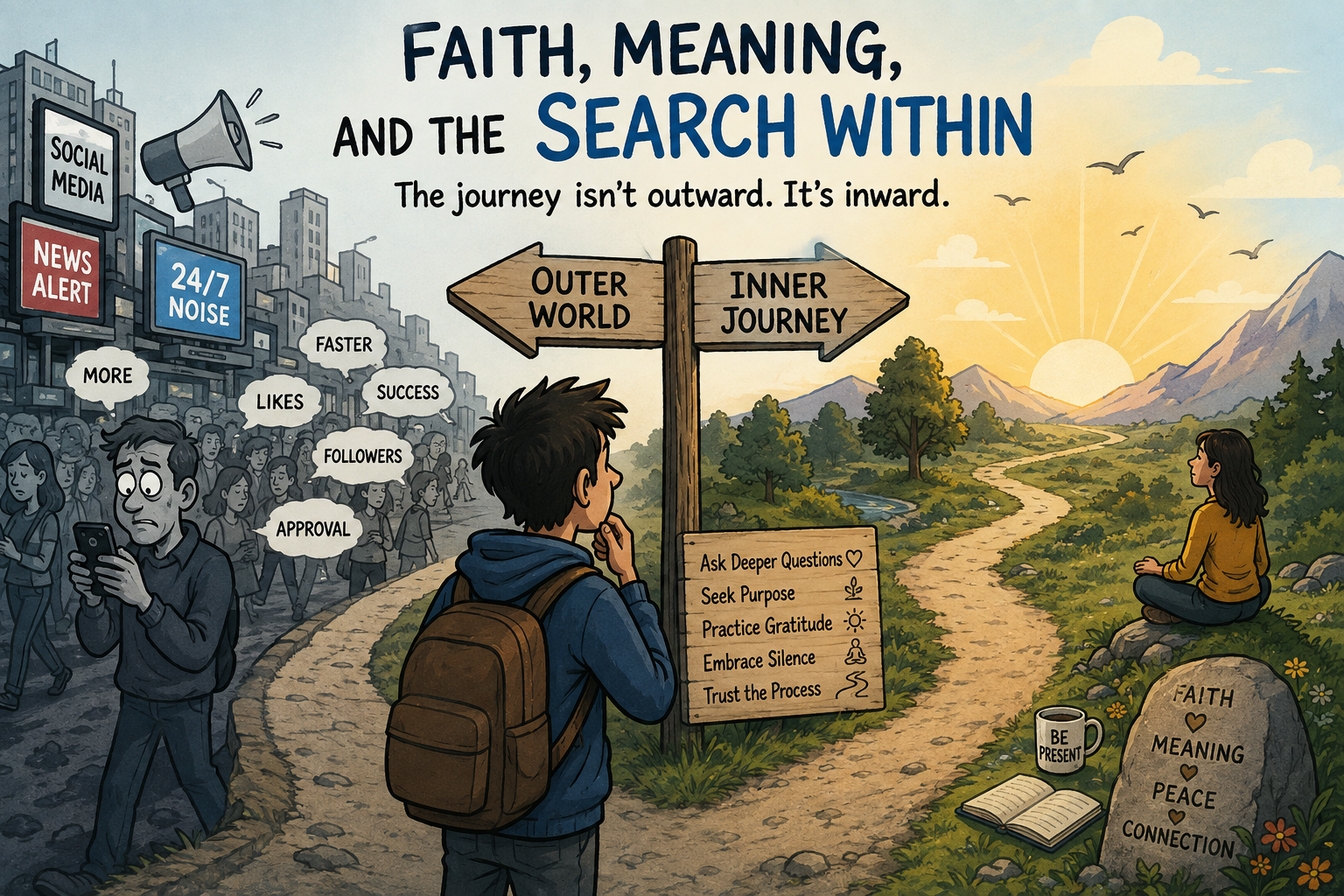
For much of human history, questions about meaning were inseparable from questions about faith: Why are we here? What makes a life worth living? What should we do with suffering, uncertainty, love and mortality?
Those questions have not disappeared as societies have become more secular or scientifically minded. If anything, the language around them has widened. People may describe themselves as religious, spiritual, philosophical, humanist, agnostic or simply curious about the inner life. A 2025 Pew Research Center report found that 46% of U.S. adults think about the meaning and purpose of life at least once a week, while another 38% do so monthly or yearly.
The important distinction is that faith and meaning are related, but they are not identical. Faith can provide a framework for interpreting existence; meaning can also emerge through relationships, responsibility, work, service, creativity, nature, personal values and the effort to understand one’s own life.
Modern psychology increasingly treats meaning not as an answer that can be measured with a single question, but as a multidimensional experience involving whether life makes sense, whether it has direction, and whether one’s existence feels significant.
That creates an interesting meeting point between ancient spiritual traditions and contemporary research: the search within is not necessarily an escape from ordinary life. It can be a way of deciding how to live it.
Key Takeaways
- Meaning is commonly understood through three dimensions: coherence, purpose and a sense that one’s life matters.
- Faith can provide meaning through beliefs, practices, community and a framework for interpreting suffering and responsibility.
- Spirituality does not always require religious affiliation; many people distinguish personal spirituality from organized religion.
- Research consistently finds associations between meaning, purpose and several measures of well-being, but associations do not prove simple cause and effect.
- The search for meaning is often less about discovering one universal answer than clarifying what deserves commitment in an individual life.
- Meaning can be cultivated through relationships, values, purposeful activity, reflection and connection with something larger than the self.
What Do We Mean by “Meaning”?
The phrase meaning of life sounds like it should have one enormous answer. Research suggests the experience is more complicated.
Psychologists commonly distinguish at least three components.
Coherence concerns whether life makes sense. A person experiences events as connected rather than as a collection of completely unrelated experiences.
Purpose concerns direction: having goals, commitments or a sense of what one is moving toward.
Significance, sometimes called mattering, concerns whether one’s existence feels valuable or worthwhile.
These distinctions matter because someone can have one without having the others.
A person may have a successful career and clear goals but still wonder whether the life they are building matters. Someone else may have strong religious beliefs that provide a coherent worldview but be uncertain about what those beliefs require from them personally.
Meaning, therefore, is not synonymous with happiness.
Happiness can describe how someone feels at a particular moment. Meaning concerns how a person understands the larger shape and value of their life.
That difference becomes especially visible during difficult periods. A meaningful life does not necessarily mean a painless life. Meaning can influence how people interpret hardship, relationships, responsibility and change without removing the hardship itself.
Why Faith Has Remained a Powerful Source of Meaning
Religious traditions have historically offered answers to several questions that scientific measurement alone does not settle.
Science can investigate how the universe developed, how the brain functions or what happens physiologically during death. It cannot, by empirical measurement alone, determine what an individual ought to regard as sacred, morally valuable or worth sacrificing for.
Faith enters this territory differently.
Religions can provide narratives about existence, moral frameworks, rituals, communities, practices of contemplation and concepts of transcendence. They can also give suffering a place within a larger story.
This does not mean every religious experience produces well-being, nor that religious belief automatically resolves existential uncertainty. Research on religion and spirituality describes both positive and negative associations with mental health and emphasizes that the pathways are complex.
Faith can therefore be understood less as a guaranteed psychological benefit and more as one of humanity’s longstanding systems for constructing meaning.
That distinction is important.
It allows room for genuine religious conviction without turning scientific research into proof of theological claims.
Spirituality Is Broader Than Religious Identity
One of the clearest signs of this changing landscape is the growing distinction people make between being religious and being spiritual.
Pew Research Center’s 2023 survey of 11,201 U.S. adults found that 70% could be categorized as spiritual in some way, while 22% described themselves as spiritual but not religious. At the same time, 48% were both religious and spiritual.
The survey also reveals why the categories can be difficult to separate.
Among Americans considered spiritual, the most commonly selected elements included being connected with something larger than oneself, being connected with God and being connected with one’s true self. Connection with nature and other people also appeared prominently.
This suggests that spirituality is not simply a replacement word for religion.
For some people, spirituality remains deeply rooted in religious belief. For others, it may involve reflection, nature, ethical living, meditation, connection, awe or an attempt to understand oneself without belonging to a formal religious institution.
The broader lesson is that the human search for meaning does not fit neatly into institutional categories.
What Psychology Can and Cannot Tell Us
Contemporary psychology has made the study of meaning more precise without solving the philosophical question of what life ultimately means.
A major review in Annual Review of Psychology describes meaning in life as a subjective experience and examines its relationship to coherence, purpose and existential significance.
This research is useful because it changes the question.
Instead of asking researchers to determine the meaning of life, we can ask measurable questions:
- Do people experience their lives as coherent?
- Do they have valued goals?
- Do they feel that their existence matters?
- What experiences strengthen those perceptions?
- How does meaning relate to well-being?
- What happens when people lose a source of meaning?
That shift does not diminish the philosophical question. It simply recognizes that empirical science and spiritual or philosophical inquiry are asking different kinds of questions.
Meaning Is Associated With Well-Being But That Is Not the Same as a Cure
There is substantial research connecting meaning and purpose with aspects of psychological and physical well-being.
A systematic review and meta-analysis of 66 studies involving 73,546 participants found weak-to-moderate associations between meaning in life and physical health. The authors also noted stronger relationships for subjective measures of health than for objective health indicators.
More recently, a 2025 review examining meaning, purpose and spirituality in lifestyle medicine reported consistent small-to-moderate associations with longevity, physical and mental health, and well-being. The authors also emphasized the need for more rigorous research on interventions and outcomes.
And in July 2026, a large meta-analysis combining 25 samples and 488,765 participants reported that greater purpose in life was associated with approximately a 30% lower risk of earlier mortality. Importantly, the association became smaller after accounting for behavioral, clinical and psychological factors. The study therefore does not establish that purpose itself prevents death.
That distinction is central to responsible reporting.
Meaning may be connected with healthier lives for several reasons. People with a strong sense of purpose may behave differently, maintain stronger social connections, cope differently with stress, or possess psychological resources that influence other aspects of health.
The evidence does not justify the much simpler claim that “finding your purpose will make you live longer.”
The Search Within Is Not Always About Finding an Answer
Perhaps the most useful insight is also the least dramatic.
The search for meaning does not necessarily end when someone discovers a belief system.
People change careers, lose loved ones, become parents, leave religions, adopt new beliefs, experience illness, encounter failure or enter new stages of life. Each transition can force previously accepted assumptions back into question.
Meaning can therefore be less like a destination and more like an ongoing relationship with one’s values.
A person may begin with inherited answers and later examine them. Another may begin without religious belief and develop a strong philosophy of service or responsibility. Someone else may find meaning primarily through family, creative work, community or intellectual discovery.
There is no scientific basis for ranking these experiences into a universal hierarchy.
What matters psychologically is whether the person experiences life as coherent, purposeful and significant.
What Different Traditions Have in Common
Religious and philosophical traditions disagree profoundly about ultimate reality. Yet many of them repeatedly return to a surprisingly familiar set of human concerns.
Responsibility: What do I owe other people?
Discipline: Which desires should govern me, and which should I learn to govern?
Connection: What relationship do I have with other people, nature, society or the sacred?
Mortality: How should awareness of death influence the way I live?
Transcendence: Is there something larger than individual preference?
Inner examination: What happens when I stop allowing external circumstances to define my entire identity?
These questions appear in different languages across traditions, but they are not exclusive to religion.
They also appear in philosophy, psychology, literature and secular ethics.
This may explain why the search within persists even when religious affiliation changes. The underlying human questions remain.
A More Practical Way to Search for Meaning
The search for meaning can become unhelpful when treated as a demand to discover one grand mission.
A more grounded approach is to examine the life already being lived.
Ask:
- What relationships would I deeply regret neglecting?
- What responsibilities do I consider worth carrying even when they are difficult?
- What activities make time feel worthwhile rather than merely occupied?
- Which values do I want my decisions to demonstrate?
- What kind of person do I want to become, not merely what do I want to possess?
- What, if anything, feels larger than my individual interests?
None of these questions requires a particular religious answer.
For a religious person, they may deepen prayer, scripture, worship or service. For someone who is spiritual but not religious, they may lead toward meditation, contemplation, nature or ethical practice. For a secular person, they may point toward relationships, community, knowledge, creativity or human responsibility.
The common element is reflection followed by action.
Meaning becomes more tangible when values influence how a person actually spends time, treats others and responds to difficulty.
The Danger of Turning Meaning Into Another Performance Metric
Modern culture can turn almost anything into an achievement target.
Purpose can become another item on the productivity checklist: discover your mission, optimize your life, maximize your potential.
That approach can miss something fundamental.
A meaningful life does not have to look extraordinary from the outside.
Caring for a family member, teaching someone, maintaining a friendship, creating something, serving a community, practicing a faith, protecting a natural place or simply becoming a more honest person may never produce impressive metrics.
Yet significance is not measured exclusively by visibility.
Indeed, the psychological literature’s distinction between purpose and significance is useful here. A life can have direction without being famous, and it can feel worthwhile without producing a conventional achievement.
The question is not necessarily How important will my life look?
It may be closer to:
What am I willing to give my life to?
Meaning Can Be Built in Ordinary Life
The search within does not require withdrawing from the world.
Meaning is often constructed through ordinary commitments: relationships that require patience, work that serves someone beyond oneself, responsibilities that cannot simply be abandoned when they become inconvenient, and moments of attention that interrupt habitual distraction.
Research on meaning has identified relationships, self-transcendence and purposeful activity among important sources or pathways through which people experience meaning.
That provides a useful corrective to the idea that meaning is something hidden inside the mind waiting to be discovered.
Sometimes meaning is discovered through participation.
We learn what matters by caring for something.
We discover what we value by deciding what we are unwilling to betray.
And we often understand our priorities more clearly when circumstances force us to choose.
Conclusion
Faith can offer an answer to the question of why existence matters. Psychology can examine how people experience meaning. Philosophy can question the assumptions behind both. None of these disciplines needs to replace the others.
The search within becomes richer when certainty is not confused with meaning.
A person does not need to possess a final explanation of existence before living according to deeply held values. Meaning can emerge through the commitments people repeatedly make: whom they love, what they protect, what they learn, what they create, what they endure and how they treat others.
Perhaps that is why the question has survived for so long.
The search for meaning is not only a search for an explanation of life. It is also a process of deciding what makes life worth living and then allowing that decision to shape the life itself.
This content is published for informational or entertainment purposes. Facts, opinions, or references may evolve over time, and readers are encouraged to verify details from reliable sources.
Related News
- Why Mark Zuckerberg Visited Kainchi Dham: The Neem Karoli Baba Connection Behind a Silicon Valley Story
- Kainchi Dham: How a Himalayan Ashram Became a Global Spiritual Landmark
- How Religious Architecture Continues to Shape Human Emotions Long After Belief Fades
- The New Search for Silence and Why It Is Becoming a Spiritual Movement