








Nature’s Signals, Science’s Answers: How Scientists Are Turning Living Systems Into Environmental Early Warnings
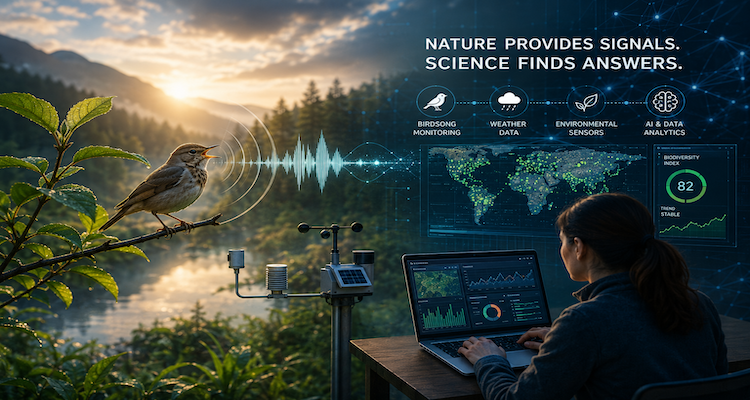
A forest does not issue a warning when drought begins. A river does not send an alert when its biological community starts changing. Coral reefs do not display a thermometer when heat stress accumulates.
Yet nature is constantly producing signals.
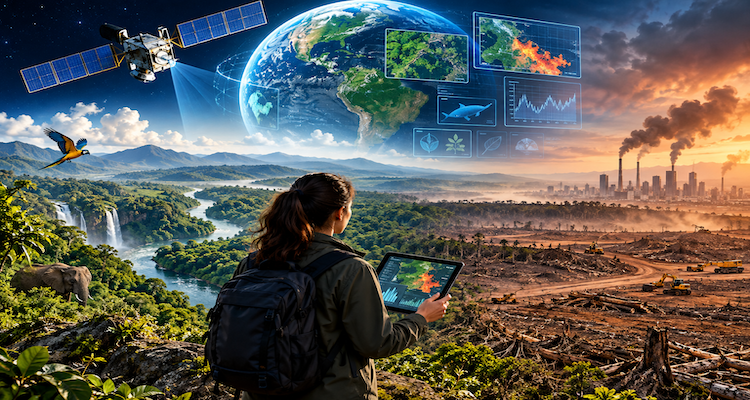
Plants change their growth and chemistry. Animals alter their behavior or disappear from places where they were once common. Microorganisms and larger organisms leave traces of DNA in water and soil. Coral reefs respond to accumulated heat stress. Vegetation reflects changes that satellites can detect from hundreds of kilometers above Earth.
For decades, scientists have learned to treat these changes as evidence rather than background scenery. The result is an increasingly sophisticated form of environmental monitoring in which organisms, ecosystems, satellites, molecular biology and emerging sensors work together to reveal changes that conventional measurements can miss.
The important shift is not that scientists have suddenly learned to “read nature.” They have become better at translating biological signals into measurements that can be compared over time, tested against physical conditions and used to support decisions.
That distinction matters. A signal is not automatically an explanation. But when biological observations are combined with temperature, chemistry, satellite imagery, genetics and long-term records, nature can become an extraordinarily informative monitoring system.
Key Takeaways
- Living organisms can reveal environmental stress that a single physical measurement may miss.
- Environmental DNA lets scientists detect species from biological traces without necessarily capturing or disturbing them.
- Satellites can translate vegetation changes into measurable indicators of plant stress, disturbance and ecosystem dynamics.
- Coral monitoring shows how physical measurements can become early-warning systems for biological damage.
- New bio-inspired sensors aim to expand environmental monitoring into more continuous, distributed measurements.
- Nature’s signals are powerful evidence, but interpreting them requires context, calibration and independent verification.
Nature Has Always Been an Environmental Sensor
One of the oldest scientific ideas in environmental monitoring is surprisingly simple: if organisms respond predictably to environmental conditions, their responses can provide information about the environment.
These organisms or biological processes are known as bioindicators.
A classic example is the canary historically used in coal mines. Its sensitivity to toxic gases made changes in its condition an early indication of dangerous air. Modern bioindicator science is much more sophisticated, covering organisms and biological communities in terrestrial and aquatic ecosystems.
Researchers can use the presence, absence, abundance, physiology or behavior of organisms to investigate environmental conditions. Some species are particularly useful because they respond to changes while still tolerating enough natural variation to provide a meaningful signal.
This gives biological monitoring an important advantage over a single snapshot of temperature or chemical concentration: organisms integrate environmental conditions over time.
That does not make them perfect sensors. Species can respond to several pressures simultaneously, and natural variability can complicate interpretation. A decline in a population, for example, does not automatically identify the cause.
The scientific task is therefore not simply to observe nature, but to determine which biological response is informative, how sensitive it is, and what additional evidence is required to interpret it correctly.
The Hidden Information in a Drop of Water
One of the most revealing developments in environmental science is environmental DNA, or eDNA.
Organisms constantly leave genetic traces behind. DNA can enter water, soil or other environments through shed cells, mucus, feces, reproductive material and other biological sources. Scientists can collect environmental samples and analyze these traces to determine which organisms may have been present.
The approach changes the question scientists can ask.
Instead of always asking, “Can we find the animal?”, researchers can sometimes ask, “What biological traces does this environment contain?”
The distinction is significant for species that are rare, elusive, difficult to capture or distributed across large areas.
The U.S. Geological Survey describes eDNA as a tool for biodiversity studies, detection of threatened or invasive species, ecosystem monitoring and other applications. Its scientists have used environmental DNA to investigate fish, mussels, pollinators and other organisms.
But eDNA is not a magic replacement for field biology.
DNA can move through environments, degrade, or be transported away from the organism that produced it. Detecting DNA can establish evidence of presence without necessarily providing a complete picture of population size, behavior or ecosystem health.
USGS guidance therefore emphasizes using eDNA alongside other forms of evidence rather than treating it as a universal substitute for conventional surveys.
That limitation is also what makes the technology scientifically interesting: its greatest value comes when genetic evidence is integrated with ecological observation rather than isolated from it.
Satellites Are Learning to Read Vegetation
Nature’s signals are not limited to things scientists can touch.
Plants interact with light in measurable ways. Their leaves absorb some wavelengths and reflect others, creating spectral patterns that can be detected remotely.
One of the best-known examples is the Normalized Difference Vegetation Index, or NDVI, which uses visible and near-infrared observations to quantify vegetation characteristics.
NASA has used satellite-based vegetation measurements for decades to study changes in plant growth and environmental conditions. More recent Earth-observation systems are making these measurements more detailed and frequent.
NASA’s Harmonized Landsat Sentinel-2 vegetation-index products combine observations from Landsat and Sentinel-2 satellites. The resulting system provides 30-meter-resolution observations at intervals of roughly one to two days and includes several indices designed to examine different properties, including vegetation greenness, moisture and disturbance.
That matters because “green” is not a complete description of plant health.
Different indices can reveal different aspects of vegetation response. Some are useful for assessing vegetation density or growth, while others are designed to identify water stress, moisture conditions or wildfire-related damage.
The broader lesson is important: scientists are increasingly combining biological processes with remote sensing to observe environmental change across scales that would be impossible to cover through fieldwork alone.
A scientist cannot walk through every forest every day. A satellite can repeatedly observe enormous areas, while ground measurements provide the validation needed to interpret what the satellite sees.
Coral Reefs Show Why Early Signals Matter
Coral reefs provide another powerful example because the biological response can be connected to a clearly measurable physical stressor: heat.
NOAA’s Coral Reef Watch uses satellite observations of sea-surface temperature to monitor thermal conditions associated with coral bleaching. Its products include sea-surface temperature, temperature anomalies, bleaching HotSpots and Degree Heating Weeks, a measure of accumulated thermal stress.
The idea behind accumulated heat stress is particularly useful.
A reef may experience short-term temperature fluctuations without suffering the same consequences as prolonged or repeated exposure to unusually warm water. A measurement that captures accumulated stress can therefore provide information that a single temperature reading cannot.
NOAA has operated satellite-derived coral heat-stress monitoring for decades, with the system evolving from earlier lower-resolution products to current global monitoring products.
In 2026, NOAA also announced a new standard operating procedure for coral-bleaching monitoring and reported that the world’s fourth mass coral-bleaching event likely ended in 2025.
The significance goes beyond coral reefs.
It illustrates a general principle of environmental science: the most useful signal is not always the largest or most visible change. Sometimes it is a measurable pattern that appears before the consequences become obvious.
From Observing Nature to Building Sensors Inspired by It
Scientists are now taking the idea one step further.
Instead of merely observing organisms as indicators, researchers are exploring technologies that borrow principles from living systems or even incorporate biological components into sensing platforms.
A 2024 review in Annual Review of Environment and Resources examined “ecosystem sentinels”organisms and ecological responses that can provide early-warning information about environmental change. The research emphasizes that animals ranging from birds to invertebrates can reveal changes in ecosystem dynamics and, in some circumstances, provide indications of emerging risks.
Meanwhile, researchers are developing biohybrid approaches that combine living organisms with engineered systems.
A study indexed by PubMed investigated biohybrid entities for aquatic monitoring, incorporating organisms such as zebra mussels and water fleas into experimental systems designed to observe stress responses. The researchers described the approach as a potential route toward longer-term aquatic monitoring, while emphasizing that further development would be required.
The newest direction is even more ambitious.
A 2026 paper in Nature Communications described research into distributed, biodegradable, bio-inspired sensors designed to move with environmental flows and measure physical and chemical conditions. The proposed systems target parameters such as temperature, humidity, pH, salinity, dissolved oxygen and pollutants, with the broader goal of mapping environmental conditions across space and time.
These systems remain an emerging research direction rather than a mature replacement for conventional environmental monitoring.
But they point toward a different model of sensing: instead of relying only on fixed instruments, scientists could eventually deploy networks of small, distributed devices capable of following environmental processes.
The Real Breakthrough Is the Combination
It is tempting to describe each technology separately: bioindicators, eDNA, satellites, remote sensors and artificial monitoring systems.
The more important development is what happens when they are combined.
Imagine a river where satellite observations detect changes in surrounding vegetation. Field instruments record unusual temperature or chemical conditions. eDNA reveals a shift in the organisms present. Biological monitoring shows changes in sensitive species.
No individual signal necessarily proves what happened.
Together, however, the evidence can become much stronger.
This is increasingly how biodiversity monitoring is being conceptualized at institutional levels. UNEP describes biodiversity monitoring frameworks as systems for assessing the status and trends of biodiversity over time and using those data to inform policy, conservation and accountability.
IPBES likewise emphasizes that indicators are derived from observations and measurements and can be used to track biodiversity conditions, pressures and outcomes. But indicator quality depends on scientific validity, consistency, transparency and appropriate documentation.
That last point is easy to overlook.
Better sensing does not automatically produce better decisions.
The quality of an environmental conclusion depends on how measurements are collected, processed, compared and interpreted.
Why Nature’s Signals Still Need Scientific Skepticism
Nature does not speak in neatly labeled datasets.
A population can decline because of habitat loss, disease, temperature, predation, pollution or a combination of pressures. Vegetation can change because of drought, seasonal cycles, fire, land management or other disturbances.
That is why environmental indicators need context.
A strong monitoring system should ask:
- Is the observed change outside normal variability?
- Is the measurement consistent across time?
- Can another mechanism explain the same signal?
- Can independent observations confirm it?
- What is the detection limit of the method?
- Does the indicator measure the condition directly or only provide an indirect clue?
These questions protect environmental science from a common mistake: confusing a signal with a diagnosis.
The distinction becomes especially important as monitoring systems become more automated. More sensors and more data can increase coverage, but they can also produce more opportunities for false positives, measurement artifacts and misleading correlations.
The goal is therefore not simply to collect more data.
It is to build evidence that survives scrutiny.
A New Relationship Between Biology and Technology
The emerging environmental-monitoring landscape suggests a subtle change in the relationship between technology and nature.
For much of modern science, instruments were designed to measure the environment from outside it. Thermometers measured temperature. Chemical instruments measured pollutants. Satellites observed landscapes remotely.
Now the boundary is becoming less rigid.
Living organisms can function as indicators. Genetic material can become a source of environmental information. Satellites can detect physiological changes expressed through vegetation. Bio-inspired materials can inform new sensor designs. Experimental biohybrid systems can connect biological responses with electronic measurements.
Technology is not replacing nature’s signals.
It is becoming better at translating them.
That distinction may prove important as environmental change becomes more complex. UNEP has noted both the importance of biodiversity indicators and the continuing gaps in the data needed to understand and track nature’s decline.
The challenge ahead is therefore partly technological, but also methodological: determining which signals matter, how early they can be detected, how confidently they can be interpreted and what action should follow.
Conclusion
Nature has been generating environmental information for billions of years. The modern scientific achievement is learning how to capture that information without mistaking every change for a warning or every correlation for a cause.
The most promising future may not belong to a single sensor, satellite or laboratory technique. It may belong to systems that combine biological signals with molecular evidence, remote sensing, physical measurements and carefully validated models.
That approach changes the role of environmental science.
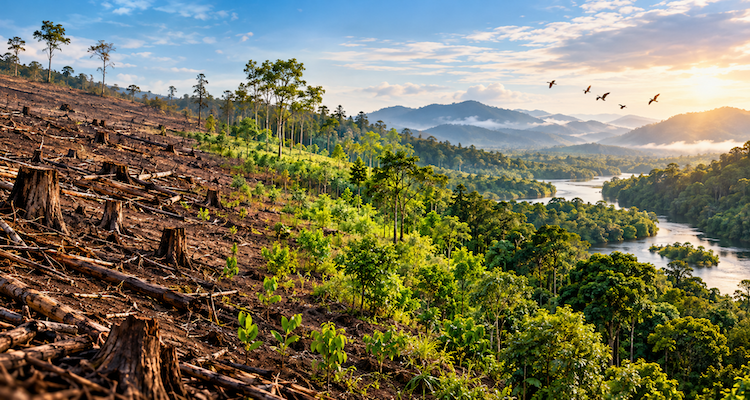
Instead of waiting until ecological damage becomes visually obvious, researchers can increasingly look for the smaller signals that precede it.
The objective is not to make nature speak louder.
It is to become better at listening.
This content is published for informational or entertainment purposes. Facts, opinions, or references may evolve over time, and readers are encouraged to verify details from reliable sources.