









Why More Young Adults Are Replacing Religious Labels With Personal Spiritual Frameworks
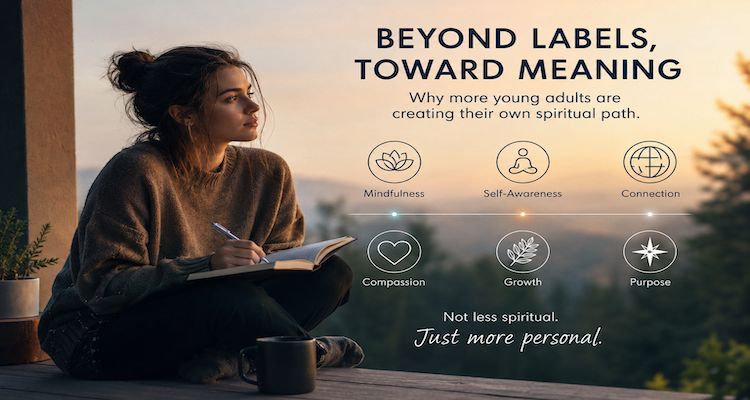
For many young adults, stepping away from an organized religion does not necessarily mean stepping away from questions about meaning, purpose, morality or transcendence. Increasingly, the change appears to be less about abandoning spirituality altogether and more about deciding who gets to define it.
The distinction matters. In the United States, younger adults are substantially less likely than older adults to identify with a religion, attend religious services or pray regularly. Yet research also finds that spiritual beliefs remain widespread, including among people who describe themselves as religiously unaffiliated. Pew Research Center’s 2023-24 Religious Landscape Study found that 43% of adults ages 18 to 24 were religiously unaffiliated, compared with 13% of adults ages 74 and older. At the same time, the age differences in several measures of spirituality were considerably smaller than the differences in traditional religious practice.
That suggests a more complicated cultural shift than simply “young people are becoming less religious.” Some are becoming secular. Some remain committed to traditional faith. Others are constructing more individualized approaches that borrow from religious traditions, meditation, nature, philosophy or personal reflection without adopting a formal religious identity.
Key Takeaways
- Young adults are less attached to organized religion, but that does not mean they have abandoned spiritual questions.
- “Religiously unaffiliated” describes an identity, not necessarily a lack of belief, ritual or spiritual curiosity.
- Personal spirituality can give people flexibility while avoiding institutions they distrust or no longer find meaningful.
- Research suggests young adults are not one homogeneous group: some reject religion, while others personalize or recombine inherited traditions.
- The important shift may be from institutional belonging toward individually constructed meaning rather than from belief toward disbelief.
- This trend is particularly visible in the United States, while international patterns vary considerably by country and culture.
The Numbers Show a Decline in Religious Affiliation Not the Disappearance of Spirituality
The clearest evidence comes from the changing religious profile of younger Americans.
Pew’s 2023-24 Religious Landscape Study found that only 46% of Americans ages 18 to 24 identified as Christian, compared with 80% among adults ages 74 and older. Young adults were also substantially less likely to pray daily or attend religious services at least monthly. Meanwhile, 43% of 18- to 24-year-olds identified as religiously unaffiliated.
But “unaffiliated” is an umbrella category. It includes atheists, agnostics and people who describe their religion as “nothing in particular.” It therefore cannot be treated as synonymous with atheist or secular.
Pew’s research on spirituality illustrates why. In a 2023 survey of 11,201 U.S. adults, 70% qualified as spiritual in some way because they either considered themselves spiritual or said spirituality was very important to them. Twenty-two percent were classified as “spiritual but not religious.”
That creates an important distinction:
Religious affiliation asks, “What tradition or institution do you belong to?”
Spirituality can ask, “What do you believe, practice or experience?”
For some young adults, the first question has become less compelling without eliminating the second.
“Religiously Unaffiliated” Does Not Mean “Nothing Matters”
One of the easiest mistakes in covering this trend is treating the religiously unaffiliated as a single cultural group.
They are not.
Pew’s research found substantial variation among people who identify as “nones.” Some reject religious belief altogether. Others retain belief in God or a higher power. Some maintain spiritual practices even without belonging to a religious community.
The 2023 Pew spirituality study found that 81% of U.S. adults believe there is something spiritual beyond the natural world, while 83% believe humans have a soul or spirit in addition to their physical body. Even among people classified as spiritual but not religious, many hold beliefs that would traditionally be associated with religion.
The result is a cultural landscape in which institutional membership and spiritual belief no longer necessarily move together.
Someone can reject church attendance while believing in transcendence. Someone can reject religious authority while maintaining prayer or meditation. Someone can be deeply interested in Buddhist philosophy without becoming Buddhist.
The category itself has become more difficult to define.
Why the Religious Label Can Feel Less Useful
There is no single explanation for why young adults move away from organized religion.
Pew’s research among U.S. religious “nones” offers several clues. Sixty percent said questioning religious teachings was an extremely or very important reason they were nonreligious. Forty-seven percent cited dislike of religious organizations, while 30% cited bad experiences with religious people. Younger nones were more likely than older nones to say they simply did not see a need for religion in their lives.
These findings point to two different processes.
The first is intellectual disengagement: a person no longer accepts the teachings of the tradition in which they were raised.
The second is institutional disengagement: a person may still be interested in spirituality but no longer believes a religious organization is necessary for pursuing it.
Those two processes can overlap, but they are not identical.
This helps explain why a person can leave a church without becoming indifferent to questions about death, consciousness, morality, purpose or transcendence.
Personal Spirituality Is Often Less a New Belief System Than a New Way of Choosing
The phrase “personal spiritual framework” can sound as though young adults are inventing entirely new religions for themselves.
The evidence is more nuanced.
Research on young adults has documented people combining elements from different traditions, maintaining personal beliefs outside formal institutions, or moving between religious, spiritual and secular identities. Scholars Tim Clydesdale and Kathleen Garces-Foley, for example, describe several types of young religious “nones,” including people who are secular, indifferent to religion, spiritually eclectic or still hold religious beliefs without formal affiliation.
That eclecticism matters.
A personal framework might involve:
- meditation without membership in a religious community;
- prayer without regular institutional participation;
- philosophical readings about meaning and ethics;
- spending time in nature as a spiritual practice;
- drawing selectively from multiple traditions;
- mindfulness or contemplative practices;
- belief in a higher power without commitment to a specific theology;
- or simply maintaining a personal set of principles about how to live.
None of these automatically makes someone “spiritual but not religious.” The point is that the boundaries between religious, spiritual and secular identities are becoming less tidy.
The Shift Is Also About Authority
Perhaps the deeper change is not simply what young adults believe, but where they believe authority should come from.
Traditional religion often provides a package: doctrine, community, ritual, moral teachings, history and institutional authority.
A personal spiritual framework separates those components.
A person might retain meditation but reject doctrine. They might retain moral teachings but reject religious hierarchy. They might value ritual while rejecting membership. Or they might treat different traditions as sources of insight rather than as mutually exclusive systems.
Scholars studying American young adults have observed this tendency toward personalization and customization of religious life. Research published through Oxford University Press has described young adults as increasingly personalizing, compartmentalizing and adapting religious ideas to their individual circumstances.
That does not mean every young adult consciously designs a spiritual philosophy. Often the process is gradual.
A person stops attending services. Certain inherited beliefs become less convincing. Meditation becomes useful. A philosophical idea resonates. A family tradition remains meaningful. Years later, the person may have a coherent set of practices and beliefs but no single label that describes them.
There Is a Difference Between Freedom and Fragmentation
Personal spirituality offers an obvious attraction: autonomy.
People can explore ideas without formally converting, participate without joining, and question without being required to resolve every doubt.
But the same flexibility has a potential cost.
Religious institutions traditionally provide communities, shared rituals, established practices and intergenerational relationships. An individualized spiritual life may offer freedom while providing less built-in social structure.
Pew’s 2023 research illustrates this distinction. Only 2% of people classified as spiritual but not religious said they attended religious services weekly or more often, compared with 40% of Americans who were both religious and spiritual. Spiritual-but-not-religious adults were also less likely to report belonging to a spiritual community that was extremely or very important to them.
This does not prove that individualized spirituality produces social isolation. It does, however, highlight an important trade-off: a framework can be personally meaningful without necessarily creating the same community infrastructure as an institution.
That distinction is often missing from simplistic discussions about the decline of religion.
Young Adults Are Not Simply Walking Away From Meaning
The most revealing finding may therefore be what has not disappeared.
Even as traditional religious affiliation declines among younger Americans, spiritual questions remain.
Pew’s 2025 analysis found that young adults were less religious than older Americans by conventional measures, but age differences were smaller on several questions concerning spirituality. Among religiously unaffiliated Americans who said they had become more spiritual during their lives, spiritual beliefs and experiences remained part of their lives despite their lack of religious affiliation.
International evidence points in a similar direction, although with substantial variation between countries. Pew’s cross-national research has found that many religiously unaffiliated adults in different societies retain beliefs about spirituality, nature or forces beyond the natural world. The precise pattern varies by country, so the American experience should not simply be projected onto the rest of the world.
This is why the familiar binary of religious versus nonreligious is increasingly inadequate for describing contemporary spiritual life.
There are more positions between those poles than the labels suggest.
What This Could Mean for Religion, Culture and Community
The long-term implication is not necessarily that religion will disappear.
The evidence does not support such a simple prediction.
Instead, religious institutions may increasingly compete with a much larger marketplace of meaning: secular philosophy, wellness practices, online communities, meditation traditions, personal development, nature-based practices and individualized forms of faith.
Some young adults may eventually return to organized religion. Others may deepen a spiritual practice. Some will become more firmly secular. Some will move between several positions over their lifetimes.
Recent evidence also cautions against assuming that religious decline is accelerating indefinitely. Pew’s 2023-24 study found that the long rise in religious disaffiliation in the United States had leveled off at least temporarily, even though younger generations remained substantially less religious than older ones.
The more durable change may therefore be the normalization of religious fluidity.
A religious identity that once functioned as a relatively stable inheritance can increasingly become something people examine, modify, leave, recover or combine with other influences.
The New Question May Be Less “Are Young People Religious?”
For decades, discussions of youth and religion have tended to ask whether younger generations are becoming more or less religious.
That question still matters, but it misses part of the transformation.
A more revealing question is: How are young adults deciding what deserves a place in their inner lives?
For some, the answer remains a church, mosque, synagogue, temple or another religious community. For others, the answer is atheism or agnosticism. For another group, it is a personal combination of beliefs and practices that does not fit comfortably inside an institutional category.
The emerging landscape is therefore not simply one in which religion is being replaced by spirituality.
It is one in which institutional affiliation, personal belief, spiritual practice and social identity are becoming less tightly connected.
That makes the change harder to measure—and more significant to understand. The religious label may be disappearing for some young adults, but the human search for meaning has not disappeared with it.
Conclusion
The strongest evidence does not support the idea that young adults are collectively abandoning belief. It shows something more complicated: traditional religious affiliation and practice have weakened among younger generations, while spiritual beliefs and meaning-making continue to exist in many different forms.
For WIOBS readers, the important distinction is between leaving an institution and leaving the search for meaning. They are not the same decision.
The rise of personal spiritual frameworks reflects a broader cultural movement toward individual choice: people increasingly want to decide which beliefs, practices and communities belong in their lives rather than accepting an inherited package unchanged.
Whether that produces a more thoughtful spiritual culture, a more fragmented one, or simply a different way of organizing human meaning remains an open question. What is already clear is that the old categories are becoming less capable of describing how many people actually live.
This content is published for informational or entertainment purposes. Facts, opinions, or references may evolve over time, and readers are encouraged to verify details from reliable sources.
Related News
- Why Mark Zuckerberg Visited Kainchi Dham: The Neem Karoli Baba Connection Behind a Silicon Valley Story
- Kainchi Dham: How a Himalayan Ashram Became a Global Spiritual Landmark
- How Religious Architecture Continues to Shape Human Emotions Long After Belief Fades
- The New Search for Silence and Why It Is Becoming a Spiritual Movement