









Why Looking at the Same Object for Too Long Can Make It Feel Wrong
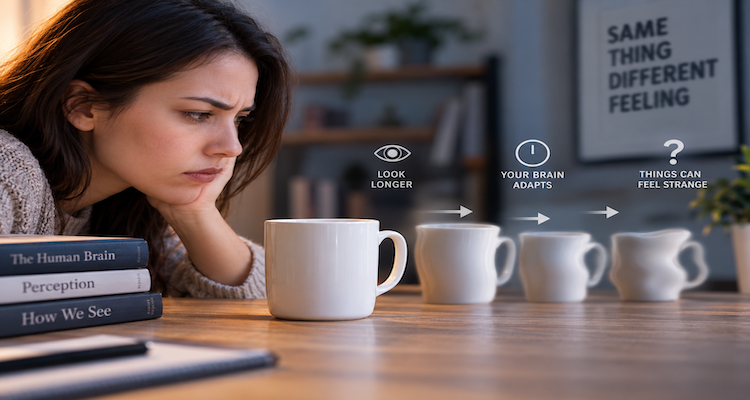
There are moments when something completely familiar suddenly looks strange. A face can seem subtly distorted. A word can stop looking like a real word. An object that has been sitting in front of you for years can, after prolonged attention, acquire an oddly unfamiliar quality.
The experience is not necessarily a sign that the object has changed. In many cases, the change is happening in perception itself.
Visual neuroscience has long documented a phenomenon called Troxler fading, in which stationary visual information particularly low-contrast information in peripheral vision can gradually disappear from conscious awareness when gaze is held unusually steady. Research on visual adaptation also shows that prolonged exposure can alter how subsequent shapes, faces and other visual features are perceived.
There is an important distinction, however: staring at something does not simply make the brain “tired.” The visual system is continuously adapting to what it considers stable information, while tiny eye movements, attention and higher-level interpretation help keep the percept fresh.
Key Takeaways
- Prolonged fixation can make stationary visual information fade from conscious awareness through perceptual adaptation.
- Tiny eye movements help refresh visual information and can restore features that have begun to disappear.
- Adaptation can affect complex perceptions, including faces, not just simple lines, colors or shapes.
- A familiar object can feel unfamiliar without physically changing because perception depends partly on neural adaptation and context.
- Repetition can also produce jamais vu, a separate experience in which something familiar temporarily feels strange or unfamiliar.
The Brain Does Not See a Perfectly Continuous Picture
It is tempting to imagine vision as a camera continuously recording everything in front of the eyes. Human perception does not work that way.
The visual system is highly responsive to change. Information that remains constant can produce progressively smaller neural responses as sensory systems adapt. This is useful because the environment contains enormous amounts of stable information background surfaces, stationary objects, illumination and other features that do not need to receive equal processing indefinitely.
Eye movements are therefore important. Even when someone appears to stare at one point, the eyes are not perfectly motionless. Small involuntary movements continually shift the image across the retina.
When fixation becomes unusually stable, certain visual signals can begin to fade. This is particularly noticeable when the target is peripheral, relatively low in contrast and surrounded by a relatively uniform background.
The resulting experience can be surprisingly dramatic: an object or part of an object seems to disappear even though the eyes remain open and the stimulus has not physically changed.
The Troxler Effect: When Something Visible Starts to Disappear
The phenomenon is known as Troxler fading, named after Swiss physician and philosopher Ignaz Paul Troxler, who described the effect in the early 19th century.
A classic demonstration involves fixing the gaze on a central point while paying attention to a nearby stationary, low-contrast shape. After some time, the peripheral shape may become less distinct or appear to vanish.
A small shift of the eyes can make it return.
That behavior provides an important clue. The disappearance is not simply the object becoming invisible to the eyes. Instead, the stability of the retinal image and the brain’s adaptation to unchanging stimulation appear to play an important role.
Research has also complicated the original explanation. Visual fading cannot always be reduced to a single mechanism involving retinal adaptation. Work on attention, cortical feedback, eye movements and perceptual filling-in has shown that several processes can contribute to what we experience.
In other words, the brain is not merely switching a visual signal off. It is continuously deciding how much importance to give information that has remained stable.
Why Tiny Eye Movements Matter
The eyes are constantly making small movements, even when a person attempts to maintain fixation.
These movements are normally so subtle that we do not notice them. Yet they can make an important difference to perception.
When the image of a stationary feature shifts slightly across the retina, the visual system receives a change in stimulation. That can help prevent the feature from completely fading from awareness.
This helps explain why deliberately staring at something can produce an experience that ordinary looking does not.
Normal vision involves exploration. The eyes move from one location to another, briefly stabilize, gather information and move again. A prolonged fixed gaze removes much of that natural variation.
Recent research on natural scene viewing also suggests that fixation duration is more complicated than a simple measure of how much visual processing is occurring. A 2026 study using eye tracking, magnetoencephalography and computational modeling found that longer fixations were associated with memory-encoding processes rather than simply reflecting prolonged visual processing of difficult image regions.
That finding reinforces a broader point: looking longer does not necessarily mean seeing more clearly.
It Can Happen With More Than Simple Shapes
Troxler fading is not limited to laboratory dots and geometric patterns.
Researchers have demonstrated visual fading with complex photographic scenes under carefully controlled fixation conditions. In a 2006 study, entire photographs could fade perceptually under certain fixation and contrast conditions.
This matters because it shows that perceptual adaptation can operate at a more complicated level than simply making a tiny dot disappear.
The brain’s interpretation of a scene is constructed from many interacting signals. When some of those signals become stable, adaptation can alter the balance between what remains prominent and what becomes less noticeable.
That can make prolonged looking feel surprisingly different from ordinary observation.
Why a Familiar Face Can Start Looking Strange
Faces provide an even more interesting example.
Scientists have studied face adaptation, in which prolonged exposure to a particular face or facial distortion changes how subsequent faces are perceived. These aftereffects can influence judgments of identity, viewpoint and facial appearance.
For example, after prolonged exposure to a distorted version of a face, a normal version can appear biased in the opposite direction. Researchers have found that these effects are not restricted to the exact image that was viewed during adaptation.
This suggests that the visual system does not treat every photograph as an isolated collection of pixels. Higher-level representations of faces can also adapt.
Familiarity matters too. Research has found that the strength and transfer of some face-adaptation effects can depend on how familiar the face is to the observer.
This provides one explanation for why a face can occasionally acquire an uncanny quality after unusually prolonged inspection. The face has not changed. The perceptual system has changed its response to the information being repeatedly presented.
That does not mean prolonged staring normally causes a lasting distortion of someone’s appearance. These are controlled perceptual aftereffects, and ordinary viewing is very different from laboratory adaptation experiments.
The Strange Feeling Is Not Always Visual Fading
There is another phenomenon that sounds similar but involves a different experience.
Jamais vu describes the feeling that something familiar has suddenly become unfamiliar or strange. It is often described as the opposite of déjà vu.
Researchers have experimentally investigated this effect by asking participants to repeatedly write familiar words. In one study, many participants eventually reported that the repeated word began to feel peculiar or unfamiliar, with the effect often emerging after roughly a minute of repetition.
This is not the same thing as Troxler fading.
Troxler fading concerns the disappearance or weakening of visual information during prolonged fixation. Jamais vu concerns a disruption in the subjective sense of familiarity.
The two experiences nevertheless illustrate a common principle: familiarity is not a permanent property attached to an object. It is something the brain actively constructs and maintains.
Why Repetition Can Change Familiarity
Repeated exposure normally strengthens familiarity. But extreme repetition can have the opposite subjective effect.
One explanation is that repeating the same perceptual or linguistic information places unusual demands on processes that normally operate automatically. A familiar word, for example, is ordinarily recognized without conscious inspection of every letter. Repeating it again and again can disrupt that automatic relationship between its appearance, sound and meaning.
The result can be a peculiar feeling: the word is still recognizable, but temporarily stops feeling like a normal word.
The same general lesson applies to prolonged visual inspection. Our everyday perception is optimized for interacting with a changing environment, not for consciously examining one unchanging stimulus indefinitely.
The Important Distinction Between Perception and Reality
Perhaps the most useful lesson is also the simplest.
When an object suddenly looks wrong after prolonged observation, that does not mean the object has physically changed.
Human perception is an active process. The brain combines incoming sensory information with adaptation, attention, previous knowledge, memory and expectations. Altering the conditions under which information is viewed can therefore alter the resulting experience.
This is why optical illusions are possible, why afterimages occur, why peripheral information can fade during fixation and why familiar things can occasionally feel unfamiliar.
The experience is real. The interpretation of the experience can be different.
What This Reveals About Everyday Vision
The strange feeling produced by prolonged staring is a small demonstration of a much larger feature of human perception: we do not experience the world by passively recording it.
Instead, the visual system continuously samples information, adapts to stable signals, emphasizes changes and combines sensory input with higher-level representations.
That system is extremely effective for everyday life. It allows people to navigate environments without consciously processing every unchanged detail.
But when we deliberately defeat some of those normal conditions by staring at one point, repeating a word dozens of times or repeatedly examining the same face the machinery of perception can become noticeable.
The object has not necessarily become strange.
Our relationship with the object has changed.
Conclusion
Looking at the same object for too long can make it feel wrong because perception is not a static recording of reality. Prolonged fixation can produce visual fading, while perceptual adaptation can alter the appearance of faces and other complex stimuli. Repetition can also temporarily disrupt familiarity, producing experiences such as jamais vu.
These effects are useful reminders that seeing is an active biological process. The brain is constantly adapting to what stays the same, responding to what changes and deciding which information deserves continued attention.
The next time a familiar object suddenly looks oddly unfamiliar after staring at it for too long, the mystery may not be in the object at all. It may be a brief glimpse of the machinery that normally remains invisible behind ordinary vision.
This content is published for informational or entertainment purposes. Facts, opinions, or references may evolve over time, and readers are encouraged to verify details from reliable sources.