








Why Modern Devices Are Easier to Use and Harder to Understand
A smartphone can unlock with a glance, pair with headphones almost instantly, translate speech in real time, restore apps after a device upgrade and quietly update itself overnight. For most people, that is exactly what good technology should do: remove friction.
But there is a trade-off hidden inside that convenience. As devices become better at managing complexity for us, more of the underlying system disappears from view. A user may know what to tap without knowing what the device is actually doing.
That distinction matters. Modern usability is increasingly built around abstraction, automation and carefully controlled interfaces. Design research has long recognized the value of hiding rarely used options through “progressive disclosure,” allowing people to complete common tasks without confronting the full complexity of a system.
The result is a curious technological paradox: devices can become easier to operate while becoming harder to understand, repair, troubleshoot or control at a deeper level.
Key Takeaways
- Modern interfaces hide technical complexity so users can complete common tasks with fewer decisions.
- Automation improves convenience but can make system behavior less visible when something goes wrong.
- Repair increasingly involves software, diagnostics and component authentication, not just physical replacement.
- New EU smartphone rules show that durability and repairability are becoming measurable product characteristics.
- Understanding technology now requires knowing not only how to operate a device, but also where its hidden dependencies lie.
The Interface Has Become the Simplest Part
Consider what happens when someone buys a new smartphone.
Years ago, setting up a device could involve transferring files manually, installing applications individually and configuring numerous settings. Today, much of that process can happen through an account, cloud backup or automated setup.
The user sees a sequence of simple prompts.
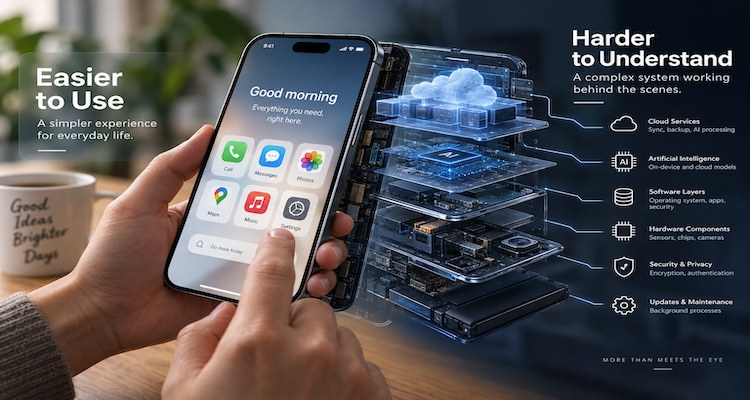
Behind those prompts may be authentication services, encrypted connections, operating-system processes, cloud storage, application permissions, synchronization systems and hardware compatibility checks.
The interface deliberately hides most of that.
This is not necessarily a weakness. It is one of the central achievements of modern interface design.
Nielsen Norman Group’s principles of progressive disclosure recommend presenting the most important options first while moving advanced or infrequently used controls elsewhere. The purpose is to reduce cognitive load and make complex applications easier to learn and use.
The important distinction is that hidden complexity has not disappeared. It has simply moved behind the interface.
Convenience Depends on Abstraction
Abstraction is one of computing’s most powerful ideas.
A person can press a camera button without understanding image sensors, computational photography, exposure algorithms, autofocus systems or image processing.
Someone can tap “Pay” without understanding the entire chain of authentication and transaction processing underneath.
A driver can use navigation without knowing how satellite positioning, map databases, routing algorithms and network services interact.
This arrangement works because users generally do not need to understand every layer.
The problem appears when something stops working.
Then the simplicity of the interface can become a barrier.
A phone might say that an accessory is unavailable, a payment cannot be completed, storage is insufficient or a component requires attention. The message may tell the user what happened, but not necessarily why the underlying system reached that state.
That is why visibility of system status remains a fundamental usability principle. Nielsen Norman Group notes that timely feedback helps users understand what happened after an interaction and decide what to do next.
The best interfaces therefore do not merely hide complexity. They hide it without hiding the information users need when something goes wrong.
Automation Changes the User’s Relationship With Technology
Automation is another reason modern devices can feel simultaneously simpler and more mysterious.
A modern device makes decisions continuously.
It may manage background processes, optimize battery use, synchronize data, select wireless connections, apply security protections, organize photographs, suggest actions or adjust performance.
Most of those decisions never require user intervention.
That is useful because human attention is limited. Few people want to manually manage every background process on a phone.
But automation creates a new requirement: users need understandable explanations when automated behavior affects them.
For example, knowing that a battery-saving feature is active can be more useful than simply seeing that an application behaves differently. Similarly, understanding why a device cannot complete an action can be more valuable than receiving a generic error notification.
The challenge for designers is therefore not to expose every technical detail. That would recreate the complexity the interface was designed to remove.
It is to expose the right explanation at the right moment.
Repair Is Where Hidden Complexity Becomes Visible
The difference between using technology and understanding technology becomes especially obvious when a device needs repair.
Replacing a physical component is increasingly connected to software, diagnostics and device configuration.
Apple, for example, provides Independent Repair Providers with access to genuine parts, tools, training, service guides and diagnostics. Its Self Service Repair program is specifically aimed at people with the knowledge and experience required to handle the complexities of electronic-device repair.
This illustrates an important shift.
A modern electronic device is not simply a collection of interchangeable physical parts. Hardware and software increasingly operate as an integrated system.
That does not mean every repair is inaccessible or that manufacturers universally prevent repair. In fact, repair programs and regulations are moving in the opposite direction in some markets.
But it does mean that technical literacy for consumers is changing.
Understanding a device increasingly involves knowing about software support, diagnostics, component compatibility, firmware and update policies alongside traditional hardware concepts.
The EU Is Turning Repairability Into a Product Characteristic
This shift is also visible in regulation.
Since June 20, 2025, new EU ecodesign and energy-labelling requirements have applied to smartphones and slate tablets placed on the EU market. The rules address durability, batteries, repair, spare parts, software updates and information available to consumers.
Among other requirements, manufacturers must provide critical spare parts to professional repairers within specified timeframes and make them available for years after a model stops being sold. The rules also require longer operating-system update availability and access to software or firmware needed by professional repairers.
The regulations introduce another notable concept: a repairability class.
That matters because repairability has traditionally been difficult for consumers to evaluate before buying a device. A product can look simple from the outside while its internal repair process may involve specialized tools, complicated disassembly or software procedures.
The EU approach attempts to make at least some of that hidden complexity visible.
Easier Operation Does Not Necessarily Mean Greater Understanding
There is a temptation to describe this development as a problem with modern technology.
That would be too simple.
Most people do not want to become electronics engineers just to use a phone. Abstraction is essential to computing, and hiding unnecessary complexity is often exactly what makes technology accessible.
The more useful question is different:
What information should remain visible when the user needs to make a decision?
A good interface can hide implementation details while still communicating consequences.
For example, users may not need to know how an operating system manages memory. They may, however, need to know why an application cannot access storage.
They may not need to understand battery chemistry. They may need to know that battery health has deteriorated and what replacement options exist.
They may not need to understand every authentication protocol. They need to know when an account, permission or security setting is preventing an action.
This is the difference between simplicity of operation and transparency of operation.
The first reduces effort.
The second preserves understanding and control.
What This Means for Consumers
The changing nature of technology suggests that digital literacy should evolve beyond knowing where buttons are located.
Consumers increasingly benefit from understanding a few underlying concepts:
- Updates: How long a device receives security and operating-system support.
- Accounts: Which services depend on cloud accounts and what happens if access is lost.
- Permissions: Which applications can access sensitive functions or information.
- Backups: What is actually backed up and what still exists only on the device.
- Repairability: Whether batteries, displays and other important components can realistically be replaced.
- Dependencies: Which features require internet access, another device, a subscription or a specific service.
- Diagnostics: What information the device provides when something fails.
These are not specialist skills in the traditional sense. They are becoming part of everyday technological literacy.
The Next Stage of Usability Is About Trust
The strongest devices may not be those that expose the most information or those that hide the most.
They will be the ones that know when to hide complexity and when to reveal it.
That principle is already embedded in established usability thinking. Progressive disclosure works because most users should not have to confront every available option. But the same design philosophy recognizes that advanced information must remain accessible when it becomes relevant.
This becomes particularly important as devices gain more automation and as software becomes more deeply connected to physical hardware.
A simple interface can make technology approachable.
A transparent interface can make it trustworthy.
The difference will matter increasingly as consumers move from merely operating their devices to making decisions about privacy, longevity, repair, security and ownership.
Conclusion
Modern technology has become remarkably good at making difficult tasks feel easy. That achievement should not be confused with technological simplicity.
The complexity is still there in software layers, cloud services, automated decisions, hardware dependencies, diagnostics and repair processes. The interface simply places much of it behind the scenes.
That is useful until the user needs to understand what happened, why it happened or what can be done about it.
The next evolution of user-friendly technology may therefore depend on a more subtle goal than simplicity alone: technology that is easy when users want convenience, but understandable when they need control.
For consumers, that means learning to look beyond the interface. For manufacturers and designers, it means recognizing that hiding complexity should never mean hiding the information people need to make informed decisions.
The information presented in this article is based on publicly available sources, reports, and factual material available at the time of publication. While efforts are made to ensure accuracy, details may change as new information emerges. The content is provided for general informational purposes only, and readers are advised to verify facts independently where necessary.