






When Health Tracking Starts to Feel Like Health Watching
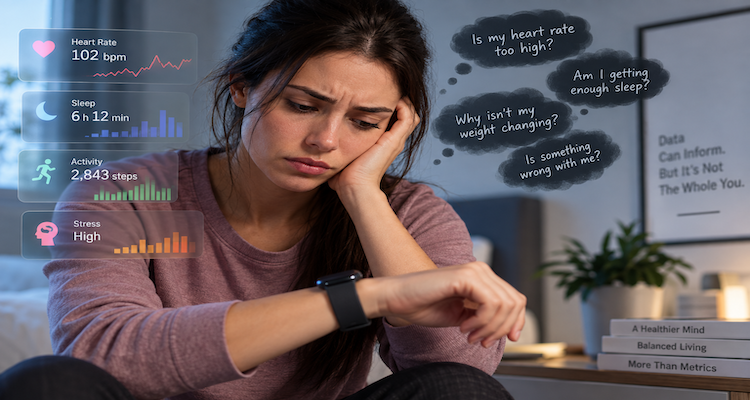
A smartwatch can tell you your heart rate, sleep duration, activity level and, on some devices, changes in heart rhythm. The promise is straightforward: better information should help people understand their health and make better decisions.
But more information is not automatically more reassurance.
For some people, repeatedly checking health metrics can turn ordinary bodily fluctuations into something that feels like a problem requiring investigation. A slightly higher heart rate, a poor sleep score or an unexpected notification can become the beginning of another round of checking, searching and worrying.
Research does not show that health tracking universally causes anxiety. In fact, wearable technology has genuine potential for monitoring physiological patterns and supporting healthcare. The more important question is how people interpret the information and whether tracking becomes useful observation or a form of repeated health checking.
Key Takeaways
- Wearables can provide useful health information, but individual readings are not automatically medical diagnoses.
- Continuous monitoring may encourage some people to pay unusually close attention to normal bodily fluctuations.
- Health anxiety is associated with repeated body checking and reassurance-seeking behaviors.
- Recent research suggests the psychological effects of smartwatch use can vary according to health status and individual circumstances.
- Wearable technology may be more useful when its data are interpreted alongside clinical information rather than in isolation.
- A healthy tracking habit should support decisions without making every number feel like a potential warning.
The Information Paradox of Wearable Health Technology
Health tracking has changed the relationship many people have with their bodies.
Previously, someone might notice that their heart was beating faster after climbing stairs. A smartwatch can now quantify that change, display it on a graph and compare it with previous measurements.
That can be valuable. Patterns that are difficult to remember can become visible over days or weeks. Activity levels, sleep patterns and other measurements can provide useful information for conversations with healthcare professionals.
The problem begins when every measurement is treated as a verdict.
Heart rate changes naturally with exercise, stress, caffeine, temperature, sleep, posture and many other factors. Sleep also varies from night to night. Yet a person who becomes highly focused on health data may interpret a deviation from a preferred number as evidence that something is wrong.
The device may simply be measuring a fluctuation. The user may experience it as a warning.
That distinction matters.
The U.S. Food and Drug Administration notes that consumer wearables can monitor measures such as physical activity, heart rate and heart rhythm, while also distinguishing wellness functions from technologies intended for medical purposes. Some wearable notifications can be useful prompts for seeking professional assessment, but the measurement itself should not automatically be treated as a diagnosis.
When Monitoring Becomes Body Checking
There is a psychological difference between checking information occasionally and repeatedly checking for reassurance.
The NHS describes health anxiety as excessive worry about being ill or becoming ill. Its examples include frequently checking the body for signs of illness, seeking reassurance and repeatedly searching for health information.
That framework helps explain why a health tracker can become stressful for some users.
Imagine a person notices an unusual heart-rate reading. They check it again. Then again ten minutes later. They search online for possible explanations. They check another health metric. A new reading appears, producing another question.
The technology has not necessarily created the original worry. Instead, it may provide an almost unlimited supply of new opportunities to check.
A 2025 systematic review of body-checking behavior found that repeated evaluation of one’s body occurs across conditions including illness anxiety disorder, eating disorders and body dysmorphic disorder. The researchers noted that the short- and long-term psychological effects are more complicated than a simple assumption that checking always produces immediate relief followed by greater anxiety.
The distinction is important because not everyone who checks a smartwatch is experiencing health anxiety. Routine tracking can be completely ordinary. Concern becomes more relevant when checking begins to consume attention, repeatedly demands reassurance or interferes with normal activities.
The Number Is Real, But Its Meaning May Not Be
One of the biggest challenges with wearable data is that a measurement and its interpretation are not the same thing.
A device might detect a change in heart rate. That does not establish why the change occurred.
Similarly, a sleep tracker may estimate changes in sleep behavior without providing the complete clinical picture of a person’s sleep health.
This is one reason researchers continue to study how wearable measurements should be interpreted.
A 2026 systematic review and meta-analysis of wrist-worn wearable data and anxiety found associations between higher heart rate, lower physical activity and greater anxiety symptoms in the available research. However, the researchers also concluded that wearable-derived measures may be more useful when combined with other information, such as self-reported symptoms and clinical data, rather than treated as stand-alone screening tools.
In other words, the same number can mean very different things depending on context.
That is especially relevant as companies increasingly use algorithms and artificial intelligence to transform raw physiological signals into interpretations about stress, recovery or emotional states.
AI Can Find Patterns But That Does Not Mean It Understands the Person
Wearable technology is increasingly being combined with machine learning to identify patterns associated with anxiety.
A 2026 systematic review of 26 studies examining wearable-based anxiety detection found that approaches combining multiple physiological signals performed better than approaches using a single signal. But the researchers also highlighted substantial methodological variation and the need for larger and more standardized research.
Earlier research has reached a similar caution. A systematic review and meta-analysis of wearable AI for anxiety detection found promising performance but concluded that the technology was not yet sufficiently advanced for clinical use as a replacement for broader assessment.
This distinction is crucial for consumers.
An algorithm can detect a statistical pattern without knowing the complete circumstances behind it. A higher heart rate could occur because someone is exercising, drinking coffee, feeling excited, experiencing stress or dealing with a medical issue. Context determines meaning.
The danger is not necessarily that the algorithm is useless. It is that people may assign more certainty to its output than the evidence supports.
Some People May Be More Vulnerable to the Checking Cycle
The psychological response to tracking is unlikely to be identical for everyone.
A person who enjoys long-term fitness trends may look at a weekly activity graph and move on. Someone already worried about their health may interpret the same dashboard very differently.
Research published in 2026 examined the relationship between smartwatch use, health conditions, gender and health anxiety among 259 participants. The study found interactions between these factors, with associations between smartwatch use and health-anxiety scores differing across groups.
Because the study was cross-sectional, it cannot establish that smartwatch use caused health anxiety. It does, however, reinforce an important point: the psychological effects of wearable technology cannot necessarily be understood by asking whether tracking is simply “good” or “bad.”
The individual using the technology matters.
When Health Tracking Is Helpful
Health tracking can serve a useful purpose when it answers a practical question rather than generating endless questions.
For example, someone may use activity data to understand whether they are becoming more active over time. Sleep information may help identify a pattern worth discussing with a healthcare professional. A medically relevant wearable feature may provide information that contributes to clinical monitoring when used appropriately.
The strongest use of tracking is often trend-based rather than moment-based.
A single unusual number may have little meaning. A persistent pattern, combined with symptoms and appropriate medical evaluation, can be more informative.
That does not mean people should ignore concerning symptoms simply because a wearable looks normal. Nor should they assume something is medically wrong because an app produces an unexpected score.
Wearables are tools for information not substitutes for clinical judgment.
How to Track Health Without Letting the Numbers Take Over
For people who notice that health tracking is increasing rather than reducing worry, changing the tracking habit may help.
Track fewer things
Not every available metric needs to be monitored. Choose information that has a clear purpose.
Look for trends instead of reacting to every reading
Day-to-day variation is normal. A longer-term pattern may be more meaningful than a single measurement.
Avoid repeated reassurance checking
If a reading produces anxiety, repeatedly checking it may keep attention locked onto the concern rather than resolving it.
Put alerts into context
A notification is a prompt to consider what is happening, not automatically a diagnosis.
Talk to a healthcare professional when concern persists
If health worries are interfering with daily life, sleep, exercise or normal activities, the issue may deserve attention independently of what a wearable reports.
The NHS specifically recommends seeking medical help when health worries are preventing someone from living normally or when self-help is not working.
The Future of Health Tracking May Need Less Data, Not Just More
The next stage of wearable technology will probably involve increasingly sophisticated sensors and AI systems capable of analyzing more physiological information.
But better technology does not necessarily mean that users need to see every piece of information.
A useful health technology should help a person make a better decision. It does not need to turn the body into a dashboard that demands constant supervision.
That may be one of the most important design challenges for the wearable-health industry: creating systems that recognize the difference between useful awareness and excessive monitoring.
The goal should not be to make people think about their health every minute of the day. It should be to give them meaningful information when that information can genuinely help.
Conclusion
Health tracking is neither inherently reassuring nor inherently anxiety-producing. Its effect depends partly on what is being measured, how reliable the measurement is, how the information is presented and, importantly, how the person responds to it.
Wearables can reveal patterns that would otherwise be difficult to notice. But constant access to bodily data can also encourage repeated checking, especially among people already prone to worrying about their health.
The most useful relationship with health technology may therefore be a measured one: use data to understand patterns, question unexpected results rather than catastrophize them, and recognize the limits of consumer technology.
A healthier form of self-tracking is not necessarily the one that collects the most information. It is the one that helps people understand their health without making them feel that their body must be watched all the time.
This article is intended for general awareness and educational purposes only. It should not be considered medical advice. Readers are encouraged to consult qualified healthcare professionals for personal health decisions.