










The Gut-Brain Connection: Can Your Digestive System Influence Your Mood?
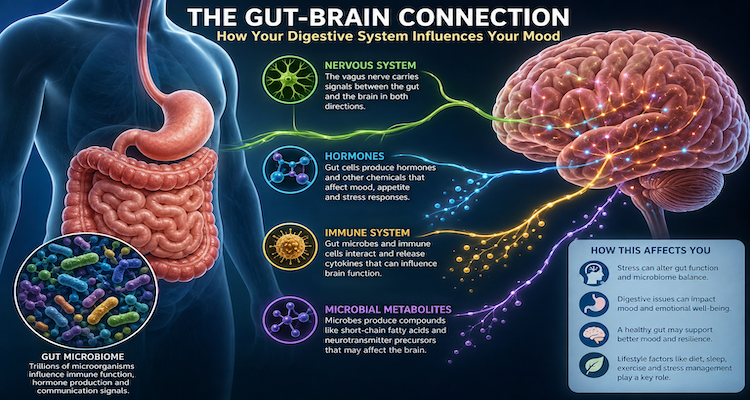
Your digestive system does far more than process food. It contains a vast ecosystem of microorganisms, communicates continuously with the nervous and immune systems, and is connected to the brain through multiple biological pathways. That has made the “gut-brain connection” one of the most closely watched areas of modern health research.
But the science requires nuance. A stressful experience can alter digestive function, and gastrointestinal disorders can affect emotional well-being. Research also suggests that the gut microbiome may be involved in brain-related processes. What remains much less certain is whether deliberately changing the microbiome can reliably treat depression, anxiety, or other mood disorders.
That distinction matters because the popularity of “gut health” has moved faster than the evidence behind many commercial claims. The more useful question is not whether the gut and brain communicate they clearly do but how much that communication can explain about mood, and what practical conclusions current evidence actually supports.
Key Takeaways
- The gut and brain communicate through nerves, hormones, immune activity, and signals associated with the gut microbiome.
- Stress can alter digestive function, while persistent gastrointestinal symptoms can also affect emotional well-being.
- The microbiome is scientifically important, but evidence does not yet support treating depression or anxiety simply by “fixing your gut.”
- Probiotic and prebiotic research is promising but inconsistent, partly because people respond differently to the same interventions.
- For most people, established foundations nutritious eating, sleep, physical activity, and appropriate medical or mental-health care remain more reliable than microbiome marketing.
The Gut and Brain Are in Constant Conversation
The idea that emotions can affect the stomach is familiar: anxiety may bring nausea, stress may change bowel habits, and anticipation can suppress or stimulate appetite. These experiences are not merely psychological metaphors. The digestive system is regulated by an extensive network of nerves, hormones and other signaling mechanisms that exchange information with the central nervous system.
The National Institute of Diabetes and Digestive and Kidney Diseases notes that nerves and hormones help control digestion, while the gastrointestinal tract contains its own enteric nervous system. Signals travel within the digestive tract and between the gut and brain, helping regulate functions including movement, digestion, hunger and fullness.
This two-way communication is the foundation of what researchers call the gut-brain axis.
One important point is often lost in popular discussions: the gut-brain axis is not synonymous with the microbiome. Microorganisms are one part of a much larger system. Neural pathways, hormonal signaling, immune activity, intestinal sensation and the physical state of the digestive tract all contribute.
That broader view helps explain why the connection is already medically relevant even though many microbiome-based treatments remain experimental.
What the Science Already Establishes
The strongest evidence for gut-brain interaction does not begin with a probiotic capsule. It can be seen in disorders where communication between the digestive system and the nervous system appears to be disrupted.
Irritable bowel syndrome, for example, is classified by NIDDK as a disorder of gut-brain interaction. These conditions involve changes in how the brain and gut work together and may affect intestinal sensitivity and bowel function.
This does not mean IBS is “all in the mind.” It means symptoms can arise through altered communication among the nervous system, the digestive tract and other biological processes. That distinction is important both scientifically and clinically.
Research on stress also illustrates the direction running from brain to gut. NIDDK highlighted 2023 research investigating biological mechanisms through which psychological stress may increase susceptibility to intestinal inflammation and influence intestinal function. The findings add mechanistic detail to a relationship that clinicians and patients have long observed, while also underscoring that the biology can be complex.
The editorial lesson is straightforward: the gut-brain connection is not a speculative wellness concept. The speculative part begins when specific products or interventions are presented as proven ways to control mood by manipulating the microbiome.
Where the Microbiome Fits Into the Picture
The gut microbiota consists of microorganisms living in the digestive tract. Researchers are investigating how these organisms and the substances they produce may interact with immune processes, metabolism and signaling pathways connected to the nervous system.
The possibility is scientifically compelling because the microbiome is dynamic. Diet, medications, age, health history and other environmental factors can influence it. But this same complexity makes simple claims difficult to support.
Two people can consume the same probiotic and have different biological responses. NCCIH has identified substantial variability in probiotic research, noting that factors including diet, age, lifestyle, health history and existing microbiome composition can contribute to inconsistent clinical effects.
This creates a major gap between a scientifically plausible mechanism and a dependable treatment.
A change in the microbiome may be measurable without producing a meaningful improvement in mood. An association between a particular microbial pattern and depression does not prove that the microbes caused the depression. And an intervention that produces encouraging results in animals cannot automatically be assumed to work in humans.
Those distinctions should be central to any serious discussion of the gut-brain connection.
Can Changing Your Gut Actually Improve Your Mood?
The most accurate answer at present is: possibly in some circumstances, but the evidence is not strong enough to make broad therapeutic promises.
Research into probiotics, prebiotics and combinations of the two sometimes discussed under the term psychobiotics is exploring whether targeted changes to the gut environment could influence stress, behavior or mental-health symptoms.
There are intriguing findings, particularly from animal research. NCCIH, for example, has described experimental work in mice examining how a probiotic-prebiotic combination affected stress-related behavioral symptoms and immune activity. But animal findings are not equivalent to evidence that the same intervention treats depression or anxiety in people.
Human studies face additional challenges:
- Different studies use different bacterial strains and formulations.
- Participants may have different diets, medical histories and baseline microbiomes.
- Outcomes can range from stress measures to clinical symptoms, making direct comparison difficult.
- Sample sizes and study durations may be limited.
- Improvements can be difficult to separate from placebo effects or other lifestyle changes.
NCCIH continues to describe the field as one with significant unanswered questions and ongoing investigation rather than a settled area of treatment.
That does not make the research unimportant. It means the science is moving through a difficult but necessary phase: determining who may benefit, from which intervention, under what conditions, and for which health outcome.
The Overlooked Problem With “Gut Health” Advice
One of the most useful ways to understand this subject is to separate three statements that are often treated as if they mean the same thing.
Statement one: The brain affects the gut.
Strongly supported.
Statement two: The gut can send signals that influence brain function and behavior.
Supported by a growing body of biological and clinical research, though the mechanisms and effects vary by context.
Statement three: You can reliably improve depression or anxiety by buying products that alter your gut microbiome.
Not established as a general rule.
The jump from the first two statements to the third is where much of the public conversation becomes less precise.
This distinction also protects readers from an increasingly common false choice: either mental-health problems originate in the brain or they originate in the gut. Human health rarely works through such neat divisions. Mood can be influenced by genetic factors, life experiences, stress, sleep, physical illness, social circumstances and many other biological and environmental processes.
The gut may be part of that network without being the single explanation.
What Can You Do With the Evidence Now?
The current science does support taking digestive and mental health seriously as connected aspects of overall health. It does not support self-diagnosing a “bad microbiome” or replacing evidence-based treatment with supplements marketed as mood solutions.
A sensible approach is to focus on measures that have broader health value rather than chasing a supposedly perfect microbiome.
These may include:
- Eating a nutritionally balanced diet appropriate to your individual needs.
- Paying attention to persistent digestive symptoms rather than repeatedly self-treating them.
- Managing chronic stress through approaches that are appropriate and sustainable.
- Maintaining adequate sleep and regular physical activity.
- Discussing significant changes in mood with a qualified health professional.
- Being cautious about supplements that promise to “reset,” “repair” or “rebalance” the microbiome without clear evidence for the specific claim.
For people with depression, established treatments may include psychotherapy, medication, or both, depending on individual circumstances and clinical needs. The National Institute of Mental Health recommends treatment decisions be made with a qualified health professional rather than assuming a single intervention will work for everyone.
Digestive symptoms deserve similar care. Persistent abdominal pain, unexplained changes in bowel habits or other ongoing symptoms can have many possible causes, and the answer may not be a probiotic or a dietary trend.
Why This Research Still Matters
The uncertainty should not obscure the significance of the field.
Gut-brain research is forcing medicine to look more closely at systems that were often studied separately. The digestive tract is not simply a tube for processing food, and emotional health cannot always be understood by looking at the brain in isolation.
A particularly important direction for future research may be precision rather than universality. Instead of asking whether one probiotic improves everyone’s mood, researchers may increasingly investigate why different people respond differently and whether biological, dietary or clinical characteristics can help identify those most likely to benefit.
That is a more demanding scientific question, but also a more realistic one.
Conclusion
Yes, your digestive system can influence processes connected to how you feel but the relationship is more complex than the popular slogan “heal your gut, heal your mind.”
The strongest evidence shows that the gut and brain are in continuous biological communication. Disorders of gut-brain interaction demonstrate how meaningful that relationship can be, and microbiome research is opening potentially important new avenues for understanding stress, behavior and mental health.
What science has not established is a universal shortcut from changing gut bacteria to curing depression or anxiety.
For readers, the practical takeaway is less glamorous but more useful: take digestive symptoms seriously, protect the foundations of overall health, be skeptical of oversized supplement claims, and use established medical or mental-health care when it is needed. The gut-brain connection is real. The challenge now is learning exactly how to use that knowledge without getting ahead of the evidence.
This article is provided for general informational and educational purposes. It is not medical advice, diagnosis, or a substitute for consultation with a qualified healthcare professional. Health evidence can change, and individual circumstances vary.