








Why Hearing Your Own Voice Recorded Can Feel So Uncomfortable
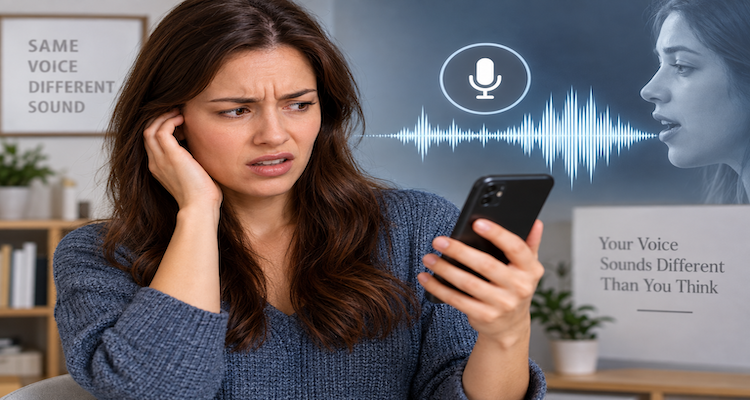
Hearing your own voice on a recording can produce an oddly immediate reaction: That doesn’t sound like me.
The recording may be perfectly clear, the microphone may be working normally, and other people may insist that the voice sounds exactly as expected. Yet to the person speaking, the playback can seem higher, thinner, unfamiliar or simply uncomfortable.
The reason is more interesting than a microphone making you sound different. When you speak, you do not hear your voice through exactly the same acoustic pathway that other people do. Your brain receives a combination of sound traveling through the air and vibrations conducted through the tissues and bones of your head. A recording largely removes that second pathway. Research also suggests that the brain treats self-produced speech differently from ordinary sounds and that repeated exposure can change how familiar and acceptable a recorded self-voice feels.
Key Takeaways
- Your everyday voice reaches your ears through both air conduction and bone conduction, unlike a normal recording.
- Bone conduction emphasizes lower-frequency information, contributing to the deeper voice you perceive while speaking.
- The brain also predicts and processes self-produced sounds differently from voices produced by other people.
- Feeling unfamiliar with a recording does not mean the recording is inaccurate or that your voice is abnormal.
- Research suggests repeated exposure to recorded self-voice can improve recognition and may increase how much people like hearing it.
- Individual differences, including listening habits and personality-related factors, can influence impressions of a recorded voice.
The Voice You Hear While Speaking Is Not the Same Sound Others Hear
The simplest explanation starts with the physics of hearing.
When another person speaks to you, most of the sound reaches your ears through the air. When you speak, however, the sound generated by your vocal folds travels outward through the air and produces vibrations that travel through tissues and the bones of your skull.
That second route is called bone conduction.
Researchers studying self-voice perception have repeatedly identified this difference as an important reason recorded speech can sound strange. A recording played through a speaker contains the airborne acoustic signal but does not reproduce the full pattern of vibrations you experience while physically producing the voice.
This changes the acoustic information reaching your auditory system.
One consequence is that bone conduction tends to add relatively more low-frequency information to the voice you perceive while speaking. That contributes to the familiar impression that your own voice sounds deeper or fuller in your head than it does on a recording.
So when you press play on a voice memo, you are not necessarily hearing a distorted version of the voice you normally hear.
You are hearing your voice through a different sensory pathway.
Your Brain Is Also Used to a Different Version of You
The acoustic difference is only part of the explanation.
Speaking is an action you generate yourself. The brain does not simply wait passively for the resulting sound. Research on self-produced speech has examined how the brain uses information about an action to anticipate its sensory consequences.
One concept used in this research is corollary discharge: broadly, a signal associated with an intended action that helps the nervous system distinguish expected self-generated sensory information from externally generated information.
A 2025 study in Royal Society Open Science examined the fundamental frequency of people’s own voices and found that the frequency they objectively produced and the frequency they subjectively experienced as defining their own voice were affected by bone- and air-conduction filtering. The researchers also found evidence that listeners were less sensitive to relatively small pitch changes around their own voice frequencies, suggesting that the perceptual system does not treat self-voice information like an entirely neutral external sound.
That helps explain why a recording can create a subtle mismatch.
Your brain has years of experience with the sensory consequences of speaking as yourself. A recording provides only part of that familiar sensory package.
The result can feel surprisingly unfamiliar even when you immediately recognize the speaker as yourself.
Why the Reaction Can Feel Stronger Than Simple “It Sounds Different”
There is another layer: self-recognition.
Your voice is one of the sounds most closely associated with your identity. Research has found that people can process their own voice differently from familiar and unfamiliar voices, and studies have investigated distinct mechanisms involved in implicit and explicit self-voice recognition.
That creates an unusual perceptual situation.
You know intellectually that the recording is yours. But the acoustic signal does not completely match the internal version of your voice that you have become accustomed to hearing.
The brain therefore has to reconcile two pieces of information:
I recognize this as my voice.
and
This does not sound exactly like the voice I normally hear.
That mismatch can make the recording feel more noticeable than an ordinary unfamiliar voice.
It is also why people often focus intensely on small characteristics of their own recordings pitch, nasality, breathiness, pronunciation, pauses or particular speech habits that they would barely notice in someone else.
Familiarity May Change How You Feel About Your Recorded Voice
The discomfort is not necessarily permanent.
Modern communication provides an unusual natural experiment: people now hear recordings of themselves far more often than many previous generations did.
Voice messages, video calls, podcasts, online meetings and social-media videos repeatedly expose people to their recorded voices.
A 2024 study of 128 regular voice-note users found that people who reported more frequent replay of their own voice recordings also tended to show better self-voice recognition and greater liking of their recorded voice. The study was correlational, so it cannot establish that replaying voice notes causes people to like their voices more. But it provides evidence that repeated exposure is associated with greater familiarity and more positive self-voice judgments.
This distinction matters.
Someone who listens to their own voice frequently may become less surprised by the acoustic differences between their internally perceived voice and their recorded one. Familiarity can make the recording feel less foreign.
That does not mean repeated listening will make everyone love their voice. It means the initial discomfort may partly reflect unfamiliarity rather than an objective problem with the voice itself.
People Do Not All Judge Their Recorded Voices the Same Way
Another reason the experience varies is that self-voice perception is not determined by acoustics alone.
A study published in Speech Communication in 2026 examined 141 Japanese participants and investigated how different individual characteristics related to impressions of recorded self-voice. The researchers considered factors including personality-related characteristics, age group, personal values and how frequently participants listened to recordings of their own voices.
The researchers found that impressions of recorded self-voice were associated with multiple individual characteristics rather than one single factor. Frequency of listening to one’s own recorded voice was among the characteristics associated with impressions, while some personality-related measures were also linked to evaluations such as attractiveness, familiarity and intelligibility.
The study does not mean that personality determines whether someone will dislike their voice. Nor does it establish a universal psychological formula for self-voice perception.
Its more useful lesson is that the reaction is individual.
Two people can hear essentially the same type of recording and evaluate their voices very differently.
Your Phone Is Not Necessarily Making You Sound “Wrong”
A common assumption is that a strange recording must mean the microphone is producing an inaccurate representation.
Recording equipment certainly can alter sound. Microphone placement, room acoustics, compression, frequency response, background noise and playback equipment can all affect what reaches the listener.
But even a technically excellent recording will not reproduce the complete sensory experience of hearing yourself speak from inside your own head.
That distinction is important.
A microphone captures an acoustic signal. Your everyday perception of your own voice combines acoustic information with bodily vibration and the sensory consequences of producing speech.
Researchers have therefore described natural self-voice perception as a multimodal experience rather than a purely auditory one. In experimental work, adding bone-conducted stimulation improved people’s ability to distinguish their own voice from another person’s voice, providing evidence that the additional bodily signal contributes to self-voice identification.
In other words, the recording may be doing exactly what it is supposed to do.
It is simply showing you a version of your voice that your perceptual system is less accustomed to hearing.
What About the “Higher” Sound?
This is one of the most noticeable differences for many people.
Because bone conduction changes the acoustic signal reaching the ear, particularly by emphasizing lower-frequency components, the voice experienced during speech can sound lower to the speaker than the same voice heard through air conduction alone.
Remove that contribution, and the recorded voice can appear higher or thinner.
But there is no universal rule that every person’s recording will sound dramatically higher. Voice anatomy, vocal technique, recording equipment, environment and individual perception all matter.
The important point is that your internal reference is not the same acoustic reference used by an external listener.
That is why asking a friend whether a recording “really sounds like you” can produce a more useful reality check than relying solely on your own first reaction.
Why This Matters Beyond Voice Memos
The phenomenon is becoming more relevant as speech technology becomes increasingly sophisticated.
Voice recordings are no longer limited to answering-machine messages or personal memos. People routinely use recorded speech for professional presentations, online meetings, social videos, podcasts, customer-service systems and increasingly AI-powered voice applications.
That makes understanding self-voice perception more than a curiosity.
It matters for how people evaluate their communication skills, respond to voice-based interfaces and react to technologies that reproduce or modify their voices.
Recent research on voice cloning also shows why familiarity matters. A 2025 study examining recorded and cloned voices found that familiar listeners’ evaluations were sensitive to how accurately and authentically a cloned voice represented a known speaker.
As synthetic voices become better at reproducing individual identities, the psychological distinction between recognizing your voice and feeling that a voice sounds like you may become increasingly important.
A voice can be recognizable without perfectly matching the sensory experience a person associates with themselves.
The Uncomfortable Feeling Is Usually a Perception Problem, Not a Defect
Hearing your recorded voice for the first time can feel almost like meeting a slightly unfamiliar version of yourself.
But that reaction does not mean the recording is necessarily wrong, your voice is unpleasant, or something is wrong with your hearing.
It reflects a basic feature of human perception: the voice you experience while speaking is created by more than the sound traveling through the air.
Bone conduction changes the acoustic signal. Bodily sensations accompany speech. The brain predicts sensory consequences of actions. And years of exposure create a highly familiar internal reference for what “my voice” is supposed to sound like.
A recording removes much of that context.
That is why the first playback can feel strangely personal and strangely unfamiliar at the same time.
With repeated exposure, the mismatch can become less surprising. And as voice messages and voice-based technologies become increasingly embedded in everyday life, becoming comfortable with the recorded version of ourselves may simply become another form of digital familiarity.
This content is published for informational or entertainment purposes. Facts, opinions, or references may evolve over time, and readers are encouraged to verify details from reliable sources.