









What an Old Diary Can Reveal About a Life We Thought We Knew
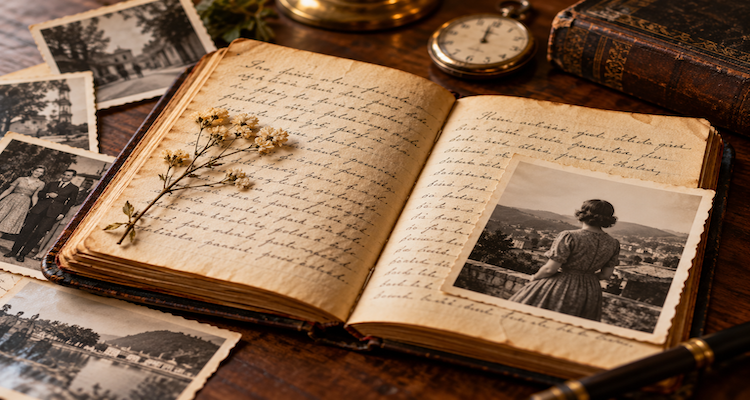
An old diary can look deceptively ordinary: a date, a few lines, perhaps a note about the weather, dinner, work, a visitor or an uneventful afternoon. Yet archival researchers repeatedly find that these small records can reveal something much larger a version of a person’s life that formal biographies, family stories and public records may never capture.
That is because diaries preserve life at its everyday scale. They can record relationships, routines, anxieties, ambitions, work, money, illness, travel and social expectations in the writer’s own words. The University of Leeds describes diaries as primary sources that can provide evidence about experiences while also warning that they are subjective and may contain omissions or revisions of memory.
The real discovery, therefore, is not necessarily a sensational secret hidden between two pages. Sometimes it is the realization that a familiar person or even a familiar period of history was much more complicated than later accounts suggested.
Key Takeaways
- Old diaries can reveal everyday experiences that official records and biographies often leave out.
- A diary is evidence of a person’s perspective, not an automatically complete record of events.
- Missing pages, silences and changes in tone can themselves provide historical clues.
- Ordinary details about work, relationships and routines can become valuable historical evidence over time.
- Digitization is making previously inaccessible diaries available to researchers and the public.
- Preserving personal records today can create historical evidence for future generations.
Why Diaries Can Change the Story
Historical records tend to favor events considered important at the time: elections, wars, business transactions, institutional decisions and public achievements.
Daily life is different.
A diary might mention an argument that never appeared in a newspaper, a career ambition that was later abandoned, an unexpected friendship, financial difficulties, household responsibilities or an ordinary journey that reveals how people actually moved through their world.
The University of Guelph notes that diaries can bring researchers unusually close to ordinary people’s everyday lives, including work, purchases, social activities, travel and relationships.
That distinction matters when reconstructing someone’s past.
A person remembered decades later as successful, respectable or conventional may have privately struggled with uncertainty. Someone described as quiet may have maintained an extensive social life. A family member remembered primarily through a profession may have spent years pursuing interests that never became part of the official family story.
The diary does not necessarily contradict the public record. It can add the missing dimensions.
The Details That Look Unimportant Can Matter Most
One of the most revealing features of historical diaries is their apparent mundanity.
A diary entry might say that someone visited a neighbor, bought an item, attended church, traveled to another town or spent several hours working at home.
Individually, these details may seem insignificant.
Across hundreds of entries, however, patterns emerge.
Researchers can use repeated observations to study social relationships, household routines, employment, travel, consumption, religious practice and changing expectations. The University of Vermont’s digital diary collection, for example, includes records documenting student life, the 1918–1919 influenza epidemic, courtship, marriage, travel, employment opportunities for women and social life.
This is one reason an apparently ordinary notebook can become more valuable with age.
The writer may not have realized that a brief note about a daily routine would eventually help someone understand how people lived during a particular period.
An Old Diary Is Not the Same as an Objective Record
There is an important complication.
A diary can feel intimate, but intimacy does not guarantee accuracy.
People choose what to write. They may leave things out, exaggerate their feelings, misunderstand events or later reinterpret what happened. Some diaries were written with the possibility of another reader in mind.
Researchers at Churchill Archives Centre specifically emphasize that diary writing involves decisions about what is recorded and what is omitted. Some diarists also removed pages, creating another layer of evidence about how they wanted their lives represented.
The University of Leeds similarly warns that diaries are subjective sources. Gaps and inaccuracies may themselves reveal something about what the writer wanted to remember, forget or reshape.
That makes an old diary both powerful and dangerous.
It can reveal a different life but it cannot automatically establish that the writer’s version is the complete truth.
The Story Hidden in the Missing Pages
Sometimes the most intriguing discovery is not what an old diary contains but what it does not contain.
A sudden gap in entries could have a simple explanation: illness, travel, lack of time or loss of interest in diary writing.
But it might also coincide with a major change in the writer’s circumstances.
Researchers therefore compare diary entries with other evidence whenever possible. Letters, photographs, newspapers, census records, employment documents, financial records and institutional archives can help establish context.
The University of Limerick’s archival research guide specifically teaches researchers to treat diaries critically and to examine them as historical sources rather than simply accepting their contents at face value.
That approach can transform an apparently simple discovery into a more nuanced historical investigation.
When a Private Life Becomes Part of Public History
A diary does not need to belong to a famous person to become historically important.
The University of Delaware, for example, preserves an 1857 journal belonging to Mary A. H. Hoskins of Philadelphia. Its entries document domestic activities, social calls, correspondence, church attendance, fashion, illnesses, funerals and other aspects of her everyday life.
The Smithsonian Institution’s archival catalog likewise contains numerous diary collections covering different periods and subjects, demonstrating how widely these records are used as historical materials.
The significance comes partly from accumulation.
One diary tells us about one person.
Many diaries, studied together, can reveal patterns across a community or generation.
That is when an individual’s private record begins contributing to social history.
What Today’s Digital Diaries Might Leave Behind
There is also a modern question hidden inside the old diary.
If handwritten notebooks can survive for generations, what happens to the equivalent records created today?
Personal memories are increasingly stored as emails, photographs, documents, websites, messages and other digital files. The Library of Congress warns that digital materials require active preservation because technology and storage media can change, making older files difficult to access. It recommends identifying valuable personal records, organizing them, maintaining multiple copies and periodically checking that they remain readable.
The modern equivalent of an old diary may therefore be scattered across a phone, computer, cloud account and social platforms rather than sitting inside a drawer.
That creates an unusual historical paradox: today’s lives may produce vastly more personal information than previous generations, while some of it may also be easier to lose.
The Life Between the Official Lines
An old diary can change how we understand the past because it restores something that formal history often compresses: ordinary human experience.
It may show that a person had ambitions that were never fulfilled, relationships that disappeared from family memory, routines that no longer exist or worries that were invisible to outsiders.
But the most responsible reading is not to treat every handwritten sentence as a revelation.
The diary is one piece of evidence.
Its greatest value emerges when its observations are placed alongside other records and read with attention to both what the writer documented and what they chose not to document. Archival collections and universities increasingly digitize such material precisely because these personal records can help researchers reconstruct everyday life from perspectives that institutional histories often overlook.
A forgotten notebook can therefore do something remarkable without containing a dramatic secret: it can make a person from another time feel less like a name in an archive and more like a complicated human being.
And sometimes that is the completely different life the diary reveals.
This content is published for informational or entertainment purposes. Facts, opinions, or references may evolve over time, and readers are encouraged to verify details from reliable sources.