










The Return of Apprenticeship Thinking in a World Obsessed With Degrees
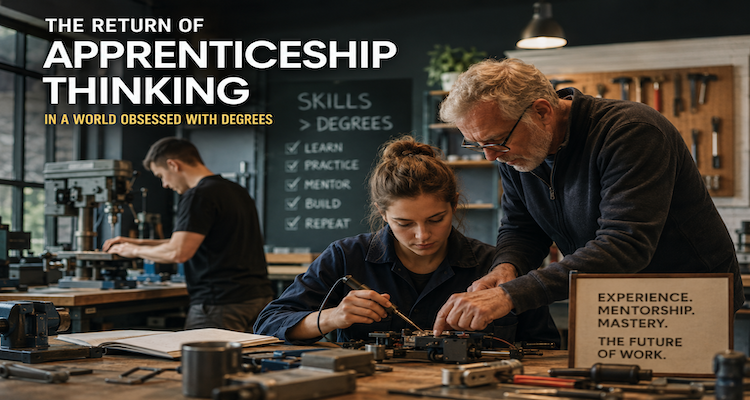
For decades, the conventional route into a professional career has been remarkably simple: study, earn a degree, then look for work. But employers are increasingly confronting a problem that a diploma alone cannot solve whether a person can actually perform, adapt and learn inside a workplace.
That does not mean degrees have stopped mattering. Research continues to find substantial economic returns to higher education, and degrees remain essential for many professions.
What is changing is the role of the credential. Employers are paying greater attention to work experience, demonstrated skills and the ability to learn on the job. The World Economic Forum’s Future of Jobs Report 2025 found that 81% of surveyed employers expect to prioritize work experience when assessing skills between 2025 and 2030, compared with 43% expecting to use a university degree as a hiring requirement.
That shift makes an old idea newly relevant: apprenticeship thinking learning through real work, guided practice, mentorship, feedback and progressively greater responsibility.
Key Takeaways
- Degrees remain valuable, but employers increasingly want evidence that candidates can apply what they know.
- Apprenticeship models combine practical work with structured learning rather than separating education from employment.
- Skills-first hiring is expanding, although degree requirements remain widespread across many occupations.
- AI may increase the importance of early-career learning because workers must adapt as tasks and tools change.
- Apprenticeships are not a universal replacement for university education; their value depends heavily on occupation and program quality.
- The strongest future model may combine formal education with sustained, mentored experience.
The degree is still useful but it is no longer the whole signal
It would be easy to misread the rise of skills-first hiring as an argument against university education. The evidence does not support such a sweeping conclusion.
Higher education continues to produce significant benefits on average. Research reviewed by the National Bureau of Economic Research has found a substantial college earnings premium, while later research suggests part of that advantage comes from graduates moving into professional occupations where continued learning and experience generate additional wage growth.
The more interesting change is therefore not degrees versus skills.
It is degrees plus demonstrated capability versus degrees as a proxy for capability.
A university qualification can tell an employer something about a person’s education, persistence and field of study. It may also be a legal or professional requirement. But it does not necessarily show how someone handles an unfamiliar customer, debugs a production problem, collaborates with colleagues, manages a deadline or learns an unfamiliar tool.
Those capabilities become easier to observe when someone has actually worked.
That is where apprenticeship thinking becomes relevant.
What “apprenticeship thinking” really means
An apprenticeship is more than an entry-level job.
A well-designed apprenticeship combines productive work with structured learning, supervision and progressive skill development. In registered apprenticeship systems, for example, participants can receive paid on-the-job learning alongside related classroom or technical instruction and earn a recognized credential.
But the broader idea can be applied far beyond traditional trades.
An apprentice software developer might learn by contributing to a real codebase under experienced supervision. A young analyst might learn by preparing increasingly complex reports while receiving feedback from a senior colleague. A laboratory trainee might develop competence by repeating procedures under supervision rather than merely reading about them.
The important principle is the sequence:
observe → attempt → receive feedback → improve → take on more responsibility.
That is different from a system in which education is largely completed before meaningful work begins.
It also changes how competence is measured. Instead of asking only, “What qualification does this person have?”, an employer can ask, “What can this person demonstrate?”
Why the idea is returning now
Several forces are pushing employers toward that question.
The first is the speed at which occupational skills are changing.
The World Economic Forum estimates that 39% of workers’ existing skill sets could be transformed or become outdated by 2030. Its research also shows employers placing substantial emphasis on work experience and direct skills assessments when evaluating candidates.
The second is the difficulty of finding workers who possess both technical knowledge and workplace capability.
The OECD’s recent work on skills-first labour markets describes work experience and university degrees as the dominant proxies employers use to assess skills, while also identifying apprenticeships, short courses and other alternative pathways as part of a broader shift toward skills-based recruitment.
The third is technology itself.
AI is changing tasks rather than simply eliminating entire occupations. Workers increasingly need to learn how to use new tools, evaluate outputs, solve problems and operate effectively when the technology changes again.
That makes the ability to learn inside a job increasingly valuable.
A credential earned at age 22 may remain useful for decades. But the specific software, workflows and technical practices learned during that degree may not.
AI may make learning on the job more important
The relationship between AI and apprenticeship is easy to overlook.
AI can give inexperienced workers access to capabilities that previously required considerable accumulated knowledge. But access to a tool does not automatically produce professional judgment.
A junior programmer can ask an AI system to generate code. The harder question is whether the programmer knows when that code is wrong, insecure, inefficient or inappropriate for the existing system.
An entry-level researcher can use AI to summarize material. The harder question is whether the researcher can recognize a weak source, identify a misleading inference or understand what evidence is missing.
This creates a paradox.
As technology makes some tasks easier to perform, experience may become more important for knowing which tasks should be performed, how they should be evaluated and when the technology should not be trusted.
That is precisely the territory in which apprenticeship models have traditionally been strong: judgment develops through repeated exposure to real situations and feedback from people who have already encountered them.
Employers are already looking beyond the diploma
The shift is visible in employer expectations.
The World Economic Forum’s 2025 research reports that 81% of surveyed employers expect to rely on work experience as a skills-assessment mechanism through 2030. Skills assessments are expected to be used by 48%, while 43% expect university degrees to remain a hiring requirement.
The numbers should not be interpreted as evidence that employers are abandoning degrees. Rather, they show that work experience is being treated as a powerful complement and sometimes an alternative to formal credentials.
There is also considerable variation between industries.
The WEF reports that the technology sector is relatively advanced in plans to remove degree requirements in favor of skills-based approaches, with 28% of technology-industry respondents identifying such a shift compared with 19% across industries.
That matters because technology occupations change quickly. Employers hiring for skills that can be demonstrated today may be better positioned to identify candidates who can adapt when particular tools become obsolete.
The same logic, however, cannot simply be transferred to every profession. Medicine, law and many regulated technical occupations require formal education, licensing or both.
Apprenticeships can produce measurable outcomes but quality matters
There is stronger evidence for apprenticeships than the phrase “learn by doing” might suggest.
A 2025 U.S. Department of Labor evaluation of apprenticeship programs supported by federal grants found statistically significant positive effects on employment and earnings for registered apprentices relative to comparison groups, including community-college students and employment-service participants. The estimated ninth-quarter earnings impact ranged from $3,230 to $4,693 depending on the comparison group. The study also found positive impacts in areas including information technology, healthcare and advanced manufacturing.
Earlier research commissioned by the Department of Labor and conducted across 10 states similarly found that completing a registered apprenticeship was associated with higher earnings and employment compared with noncompletion, although the precise effects varied by state and methodology.
These findings support apprenticeship as a serious workforce-development model.
They do not mean every apprenticeship is automatically good.
A poorly structured placement can become cheap labor with little meaningful instruction. A strong apprenticeship requires qualified mentors, clear learning objectives, progressive responsibility, appropriate pay and a credible pathway toward recognized competence.
That distinction is crucial if apprenticeship thinking is going to expand into white-collar and technology work.
The biggest opportunity may be before the first full-time job
One of the weaknesses of traditional education-to-work pathways is the gap between academic achievement and workplace readiness.
A graduate can leave university with years of study but limited experience operating inside an organization. Employers, meanwhile, increasingly want candidates who can contribute quickly.
The result can be an uncomfortable loop:
employers want experience → young workers need a first opportunity to gain experience → entry-level jobs become harder to enter.
Recent World Economic Forum reporting has highlighted this pressure, including the increasing prevalence of entry-level positions asking candidates for prior experience.
Apprenticeship models attack the problem from the opposite direction.
Instead of expecting a worker to arrive fully formed, they make the workplace part of the education process.
That can be particularly valuable for people who cannot afford to spend several additional years outside the labor market pursuing credentials.
But “skills-first” is not automatically fair
There is another complication.
Removing a degree requirement does not necessarily eliminate bias.
The OECD explicitly warns that degree removal alone does not automatically expand opportunities for underrepresented groups. Employers may need alternative recruitment practices, structured skills assessments and accessible entry routes such as apprenticeships and short training programs.
This is an important correction to the idea that skills-first hiring is inherently meritocratic.
If a company replaces “must have a degree” with “must have three years of experience,” it may simply move the barrier.
If it replaces the degree requirement with an opaque personality test, it may create another barrier.
A genuine skills-first organization therefore has to define what competence means, determine how it can be demonstrated and provide credible ways for people to acquire that competence.
Apprenticeship can be one of those ways.
The future may be a hybrid, not a reversal
The strongest case for apprenticeship thinking is not that universities have become obsolete.
It is that education and employment may need to become less separate.
A student studying computer science could graduate with a degree and several years of supervised project experience. A business student could combine coursework with structured workplace rotations. A technician could progress through an apprenticeship while earning qualifications that remain portable. A mid-career professional could use short courses and supervised projects to acquire new skills without starting another full degree.
The OECD’s recent research points toward this broader skills-first model, in which skills assessment, training, career development and progression are connected rather than treated as separate processes.
That is a more useful way to think about the debate.
The choice is not necessarily between a university classroom and a workshop.
It can be between education that ends when employment begins and education that continues through employment.
What workers should take from the shift
For individuals, the practical lesson is straightforward: a credential should increasingly be accompanied by evidence of what you can do.
That evidence might include:
- substantial projects with documented outcomes;
- internships or apprenticeships;
- portfolios and work samples;
- technical assessments;
- professional certifications where relevant;
- open-source contributions;
- supervised workplace experience;
- references that can speak to actual performance.
The right combination depends on the occupation.
For employers, the lesson is different: if a role genuinely requires a degree, keep the requirement. If it does not, employers should consider whether the degree is actually measuring a necessary capability or merely serving as a convenient screening device.
And for educators, the challenge is to connect academic knowledge more deliberately with the environments in which that knowledge will eventually be used.
Conclusion
The return of apprenticeship thinking is not the return of an old system at the expense of modern education. It is a response to a more complicated labor market in which credentials, experience, technical skills and adaptability all matter.
Degrees still open doors. In many professions, they are indispensable. But the evidence increasingly suggests that employers also want to see what candidates can do with what they have learned.
That distinction may become more important as AI accelerates changes in workplace tasks.
The most resilient education model may therefore be neither purely academic nor purely vocational. It may be one in which people learn, work, receive feedback, earn credentials and continue learning at the same time.
The apprenticeship idea has survived because it addresses a basic fact about human capability: knowledge becomes useful when people learn how to apply it and judgment grows through practice.
The information presented in this article is based on publicly available sources, reports, and factual material available at the time of publication. While efforts are made to ensure accuracy, details may change as new information emerges. The content is provided for general informational purposes only, and readers are advised to verify facts independently where necessary.