










Heritage Is More Than the Past: How Memory Gives Culture Its Lasting Influence
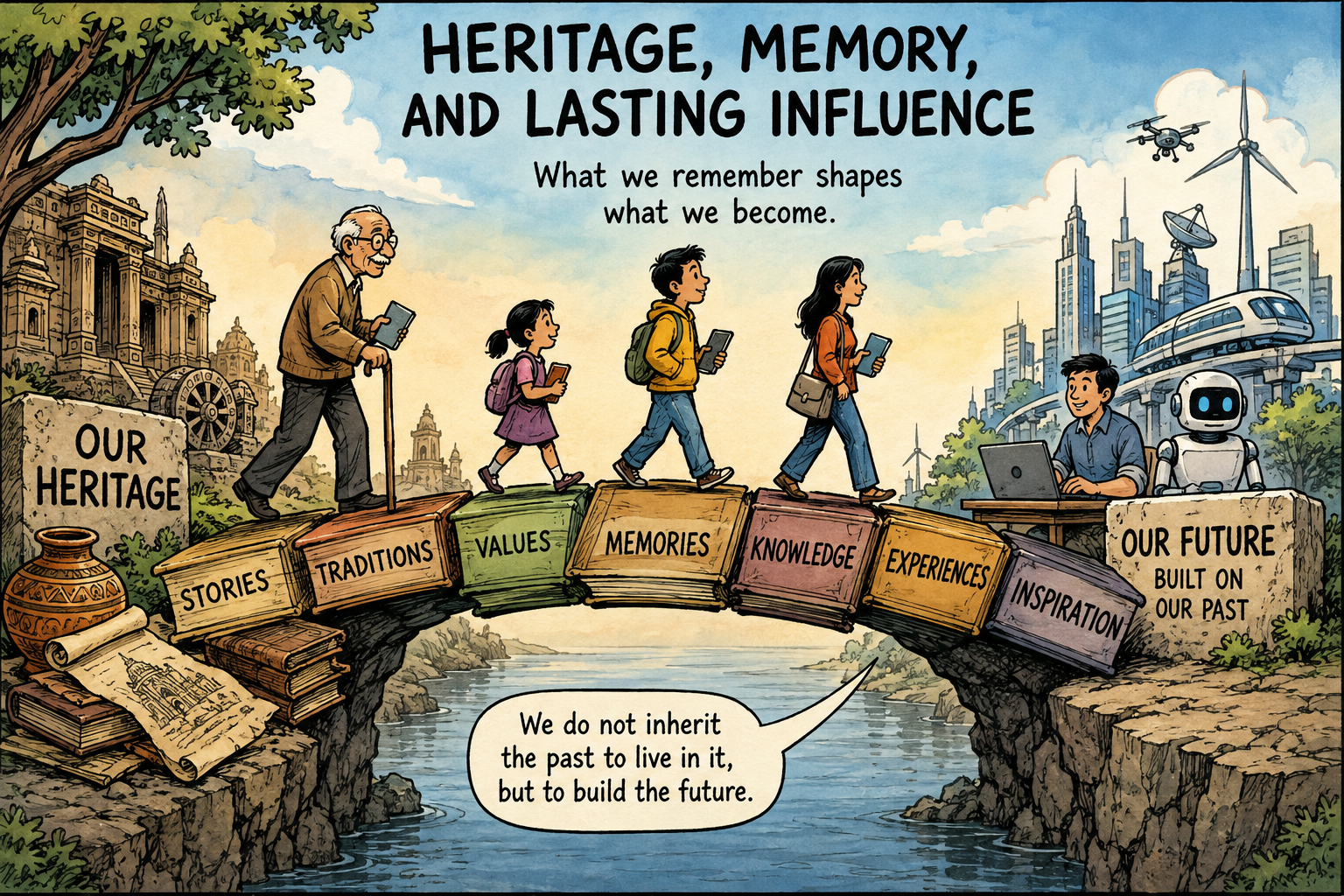
A heritage site can survive for centuries, yet the meaning attached to it can disappear within a generation. The opposite can also happen: a tradition may have no monumental building at all, but remain powerful because people continue to remember it, practice it and pass it forward.
That distinction matters because heritage is often understood too narrowly. It is associated with ancient buildings, archaeological sites, museums and protected monuments. But cultural heritage also includes languages, rituals, craftsmanship, oral traditions, celebrations, knowledge and everyday practices. UNESCO describes intangible cultural heritage as something communities inherit, continually recreate and transmit, giving them a sense of identity and continuity.
The deeper story of heritage, therefore, is not simply about preserving the past. It is about how societies decide what should be remembered, how that memory is carried into the present, and what happens when the connection between generations begins to weaken.
Key Takeaways
- Heritage survives most meaningfully when communities continue to practice, interpret and transmit it.
- Cultural memory includes knowledge, language, rituals and skills as well as physical monuments.
- Preservation can protect historical places, but living traditions require people who continue to carry them.
- Documentary heritage provides societies with another way to preserve evidence of their collective past.
- Heritage can strengthen identity and continuity without remaining frozen in its historical form.
- The people connected to a tradition should have a central role in deciding how it is safeguarded.
Heritage Is Not Simply What Remains
The most visible form of heritage is usually physical: a monument, historic building, archaeological site or landscape.
International heritage policy has long recognized the importance of protecting such places. UNESCO’s 1972 World Heritage Convention established an international framework for identifying and safeguarding cultural and natural properties considered to have outstanding universal value. It defines cultural heritage through categories including monuments, groups of buildings and sites with historical, artistic, scientific, ethnological or anthropological significance.
But a building alone cannot carry an entire culture.
A historic structure may tell us where something happened. It may reveal architectural techniques or political power. It may preserve physical evidence that would otherwise disappear. Yet the meanings people attach to that place often exist outside its walls.
A song associated with a community, a craft technique learned from a parent, a seasonal ritual, a language passed between generations or knowledge about local environments can contain forms of cultural memory that cannot be preserved simply by protecting a structure.
This is why the idea of living heritage is important.
Memory Becomes Heritage Through Transmission
UNESCO’s framework for intangible cultural heritage emphasizes transmission. Traditions are not treated as museum objects that must remain exactly as they were. They are continually recreated as people pass knowledge and skills from one generation to another.
That creates an important tension.
Preservation sounds like keeping something unchanged. Cultural continuity often requires change.
A traditional craft may use contemporary materials. A festival may develop new forms of participation. A language may absorb new vocabulary. A musical tradition may be performed in settings that did not exist when it began.
Change does not automatically mean cultural loss.
In many cases, the ability to adapt is precisely what allows a tradition to remain meaningful. UNESCO explicitly recognizes intangible heritage as traditional, contemporary and living at the same time.
The real danger is not necessarily that a tradition changes. It is that the knowledge required to continue it stops being transmitted.
Once there are no people learning the technique, speaking the language, performing the ritual or understanding the knowledge behind a practice, documentation alone may not restore what has been lost.
The People Who Carry Memory Matter Most
Heritage preservation can sometimes be discussed as though institutions are the primary actors and communities are simply beneficiaries.
The reality is more complicated.
UNESCO’s 2003 Convention places communities, groups and individuals at the center of intangible cultural heritage. It states that such heritage is recognized by the communities that create, maintain and transmit it. UNESCO also emphasizes community participation in safeguarding decisions.
That principle changes the question from:
“How do we preserve this tradition?”
to:
“How do the people who carry this tradition want it to continue?”
That is an important distinction.
A community may want a practice documented, taught in schools, supported financially or introduced to younger generations. It may also have legitimate concerns about commercialization, misrepresentation or outsiders deciding what constitutes its heritage.
UNESCO’s ethical principles therefore emphasize the primary role of communities in safeguarding their own intangible cultural heritage and call for respectful, transparent collaboration and informed consent.
Preservation works best when memory remains connected to the people for whom that memory has meaning.
Documentary Memory Gives the Past Another Life
Not all cultural memory is transmitted through performance or personal teaching.
Books, manuscripts, photographs, maps, archives, recordings and other documentary materials can preserve evidence of human experience across generations.
UNESCO’s Memory of the World Programme, launched in 1992, was created to help protect documentary heritage and make it more widely accessible. Its stated objectives include preservation, access and greater public awareness of the significance of documentary heritage.
This matters because societies can lose their documentary memory through war, disasters, neglect, deterioration or simple inaccessibility.
A document can preserve a voice long after the person who created it is gone. An archive can reveal how communities understood themselves at a particular moment. A historical photograph can provide evidence that written accounts cannot fully capture.
But archives also require interpretation.
Preserving a document does not automatically tell us how to understand it. Historical records can reflect the perspective, priorities and power structures of the people who produced them. The preservation of memory therefore requires not only storage, but responsible scholarship and context.
Heritage Connects Generations Without Freezing Them
One of the most useful ways to think about heritage is as a conversation between generations.
The past provides materials: stories, skills, buildings, language, records, beliefs, artistic forms and collective experiences.
The present decides how those materials are understood and used.
The future determines which elements continue.
This makes heritage an active process rather than a one-time act of preservation.
UNESCO notes that intergenerational transmission is central to safeguarding living heritage and describes education as one avenue through which transmission can continue. Schools and other learning environments can create additional spaces for communities and heritage bearers to share knowledge with younger generations.
That has an important practical implication: a heritage policy that protects buildings while neglecting knowledge, skills and people may preserve the appearance of a culture without preserving its living substance.
When Heritage Becomes a Resource for the Present
Heritage also influences contemporary society.
It can shape local identity, support cultural education, create opportunities for traditional crafts and strengthen connections between generations. UNESCO identifies intangible heritage as contributing to identity, continuity, social cohesion, respect for cultural diversity and human creativity.
But heritage also carries risks when treated purely as a commercial product.
Tourism, cultural branding and commercial promotion can provide resources for preservation, but they can also encourage simplified versions of traditions designed primarily for visitors or markets.
The challenge is therefore not to keep heritage untouched or to commercialize it without limits. The more difficult task is to find forms of use that respect the people and meanings behind it.
That requires asking who benefits, who decides, what is being represented and what may be lost through simplification.
India Shows Why the Living Dimension Matters
India offers an especially useful illustration of the relationship between physical heritage and living cultural memory.
UNESCO’s World Heritage framework currently lists 45 properties for India, including cultural sites such as the Taj Mahal, Ajanta Caves, Dholavira and the Chhatrapati Shivaji Terminus.
These places provide extraordinary physical evidence of different periods of Indian history.
But India’s cultural inheritance extends far beyond its World Heritage properties.
Languages, oral traditions, music, foodways, rituals, performing arts, crafts and community practices form another layer of memory. These traditions do not depend entirely on monumental architecture. Their survival depends on people continuing to learn and use them.
That distinction is particularly relevant as younger generations experience culture through new technologies, migration, urbanization and global media.
The question is not whether culture will change. It always has.
The question is whether the knowledge and meaning embedded in cultural practices can continue to travel across generations while remaining relevant to the people who inherit them.
The Future of Heritage Depends on Participation
Digital technology can make heritage easier to document, catalogue and share. High-quality photography, digital archives, recordings, mapping and online educational resources can extend access to material that was once available only in specific locations.
But digitization has a fundamental limitation: it can preserve a representation without necessarily preserving the living practice itself.
A recording of a traditional performance is not the same as knowing how to perform it. A digital image of a craft object does not transmit the skill required to make it. An archived language recording cannot by itself create a community of speakers.
Technology can therefore become an important preservation tool, but it should not be mistaken for cultural continuity.
The strongest preservation model combines documentation with transmission: record the knowledge, make it accessible, teach it, support the people who carry it and allow communities to determine how their heritage should evolve.
Conclusion
Heritage is often described as something inherited from the past. That is only half the story.
The more important question is what people do with that inheritance.
A monument can survive while its meaning fades. A tradition can change while its essential knowledge remains alive. A document can preserve evidence of a vanished world, while a community can keep another part of that world active through everyday practice.
That is why heritage is ultimately inseparable from memory.
Its lasting influence does not come simply from how old something is. It comes from whether people continue to find meaning in it, teach it, question it, adapt it and pass something of it forward.
The responsibility of preservation, then, is not merely to protect yesterday. It is to make informed choices about what should remain meaningful tomorrow.
This content is published for informational or entertainment purposes. Facts, opinions, or references may evolve over time, and readers are encouraged to verify details from reliable sources.