








Why New York Is Facing One of Its Most Unusual Summer Weekends
Key Takeaways
- Extreme heat, large public events, and holiday celebrations are converging across New York City simultaneously.
- Authorities are balancing public safety concerns involving weather, infrastructure strain, transportation, and crowd management.
- Major sports events, tourism activity, and Independence Day festivities are drawing unusually large crowds into the city.
- Debate over energy use and air-conditioning settings highlights broader questions about urban sustainability and resilience.
- The weekend offers a glimpse into how global cities may manage overlapping climate, social, and economic pressures in the future.
Introduction
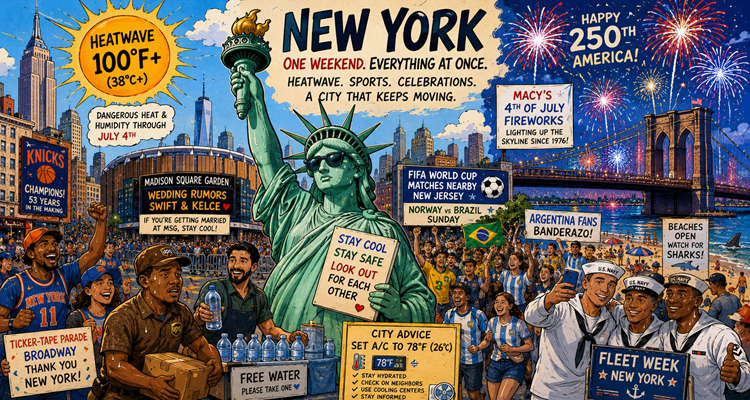
Cities are built to handle complexity, but occasionally a moment arrives when multiple challenges and celebrations collide at once. This holiday weekend, New York City finds itself at the center of an extraordinary convergence of events. Extreme temperatures, major sporting spectacles, large public gatherings, Independence Day celebrations, increased tourism, and concerns about public safety are all unfolding simultaneously.
At first glance, these developments may appear unrelated. Yet together they reveal something important about life in modern metropolitan centers. Cities are increasingly expected to host global events, support growing populations, manage climate-related risks, and maintain essential services without interruption.
New York’s experience this weekend is about more than a heatwave or a crowded calendar. It highlights how urban centers are evolving into complex ecosystems where weather, infrastructure, culture, economics, and public policy intersect in real time. For residents, visitors, businesses, and policymakers alike, the weekend serves as a case study in urban resilience and adaptation.
Understanding the Development
A Rare Convergence of Events
New York is experiencing an unusually dense concentration of activity over a single holiday period. Forecasts indicate dangerous heat and humidity levels, while the city simultaneously prepares for large-scale Independence Day celebrations, international sporting events, and significant tourism inflows.
Public spaces, transportation systems, emergency services, and businesses are all operating under heightened demand. Major attractions, waterfront areas, public pools, beaches, and entertainment venues are expected to draw large crowds despite the challenging weather conditions.
The city’s annual fireworks celebrations add another layer of logistical complexity. Organizing massive public events during periods of extreme weather requires extensive planning involving emergency management agencies, transportation authorities, law enforcement, healthcare providers, and utility operators.
The Climate Factor
Extreme heat has become one of the most significant weather-related threats facing cities worldwide.
Unlike dramatic storms or floods, heat emergencies often develop gradually. Yet their impacts can be equally serious. High temperatures increase health risks, strain energy systems, disrupt transportation networks, and affect worker productivity.
For cities like New York, prolonged periods of heat are becoming less of an exception and more of a recurring challenge. Urban environments tend to retain heat due to concrete, asphalt, and dense development, creating what experts call the “urban heat island” effect.
As temperatures rise, even routine daily activities become more demanding for residents, commuters, delivery workers, construction crews, and emergency responders.
Why This Matters
Cities Are Becoming Stress Tests for Modern Infrastructure
The significance of this weekend extends beyond weather forecasts and event schedules. It raises important questions about how major cities function under simultaneous pressures.
Electricity demand typically surges during heatwaves as households and businesses increase air-conditioning use. Transportation systems must handle larger crowds while operating safely in high temperatures. Healthcare facilities prepare for increased heat-related illnesses. Emergency services remain on alert for weather-related incidents.
These interconnected systems form the backbone of urban life. When multiple stressors occur at the same time, the resilience of the entire city ecosystem is tested.
The Human Experience Behind the Headlines
Large-scale events often focus attention on celebrities, sporting competitions, or public celebrations. Yet the real story frequently involves the people who keep cities running.
Delivery workers, restaurant staff, transit employees, sanitation crews, healthcare professionals, utility workers, and first responders continue performing essential tasks regardless of weather conditions.
Their experiences reveal a critical reality: climate impacts are not distributed equally. Those working outdoors or in physically demanding roles often face greater exposure to extreme temperatures than office workers or individuals with access to climate-controlled environments.
This disparity is becoming an increasingly important social and economic issue in cities worldwide.
What Is Changing
Climate Resilience Is Moving to the Center of Public Policy
Heat preparedness was once considered a seasonal concern. Today, it is becoming a year-round planning priority.
Cities are investing in cooling centers, public awareness campaigns, expanded green spaces, heat-resilient infrastructure, and emergency response systems designed specifically for extreme temperature events.
The debate surrounding recommended air-conditioning settings reflects a larger conversation about balancing comfort, energy consumption, grid reliability, and environmental sustainability.
While seemingly minor, discussions about thermostat settings point to broader questions facing urban policymakers: How can cities reduce energy demand during peak periods while protecting public health? What role should individuals play in collective resilience efforts?
These questions are likely to become more common as climate-related pressures intensify.
Public Spaces Are Adapting
Municipal leaders increasingly view public pools, parks, waterfronts, and cooling facilities as critical infrastructure rather than optional amenities.
Traditionally, infrastructure discussions focused on roads, bridges, and utilities. Today, access to safe cooling spaces is emerging as an essential component of urban planning.
As temperatures rise, cities may need to rethink everything from building design to public transportation shelters and outdoor event management strategies.
The Bigger Picture
New York Reflects a Global Urban Trend
What is happening in New York is not unique.
Cities across North America, Europe, Asia, and the Middle East are facing similar combinations of climate stress, tourism growth, population density, and increasing demands on public services.
Major urban centers are simultaneously competing to attract visitors, host international events, and stimulate economic activity while adapting to changing environmental realities.
The challenge is maintaining quality of life without overwhelming infrastructure systems.
The New Era of Mega-City Management
Modern cities increasingly operate as global stages. Sporting events, entertainment spectacles, tourism campaigns, cultural festivals, and economic activity often overlap throughout the year.
This creates significant opportunities for local businesses and workers. Hotels, restaurants, transportation providers, retailers, and entertainment venues often benefit from increased visitor spending.
However, success brings complexity.
The more active and attractive a city becomes, the greater the need for sophisticated planning, real-time coordination, and investment in resilience measures.
New York’s crowded holiday weekend illustrates both sides of this equation.
Opportunities and Challenges
Economic Gains From Activity and Tourism
Periods of heightened activity can generate substantial economic benefits.
Visitors spend money on accommodations, food, transportation, entertainment, and retail purchases. Sporting events and holiday celebrations attract domestic and international audiences. Local businesses often experience increased revenue during major tourism periods.
These economic gains help support employment and contribute to municipal revenues.
Rising Risks and Operational Pressures
At the same time, concentrated activity introduces challenges.
Extreme heat can discourage outdoor participation, increase public health risks, and place additional pressure on emergency services. Large crowds require enhanced security and transportation planning. Infrastructure systems face heavier demand precisely when weather conditions may reduce operational flexibility.
Cities must therefore strike a careful balance between maximizing economic opportunities and ensuring public safety.
Environmental Considerations
The weekend also highlights the environmental costs associated with dense urban activity.
Higher energy consumption, increased transportation demand, and large-scale events can contribute to greater resource use. Policymakers increasingly face pressure to support economic growth while advancing sustainability goals.
Finding practical solutions that satisfy both objectives remains one of the defining challenges of urban governance.
What Comes Next
Preparing for a More Complex Urban Future
Experts increasingly view extreme weather events not as isolated incidents but as indicators of broader long-term trends.
Cities are likely to experience more frequent periods where climate challenges overlap with economic, social, and cultural demands. As a result, urban planning strategies are evolving.
Future investments may focus on smarter energy grids, expanded cooling infrastructure, climate-adaptive public spaces, advanced crowd-management technologies, and more resilient transportation systems.
A New Definition of Urban Success
Historically, successful cities were judged by economic growth, population expansion, and cultural influence.
Today, resilience is becoming equally important.
The ability to manage heatwaves, protect vulnerable populations, maintain critical services, and host major events safely may increasingly define whether a city is considered well-prepared for the future.
New York’s experience this weekend offers a glimpse into that evolving standard.
Conclusion
The unusual convergence of extreme heat, large public gatherings, sporting events, holiday celebrations, and infrastructure pressures makes this one of New York City’s most revealing summer weekends in recent memory. Beyond the immediate challenges, it highlights a broader transformation affecting cities around the world.
As climate risks grow and urban activity intensifies, resilience is becoming a defining measure of civic success. The lessons emerging from New York are not simply about surviving a busy holiday weekend. They are about understanding how modern cities can continue to thrive when multiple demands compete for attention at the same time.
The weekend may pass quickly, but the questions it raises about climate adaptation, infrastructure readiness, public safety, and urban life are likely to shape city planning for years to come.
This content is published for informational or entertainment purposes. Facts, opinions, or references may evolve over time, and readers are encouraged to verify details from reliable sources.