









Portugal’s Emotional Triumph Keeps Ronaldo’s World Cup Dream Alive
Key Takeaways
- Cristiano Ronaldo scored his first-ever World Cup knockout-stage goal, setting a new age-related tournament record.
- Portugal overcame a resilient Croatia side and survived a dramatic VAR review in stoppage time.
- Gonçalo Ramos once again highlighted Portugal’s attacking depth with a decisive late winner.
- The victory carried emotional significance as Portugal honored the memory of Diogo Jota throughout the match.
- A blockbuster showdown against Spain now awaits, offering Portugal a major test of their championship credentials.
Introduction
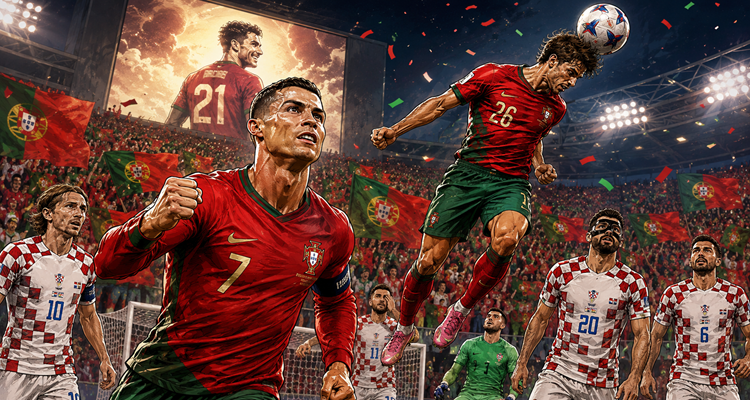
World Cups are often remembered not just for trophies, but for moments that define careers, nations, and generations of fans. Portugal’s dramatic 2–1 victory over Croatia delivered exactly that kind of moment. In a match filled with tension, emotional tributes, shifting momentum, and late controversy, Cristiano Ronaldo added another milestone to a career already overflowing with historic achievements.
Yet this was not simply a story about one player. It was a reflection of how Portugal has evolved into a team capable of blending veteran leadership with emerging talent. While Ronaldo provided the headline moment, it was Gonçalo Ramos who delivered the decisive blow, underscoring the depth that makes Portugal one of the tournament’s most intriguing contenders.
The result also highlighted a broader theme shaping modern international football: success increasingly belongs to teams that combine experience, tactical flexibility, and emotional resilience. Portugal demonstrated all three in Toronto, and their reward is a compelling last-16 encounter against Spain.
Understanding the Development
A Match Defined by Turning Points
Portugal entered the knockout match carrying expectations and pressure. Croatia, meanwhile, brought the experience of a nation that has consistently exceeded expectations on football’s biggest stage over the past decade.
The opening half largely belonged to Portugal in terms of possession and territorial control. However, dominance on the ball did not translate into goals. Croatia remained organized, disciplined, and dangerous on the counterattack.
The match changed dramatically after halftime.
Croatia found the breakthrough through Ivan Perišić, exposing Portugal during a period when the game became increasingly open. Rather than collapsing under pressure, Portugal responded with urgency and purpose.
Ronaldo’s equalizing penalty restored belief. Then, as extra time approached and fatigue began influencing decision-making, Ramos delivered the decisive header that ultimately separated the two sides.
The VAR Decision That Changed Everything
The final moments added another layer of drama.
Croatia appeared to have rescued the match with a stoppage-time equalizer. Celebrations erupted before a video review determined that an offside infringement had occurred during the build-up.
The decision preserved Portugal’s lead and ended Croatia’s hopes.
Whether celebrated or criticized, VAR once again demonstrated its growing influence in football’s biggest competitions. Increasingly, matches are not decided solely by goals but by the precision of technology designed to enforce marginal decisions.
Why This Matters
Ronaldo’s Record Is About More Than Statistics
Cristiano Ronaldo’s goal carried significance beyond the scoreline.
At 41, he became the oldest player to score in a World Cup knockout-stage match. More importantly, it represented the first knockout goal of his World Cup career.
For many elite athletes, longevity is measured by participation. Ronaldo continues to pursue influence.
His ability to remain decisive deep into his fourth decade speaks to broader shifts in sports science, nutrition, recovery methods, and athlete preparation. Modern football is increasingly extending careers once thought impossible.
Ronaldo’s achievement therefore reflects not only personal excellence but also the changing limits of elite athletic performance.
Portugal’s Growing Depth
Perhaps the bigger takeaway for Portugal supporters is that the team no longer depends entirely on Ronaldo.
Players such as Gonçalo Ramos, Rafael Leão, Bruno Fernandes, and others have emerged as genuine match-winners. This evolution makes Portugal significantly more dangerous than previous generations that often relied heavily on one superstar.
Successful tournament teams require multiple sources of goals, creativity, and leadership. Portugal increasingly fits that profile.
What Is Changing
The Shift Toward Collective Strength
International football has entered an era where balanced squads frequently outperform teams built around singular stars.
Portugal offers a compelling example.
Ronaldo remains the emotional and symbolic leader, but younger players are assuming greater responsibility in critical moments. Ramos’ winning goal illustrated how Portugal’s future is developing alongside its legendary past.
This transition is particularly important because knockout tournaments often require contributions from unexpected sources.
Championship teams rarely rely on one player alone.
A New Generation Learning Under Legends
Few countries have managed succession planning as effectively as Portugal.
The current squad allows younger players to develop alongside experienced leaders who understand the pressures of major tournaments.
This environment creates a valuable transfer of knowledge.
Young attackers learn positioning, professionalism, and mental preparation from players like Ronaldo, while also developing their own identities.
Such continuity strengthens a national team beyond a single tournament cycle.
The Bigger Picture
Football’s Enduring Fascination With Legacy
The match also reflected football’s ongoing fascination with legacy.
On one side stood Ronaldo, still pursuing the one major international achievement missing from his collection. On the other stood Luka Modrić, another veteran icon whose future at the international level remains uncertain.
These stories resonate because they connect sporting achievement with universal themes of time, ambition, and perseverance.
Fans are not merely watching matches. They are witnessing the closing chapters of extraordinary careers.
The Global Nature of Modern Football
Toronto provided an ideal backdrop for the occasion.
The large Portuguese and Croatian communities transformed the stadium into a celebration of identity, culture, and sporting passion.
Modern World Cups increasingly demonstrate football’s ability to unite global diaspora communities. Matches become cultural events as much as sporting contests, reinforcing connections between nations and citizens living far from home.
That phenomenon continues to expand the tournament’s global significance.
Opportunities and Challenges
Reasons for Optimism
Portugal leaves the match with several encouraging signs:
- Ronaldo remains capable of influencing major games.
- Ramos continues developing into a reliable scoring threat.
- The squad possesses depth across multiple positions.
- The team showed resilience after conceding first.
- Defensive organization largely held under pressure.
These attributes are essential for teams seeking deep tournament runs.
Areas of Concern
However, challenges remain.
Portugal’s first-half dominance produced limited end product. Against stronger opponents, wasted opportunities can prove costly.
Defensive lapses also allowed Croatia several dangerous moments. Teams with greater attacking efficiency may exploit similar weaknesses.
Furthermore, emotional victories can sometimes mask tactical issues that become more apparent in later rounds.
The coaching staff will likely focus on improving efficiency in both penalty areas before facing Spain.
What Comes Next
A Defining Test Against Spain
The upcoming clash with Spain may reveal more about Portugal’s true championship potential than any previous match.
Spain’s technical quality, midfield control, and tactical discipline will present a completely different challenge from Croatia.
The encounter will also offer a fascinating contrast between football philosophies. Portugal’s blend of direct attacking talent and experienced leadership will meet a Spanish side known for structure, possession, and collective movement.
Ronaldo’s Final Pursuit
Every World Cup appearance by Ronaldo now carries additional meaning.
While speculation about retirement continues, his performance against Croatia demonstrated that he remains capable of shaping outcomes on the biggest stage.
Whether Portugal ultimately lifts the trophy or not, the tournament has become part of a larger narrative: the pursuit of one final crowning achievement for one of football’s most influential figures.
That storyline will continue to captivate audiences around the world.
Conclusion
Portugal’s victory over Croatia was more than a passage into the next round. It was a reminder of how football blends emotion, history, technology, and human determination into unforgettable moments.
Cristiano Ronaldo added another remarkable chapter to his legacy, but Portugal’s success also highlighted the emergence of a new generation ready to carry the nation forward. The combination of experience and youthful ambition could prove decisive as the tournament progresses.
With Spain waiting in the next round, Portugal now faces a challenge that may define its World Cup journey. If the drama in Toronto is any indication, the road ahead promises even greater tests—and potentially even greater moments.
This content is published for informational or entertainment purposes. Facts, opinions, or references may evolve over time, and readers are encouraged to verify details from reliable sources.