










How Scientists Are Tracking the Hidden Pulse of Modern Cities
Key Takeaways
- Researchers have developed a satellite-based method that measures urban growth patterns almost in real time rather than relying on infrequent datasets.
- The study found that city development is often uneven, occurring in bursts, pauses, and localized cycles instead of steady expansion.
- Different cities display distinct growth signatures shaped by economic systems, governance models, and investment patterns.
- The approach could help planners identify economic stress, infrastructure risks, and development slowdowns before major problems emerge.
- Understanding a city’s “urban pulse” may transform how governments manage growth, resilience, and long-term sustainability.
Introduction
Cities are often described as engines of economic activity, centers of innovation, and hubs of human ambition. Yet beneath their skylines, transportation networks, and expanding neighborhoods lies a far more dynamic story—one that traditional urban statistics frequently fail to capture.
For decades, urban development has been measured using snapshots: census reports, economic indicators, population counts, or maps comparing changes over several years. While useful, these measurements often reveal outcomes rather than the processes driving them. By the time a slowdown, housing shortage, infrastructure bottleneck, or economic imbalance appears in official data, the underlying forces may have been building for years.
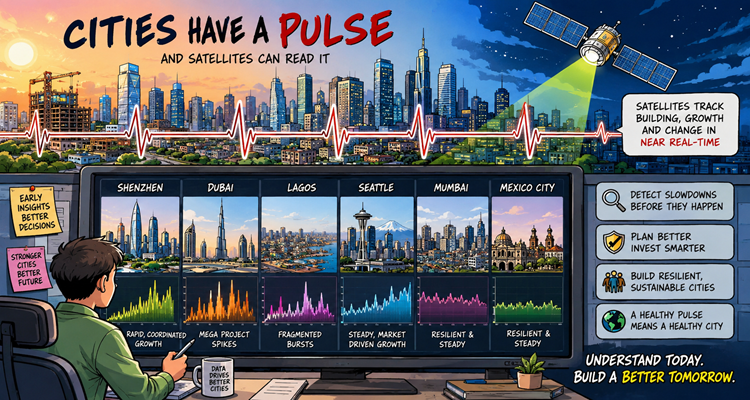
A new research approach is challenging that limitation by treating cities less like static landscapes and more like living systems. Using high-frequency satellite imagery, scientists have identified what they call an “urban pulse”—a pattern of growth, transformation, and recovery that reveals how cities evolve in near real time. The findings offer a fresh way to understand urbanization and may help policymakers anticipate challenges before they become crises.
Understanding the Development
A New Way to Measure Urban Change
The concept of an urban pulse draws inspiration from human health monitoring. Just as a person’s pulse provides ongoing information about physical condition, cities also generate signals that reveal their developmental health.
Researchers analyzed satellite imagery collected by NASA’s Landsat program and the European Space Agency’s Sentinel-2 satellites. Instead of focusing solely on final outcomes, they tracked continuous physical changes occurring across urban landscapes.
These changes included:
- New building construction
- Demolition activities
- Infrastructure expansion
- Redevelopment projects
- Encroachment into green spaces
- Neighborhood transformation patterns
By observing these changes over time, scientists were able to detect recurring rhythms in urban development.
Moving Beyond Static Urban Data
Traditional urban metrics often operate on annual or multi-year timelines. Population counts, economic reports, and infrastructure assessments can provide valuable information, but they often lack the temporal detail needed to understand rapid shifts.
The urban pulse approach introduces a process-oriented perspective. Rather than asking what a city looks like today, it examines how the city arrived at its current state and whether its trajectory suggests acceleration, stagnation, or transformation.
This distinction is significant because urban development rarely unfolds in a straight line.
Why This Matters
The Myth of Continuous Urban Growth
One of the study’s most important findings is that urbanization is not a smooth process.
Cities do not expand evenly year after year. Instead, development tends to occur in bursts. Certain neighborhoods experience rapid growth while others remain unchanged. Major construction waves can emerge suddenly, followed by periods of relative inactivity.
This pattern challenges long-held assumptions in urban planning and economic forecasting.
Understanding these fluctuations can help decision-makers distinguish between temporary slowdowns and structural weaknesses. It can also prevent overreactions to short-term changes that may simply be part of a city’s natural development cycle.
Early Detection Creates New Opportunities
In many cases, governments respond to urban problems after they become visible. Traffic congestion, housing shortages, declining neighborhoods, and infrastructure failures are often addressed once their consequences are already affecting residents.
A real-time urban monitoring system could change that dynamic.
If planners can identify declining development activity in a particular district months or years before conventional indicators highlight a problem, they may have time to intervene through investment, policy adjustments, or infrastructure upgrades.
This predictive capability could become increasingly valuable as cities face mounting pressures from population growth, climate risks, and economic uncertainty.
What Is Changing
Every City Has Its Own Development Signature
The study examined six globally significant cities representing diverse economic and political systems: Mumbai, Shenzhen, Dubai, Lagos, Seattle, and Mexico City.
Rather than revealing a universal growth pattern, the analysis showed that each city possesses a distinctive urban rhythm.
Shenzhen’s Coordinated Growth Engine
Shenzhen demonstrated some of the strongest and most concentrated growth patterns.
Once a small fishing community, it has evolved into one of the world’s most prominent technology and manufacturing centers. The city’s development pulse reflected highly coordinated investment and large-scale expansion efforts.
Its growth patterns suggest the effectiveness of centralized planning combined with sustained economic investment.
Dubai’s High-Intensity Development Cycles
Dubai displayed dramatic spikes in development associated with major construction initiatives and ambitious urban projects.
However, these bursts were often followed by pauses, indicating a development model heavily influenced by large-scale investment cycles.
This pattern highlights how capital-intensive megaprojects can rapidly reshape urban landscapes while also creating periods of slower activity between expansion phases.
Lagos and Fragmented Urban Expansion
Lagos presented a different picture.
Its development pattern was characterized by irregular bursts separated by longer intervals of relative inactivity. Such fragmentation reflects the challenges and opportunities associated with rapid population growth, informal urban expansion, and infrastructure constraints.
The findings suggest that growth in emerging megacities can be highly dynamic but unevenly distributed.
Market-Driven Growth in Seattle
Seattle’s pulse reflected continuous redevelopment and densification.
Rather than relying on large state-directed projects, growth appeared closely tied to market activity, investment flows, and evolving housing demand.
This pattern illustrates how economic incentives can generate steady urban transformation even without centralized development programs.
The Bigger Picture
Cities as Complex Adaptive Systems
The urban pulse concept aligns with a broader shift in urban science.
Increasingly, researchers view cities as complex adaptive systems where economic activity, transportation, housing, technology, demographics, and environmental conditions constantly interact.
Small changes in one area can create ripple effects across entire metropolitan regions.
This perspective helps explain why seemingly similar cities can respond very differently to identical external events.
What the Pandemic Revealed
The COVID-19 pandemic provided a unique stress test.
The satellite data captured development slowdowns across multiple cities. Yet recovery patterns varied significantly.
Some urban centers rebounded quickly, while others experienced more gradual recoveries. This divergence demonstrates that resilience depends on a combination of governance, economic structure, investment capacity, labor markets, and social conditions.
The lesson extends beyond pandemics. Climate events, financial crises, geopolitical disruptions, and technological transitions are also likely to affect cities differently.
Understanding urban pulse dynamics could therefore become an essential component of resilience planning.
The Rise of Data-Driven Urban Management
Cities are generating unprecedented amounts of information through satellites, sensors, mobility networks, and digital infrastructure.
The urban pulse framework represents part of a broader movement toward data-informed governance.
Rather than relying solely on historical reports, city leaders may increasingly use continuous monitoring systems to make decisions based on evolving conditions.
This shift could fundamentally change how urban policy is designed and implemented.
Opportunities and Challenges
Benefits for Policymakers and Planners
The practical applications are substantial.
Potential benefits include:
- Earlier identification of declining neighborhoods
- Better infrastructure investment timing
- Improved land-use planning
- More efficient allocation of public resources
- Enhanced disaster recovery planning
- Stronger economic resilience strategies
These capabilities could help cities respond proactively rather than reactively.
Risks of Over-Reliance on Data
However, data alone cannot solve urban challenges.
Satellite imagery may reveal physical changes, but it does not always capture social realities such as community well-being, affordability concerns, or quality-of-life outcomes.
A neighborhood experiencing rapid construction activity may still face social inequality, displacement pressures, or environmental stress.
For this reason, urban pulse monitoring should complement, not replace, community engagement and traditional planning methods.
Balancing Growth and Sustainability
Another challenge involves interpreting growth itself.
A strong urban pulse is not automatically positive. Rapid expansion can strain infrastructure, increase environmental pressures, and widen social disparities if growth is poorly managed.
Likewise, slower development may sometimes reflect stabilization rather than decline.
Effective interpretation will require combining physical development signals with economic, environmental, and social indicators.
What Comes Next
Toward Predictive Urban Intelligence
The future of urban management may increasingly resemble preventive healthcare.
Rather than waiting for visible symptoms, city leaders could continuously monitor developmental indicators and identify risks at an early stage.
Advances in artificial intelligence, remote sensing, and geospatial analytics are likely to make such systems more sophisticated and accessible.
Future urban pulse models may integrate:
- Housing market data
- Transportation patterns
- Energy consumption
- Climate indicators
- Population movement
- Economic activity metrics
Together, these signals could create comprehensive urban health dashboards.
A New Era for Growing Cities
As the global urban population continues to expand, governments face the challenge of balancing growth, sustainability, affordability, and resilience.
Tools capable of detecting subtle shifts before they become major disruptions could prove invaluable.
The ability to understand not just where cities are, but where they are heading, may become one of the most important advantages in urban governance.
Conclusion
The discovery of urban pulse patterns offers a compelling new lens through which to view modern cities. Rather than static collections of buildings and infrastructure, cities emerge as dynamic systems constantly adapting to economic, social, and environmental forces.
By capturing development activity in near real time, researchers are providing planners, policymakers, and communities with a more nuanced understanding of urban change. The greatest value of this approach may not lie in documenting growth itself, but in revealing the signals that precede transformation. In a century increasingly defined by urbanization, learning to read those signals could help cities become more resilient, sustainable, and responsive to the needs of the people who call them home.
This content is published for informational or entertainment purposes. Facts, opinions, or references may evolve over time, and readers are encouraged to verify details from reliable sources.