










Could Greenland’s Melting Ice Reshape Europe’s Climate Future?
Key Takeaways
- Scientists are launching a major Greenland expedition to better understand how glacier melt affects Atlantic Ocean circulation.
- Freshwater from melting ice could alter ocean currents that help regulate temperatures across Europe.
- New data collected beneath glaciers may improve climate models and strengthen early-warning systems for climate risks.
- The research comes as Europe experiences record-breaking heat, highlighting growing concerns about climate instability.
- Findings could influence future climate planning, coastal protection strategies, and global adaptation efforts.
Introduction
Greenland’s vast ice sheet has become one of the most closely watched regions on Earth. As global temperatures continue to rise, scientists are increasingly focused on understanding what happens when enormous volumes of freshwater flow from melting glaciers into the North Atlantic Ocean. The concern extends far beyond Greenland itself. Changes occurring in the Arctic have the potential to influence weather patterns, sea levels, and ocean circulation systems that affect millions of people across Europe and beyond.
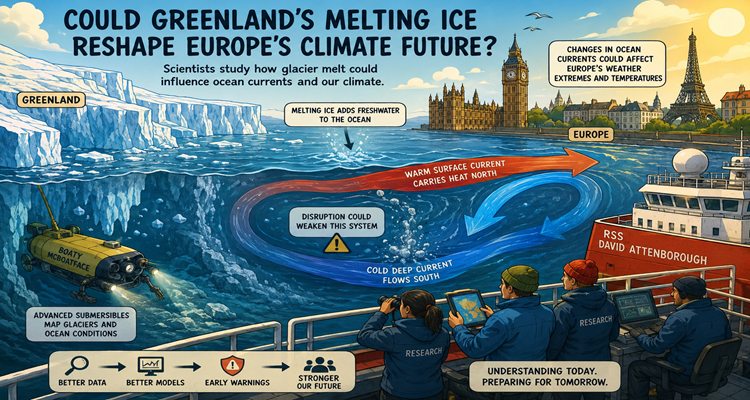
This week, an international team of researchers embarked on a major scientific mission aboard the RSS David Attenborough, one of the world’s most advanced polar research vessels. Their goal is not simply to observe melting ice but to answer a far more consequential question: could Greenland’s accelerating glacier loss destabilize critical ocean currents that help moderate Europe’s climate?
The answer carries implications for governments, industries, and communities preparing for a future shaped by increasingly complex climate risks.
Understanding the Development
A Mission Focused on Climate Tipping Points
The expedition forms part of a major scientific initiative known as GIANT (Greenland Ice Sheet to Atlantic Tipping Points), a multi-year research effort aimed at understanding the relationship between Greenland’s glaciers and the wider Atlantic climate system.
Around 80 scientists, engineers, and crew members are participating in the mission. Over several weeks, researchers will investigate how glaciers melt, how ice breaks apart and enters the ocean, and how the resulting freshwater affects surrounding marine environments.
The project seeks answers to one of climate science’s most pressing questions: whether increasing amounts of meltwater could interfere with large-scale ocean circulation patterns that distribute heat around the planet.
Why Ocean Currents Matter
The Atlantic Ocean is home to a vast network of currents that transport warm water northward and colder water southward. These currents play a significant role in maintaining relatively moderate temperatures across much of Western Europe.
Without these oceanic heat transport systems, regions such as the United Kingdom, Ireland, and parts of northern Europe could experience substantially different climatic conditions.
Scientists worry that excessive freshwater entering the North Atlantic may reduce the density of seawater, potentially weakening the natural sinking processes that help drive these currents. Although a complete shutdown is not considered imminent, even partial disruptions could have significant consequences.
Why This Matters
Europe Is Already Experiencing Climate Stress
The timing of the Greenland mission is particularly significant. Across Europe, recent summers have delivered unprecedented heatwaves, placing pressure on energy systems, transportation networks, agriculture, and public health infrastructure.
Extreme temperatures have led to higher electricity demand, increased wildfire risks, and mounting concerns about heat-related illnesses. These events provide a glimpse of how sensitive modern societies remain to climatic changes.
Understanding future climate risks is no longer merely a scientific challenge. It has become an economic and social necessity.
Better Predictions Mean Better Decisions
Climate adaptation depends heavily on forecasting. Governments need reliable projections to design flood defenses, upgrade infrastructure, manage water resources, and protect vulnerable communities.
If scientists can better understand how Greenland’s melting ice influences ocean circulation, climate models can become more accurate. Improved forecasting enables policymakers to prepare for emerging risks before they become crises.
This research therefore serves not only academic interests but also practical decision-making across multiple sectors.
A Global Issue, Not Just an Arctic Problem
Although Greenland lies thousands of kilometers from most European population centers, climate systems do not respect geographic boundaries.
What happens in the Arctic influences weather patterns across continents. Changes in sea ice, glacier melt, and ocean temperatures can alter atmospheric circulation, affecting rainfall patterns, storms, agricultural productivity, and coastal conditions around the world.
The Greenland ice sheet has become a symbol of how interconnected Earth’s climate systems truly are.
What Is Changing
New Technology Is Opening Hidden Frontiers
One of the most innovative aspects of the expedition involves the use of advanced autonomous underwater technology.
Researchers will deploy a sophisticated submersible capable of exploring beneath dense mixtures of sea ice, snow, and glacier fragments near the ocean-facing edges of glaciers.
These environments are notoriously difficult to access, making them among the least understood parts of the polar system.
The submersible will map underwater glacier structures and gather detailed measurements that were previously impossible to obtain at scale. Such information can reveal how glaciers interact with warmer ocean waters and why some glaciers retreat faster than others.
Climate Models Are Entering a New Era
For decades, climate models relied heavily on satellite observations and surface measurements. While these tools remain essential, researchers increasingly recognize the need for direct observations from locations where critical processes occur.
Data collected during the Greenland mission will help fill important knowledge gaps.
More detailed information about underwater glacier behavior, freshwater release, and ocean mixing processes can improve the next generation of climate simulations. These improvements could provide earlier indications of instability and help scientists identify emerging tipping points before they are crossed.
The Bigger Picture
Greenland Is Losing Ice at an Accelerating Pace
The Greenland Ice Sheet contains enough frozen water to raise global sea levels by several meters if it were to melt completely. While such a scenario would unfold over centuries, current melting rates have increased significantly compared with historical norms.
Warmer air temperatures, changing ocean conditions, and feedback mechanisms are contributing to faster ice loss.
Satellite observations over recent decades have consistently shown that Greenland is shedding mass at an accelerating rate, making it one of the largest contributors to global sea-level rise.
Climate Risks Are Becoming More Connected
One of the defining characteristics of modern climate science is the recognition that environmental risks rarely occur in isolation.
Glacier melting affects sea levels. Sea-level rise influences coastal communities. Ocean circulation changes can alter weather systems. Weather changes impact agriculture, health, infrastructure, and economies.
This interconnectedness means that a shift occurring in one region can create cascading effects elsewhere.
The Greenland expedition reflects a growing scientific effort to understand these linkages before they become larger societal challenges.
The Rise of Tipping Point Research
Climate researchers are increasingly focused on tipping points—thresholds beyond which environmental systems may undergo rapid or irreversible changes.
Examples include collapsing ice sheets, weakening ocean currents, disappearing coral reefs, and thawing permafrost.
While significant uncertainty remains regarding the timing and likelihood of specific tipping points, scientists agree that understanding these risks is critical.
The GIANT project represents part of a broader global effort to identify warning signs before major transitions occur.
Opportunities and Challenges
The Opportunity to Improve Climate Resilience
One of the most valuable outcomes of this research could be stronger early-warning capabilities.
If scientists can detect indicators of glacier instability or ocean circulation changes earlier, governments and communities gain more time to adapt.
Better warning systems can support:
- Coastal planning
- Infrastructure investment
- Disaster preparedness
- Water resource management
- Agricultural adaptation strategies
The economic value of advanced climate intelligence could be substantial.
Scientific Complexity Remains a Major Challenge
Despite technological advances, polar environments remain among the most difficult places on Earth to study.
Extreme weather, remote locations, sea ice conditions, and logistical constraints make data collection expensive and challenging.
Climate systems themselves are also highly complex. Multiple variables interact simultaneously, making it difficult to isolate specific causes and effects.
This complexity means that researchers must continue gathering long-term observations rather than relying on short-term findings.
Balancing Urgency With Scientific Rigor
Public concern about climate change often creates pressure for immediate answers. However, responsible science requires careful analysis, verification, and peer review.
The challenge for researchers is to communicate risk clearly while avoiding exaggeration.
The Greenland expedition demonstrates how science advances through evidence gathering rather than assumptions. Each new dataset contributes another piece to a much larger puzzle.
What Comes Next
Building the Climate Forecasting Systems of Tomorrow
The data collected during this mission will feed into future climate models and support the development of advanced monitoring systems.
Researchers hope these tools will improve understanding of glacier dynamics, ocean circulation behavior, and climate tipping points.
Over time, such systems may function similarly to weather forecasting networks, providing earlier signals of environmental changes that could have broad societal impacts.
A New Phase of Polar Research
The expedition also highlights a broader shift in climate science. Researchers are moving beyond documenting environmental change and toward understanding the mechanisms driving it.
This transition is crucial. Measuring ice loss tells us what is happening. Understanding glacier-ocean interactions helps explain why it is happening and what might happen next.
That distinction is essential for planning future responses.
Climate Knowledge as Strategic Infrastructure
As climate risks increasingly influence economies, public health, national security, and resource management, scientific knowledge itself is becoming a form of infrastructure.
The ability to anticipate change may prove as important as physical defenses against it.
Research missions like this one are therefore investments not only in science but also in long-term resilience.
Conclusion
The voyage of the RSS David Attenborough to Greenland represents far more than a scientific expedition into remote polar waters. It is part of a global effort to understand how changes unfolding at the planet’s frozen edges may shape the future of entire regions.
As Europe grapples with record heat and growing climate uncertainty, understanding the relationship between glacier melt and ocean circulation has become increasingly urgent. The answers gathered beneath Greenland’s icy waters could help refine climate forecasts, strengthen adaptation strategies, and provide earlier warnings of emerging risks.
In an era when environmental change is accelerating, the most valuable resource may not be technology alone, but knowledge—particularly the knowledge needed to anticipate what comes next.
This content is published for informational or entertainment purposes. Facts, opinions, or references may evolve over time, and readers are encouraged to verify details from reliable sources.