









How Environmental DNA Is Changing the Future of Wildlife Monitoring
A rare amphibian slips through a wetland at night. A fish swims beneath murky water. A mammal passes through a forest hours before sunrise. For decades, documenting the presence of these animals required cameras, traps, field surveys, or direct observation methods that often demanded significant time, funding, and expertise.
Today, scientists can sometimes detect these same species without ever seeing them.
The reason is environmental DNA, often called eDNA, a rapidly advancing scientific tool that is reshaping how researchers understand wildlife populations and ecosystems. By analyzing tiny genetic traces that organisms leave behind in water, soil, snow, or even air, scientists are gaining access to information that was previously difficult, expensive, or sometimes impossible to collect.
What makes this development particularly significant is not simply that it improves wildlife monitoring. It changes the scale at which nature can be observed, creating new possibilities for conservation, ecosystem management, and biodiversity protection at a time when many species face increasing environmental pressures.
Reading Nature’s Genetic Footprints
Every living organism continuously sheds genetic material into its surroundings. Fish release cells into rivers and lakes. Mammals leave traces through skin, hair, saliva, and waste. Birds, insects, and amphibians contribute their own microscopic genetic signatures to the environment.
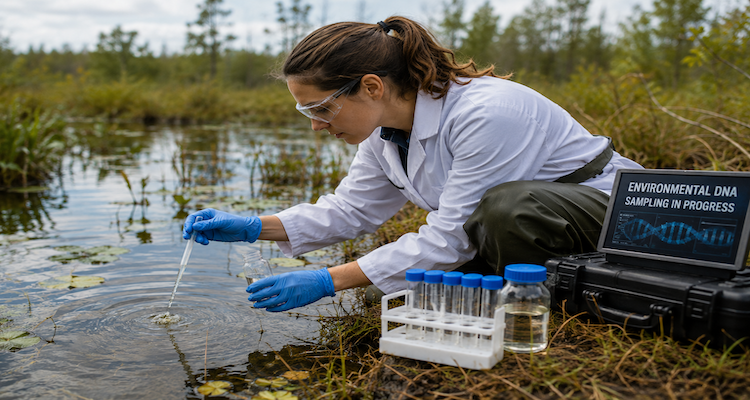
Environmental DNA analysis involves collecting samples from natural settings and examining them for these traces. Scientists can then compare the genetic material against reference databases to identify which species have recently been present in a particular area.
Unlike traditional monitoring techniques, eDNA does not always require capturing, observing, or disturbing animals directly. A single water sample from a river may reveal multiple species living within an ecosystem, offering a broader picture of biodiversity.
This capability is especially valuable in environments where visibility is poor or where species are elusive. Deep-water habitats, dense forests, wetlands, and remote landscapes have historically posed challenges for researchers. Environmental DNA offers a way to gather evidence without relying solely on physical sightings.
Why Conservationists Are Paying Attention
The growing interest in eDNA reflects a larger challenge facing conservation efforts worldwide: the need for better information.
Protecting wildlife depends on knowing where species live, how populations are changing, and whether conservation measures are working. Yet gathering reliable ecological data can be difficult, particularly for endangered or hard-to-find animals.
Environmental DNA can help fill these gaps.
Researchers have used eDNA to monitor invasive species before populations become established, detect endangered species that might otherwise go unnoticed, and assess biodiversity across large geographic areas. Early detection is particularly important because conservation interventions are often more effective when problems are identified before they escalate.
In some cases, environmental DNA can reveal the presence of species that traditional surveys miss entirely. This does not mean older methods are becoming obsolete, but it does provide an additional layer of information that can improve decision-making.
As conservation budgets remain limited in many regions, tools that increase efficiency while expanding ecological insight are attracting growing attention from governments, universities, and environmental organizations.
A Shift From Observation to Detection
One of the most important implications of eDNA is philosophical as much as technological.
Historically, wildlife monitoring has depended heavily on direct observation. Researchers looked for animals, tracks, nests, calls, or visual evidence. Environmental DNA introduces a different approach: detecting presence through biological traces rather than physical encounters.
This subtle shift has profound consequences.
Instead of asking, “Can we find the animal?” scientists increasingly ask, “Can we find evidence that the animal was here?”
The distinction matters because ecosystems are often more active and diverse than direct observations suggest. Many species avoid humans, move at night, or inhabit inaccessible environments. Environmental DNA can uncover ecological activity that would otherwise remain hidden.
The result is a more detailed and potentially more accurate understanding of biodiversity patterns.
The Rise of Biodiversity Intelligence
Environmental DNA is also contributing to a broader trend that could be described as biodiversity intelligence.
Across many industries, data-driven decision-making has transformed how organizations operate. Businesses rely on analytics to understand customers. Cities use sensors to manage infrastructure. Healthcare increasingly depends on biological and digital data.
Conservation is beginning to follow a similar path.
Environmental DNA allows ecosystems themselves to become sources of continuous biological information. Instead of relying solely on periodic surveys, future monitoring systems may combine eDNA sampling with remote sensing, artificial intelligence, satellite imagery, and automated environmental sensors.
The emerging goal is not merely documenting wildlife but creating dynamic, near-real-time pictures of ecological health.
This represents a significant evolution in conservation thinking. Rather than reacting to biodiversity loss after it becomes visible, organizations may increasingly identify warning signs earlier and respond more proactively.
Challenges Behind the Promise
Despite its potential, environmental DNA is not a perfect solution.
Detecting DNA does not always reveal how many individuals are present. A positive result may indicate recent activity but not necessarily current abundance. Environmental conditions can also affect how long genetic material remains detectable.
Interpretation therefore requires caution.
Scientists must consider factors such as water movement, contamination risks, seasonal variation, and laboratory methodologies. A river sample, for example, may contain DNA transported from locations upstream, complicating efforts to pinpoint an exact source.
There are also ongoing questions about standardization. As eDNA becomes more widely adopted, researchers continue working toward consistent sampling protocols and analytical frameworks that allow results to be compared across studies and regions.
For these reasons, many experts view environmental DNA as a powerful complement to traditional monitoring methods rather than a complete replacement.
Why This Matters Beyond Science
The importance of environmental DNA extends beyond research institutions and conservation agencies.
Public awareness of biodiversity issues has grown significantly in recent years. Concerns about habitat loss, species decline, climate change, and ecosystem resilience are increasingly influencing policy discussions, corporate sustainability strategies, and consumer expectations.
Reliable ecological information plays a critical role in these conversations.
Environmental DNA has the potential to improve transparency by providing stronger evidence about ecosystem conditions and species presence. Governments can use this information to inform environmental planning. Companies may rely on biodiversity assessments when evaluating development projects. Conservation groups can better measure the effectiveness of restoration efforts.
Perhaps most importantly, environmental DNA offers a reminder that ecosystems contain far more complexity than human observation alone can reveal.
Every stream, forest, wetland, and coastline carries hidden biological information waiting to be interpreted.
The Future of Wildlife Monitoring
Environmental DNA is still an evolving field, but its trajectory suggests it will become an increasingly important component of wildlife monitoring in the years ahead.
As genetic sequencing technologies become faster and more accessible, the ability to analyze environmental samples is likely to expand. New techniques may improve species identification, enhance monitoring precision, and open opportunities for broader ecosystem assessment.
The deeper significance of environmental DNA lies in what it reveals about humanity’s relationship with nature. For generations, understanding wildlife depended on seeing animals directly. Today, scientists are learning to read the invisible genetic footprints that organisms leave behind.
That shift is helping transform wildlife monitoring from a process of occasional observation into a more comprehensive system of ecological discovery one capable of uncovering hidden biodiversity and informing smarter conservation decisions in an increasingly complex world.
This content is published for informational or entertainment purposes. Facts, opinions, or references may evolve over time, and readers are encouraged to verify details from reliable sources.