









Why Microclimates Are Reshaping Real Estate Decisions
A home’s value has traditionally been linked to familiar factors: location, schools, transportation, amenities, and neighborhood reputation. Increasingly, however, another variable is entering the conversation, one that can vary dramatically within the same city, or even between adjacent neighborhoods. That variable is climate.
Not the broad climate patterns that define regions, but microclimates: localized environmental conditions that create noticeable differences in temperature, humidity, wind exposure, air quality, flood risk, and weather resilience. As extreme weather events become more frequent in many parts of the world, buyers, developers, investors, and insurers are paying closer attention to these hyperlocal climate realities.
What was once considered a niche environmental concern is gradually becoming a practical real estate consideration with financial consequences.
The Rise of Hyperlocal Climate Awareness
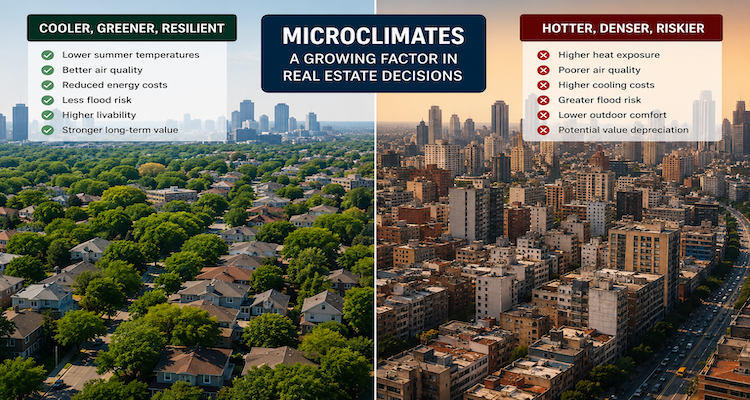
A microclimate exists when a small geographic area experiences environmental conditions that differ from surrounding locations. Urban parks, waterfront districts, tree-lined neighborhoods, elevated terrain, and densely built commercial zones can all develop distinct climate characteristics.
In many cities, residents already recognize these differences intuitively. One neighborhood may feel significantly cooler during summer because of abundant tree cover, while another just a few miles away absorbs and retains heat due to concrete surfaces and limited vegetation.
Advances in environmental mapping, satellite monitoring, and local weather analytics are making these differences more visible and measurable. As a result, climate awareness is moving from environmental reports into real estate evaluations.
For prospective buyers, the question is no longer simply, “Is this a good neighborhood?” Increasingly, it is also, “How will this location perform during heatwaves, heavy rainfall, droughts, or changing weather patterns over the next decade?”
Why Climate Conditions Are Becoming Property Factors
Climate has always influenced where people choose to live. Coastal communities, mountain towns, and temperate regions have long attracted residents seeking specific environmental conditions.
The difference today is that climate considerations are becoming more granular.
Rather than comparing one city to another, buyers are comparing one district to another based on environmental resilience. A neighborhood with mature trees, effective drainage systems, and lower heat exposure may offer a different quality of life than a nearby area that experiences recurring flooding or extreme summer temperatures.
These differences affect daily comfort, energy consumption, outdoor activity, and long-term maintenance costs.
For homeowners, climate resilience increasingly translates into financial resilience.
The Growing Influence of Heat
One of the most visible examples involves urban heat.
Many cities experience the “urban heat island” effect, where dense concentrations of buildings, roads, and paved surfaces absorb and retain heat. Areas with limited green space can become significantly warmer than nearby neighborhoods with parks, water features, or tree canopies.
As summers become hotter in many regions, buyers are beginning to recognize the practical implications.
A cooler neighborhood may reduce air-conditioning costs, improve outdoor livability, and offer a more comfortable environment for families and older residents. Developers are responding by incorporating green infrastructure, rooftop gardens, shade systems, and landscape design intended to mitigate heat exposure.
What was once viewed primarily as an environmental feature is increasingly becoming a lifestyle and property-value consideration.
Flood Risk Is Moving Into Mainstream Decision-Making
Flooding presents another area where microclimates are influencing real estate choices.
Historically, many buyers focused on visible risks such as proximity to rivers or coastlines. Today, localized flooding can result from drainage limitations, changing rainfall patterns, soil conditions, and urban development decisions.
Two neighborhoods within the same city may face dramatically different levels of vulnerability during heavy storms.
As climate risk assessments become more accessible, homebuyers are asking more detailed questions about flood history, water management systems, and future resilience planning.
Insurance providers are also paying attention. In some regions, risk exposure can affect premiums, coverage availability, and long-term ownership costs. This means climate-related factors are no longer purely environmental concerns, they can directly influence affordability.
The Hidden Role of Air Quality
Air quality is emerging as another underappreciated factor in residential decision-making.
Topography, traffic density, industrial activity, and vegetation can create substantial variations in air quality across relatively small geographic areas.
For families with children, older adults, or individuals with respiratory concerns, these differences may become increasingly important. The growing availability of environmental data allows prospective residents to evaluate neighborhoods using criteria that were difficult to assess only a few years ago.
This shift reflects a broader change in consumer behavior. People are not merely purchasing a property; they are evaluating an entire living environment.
Developers Are Designing for Microclimates
The influence of microclimates is extending beyond buyers and affecting how communities are planned and built.
Forward-looking developers increasingly consider localized environmental conditions during project design. Building orientation, natural ventilation, shading strategies, water management systems, and green spaces can all improve resilience and comfort.
In some cases, climate-responsive design can make a development more attractive to future residents seeking sustainable and livable communities.
This trend reflects a larger evolution in real estate. Property value is becoming tied not only to square footage and amenities but also to environmental performance.
Neighborhoods that effectively adapt to local climate conditions may gain a competitive advantage over those that do not.
A New Kind of Real Estate Insight
Perhaps the most important shift is psychological rather than environmental.
For decades, real estate decisions were heavily influenced by past conditions. Buyers examined historical property values, neighborhood trends, and existing infrastructure.
Climate awareness introduces a more future-oriented perspective.
People are increasingly evaluating how a location may perform years from now rather than focusing solely on current conditions. Questions about resilience, adaptability, and long-term sustainability are becoming part of the decision-making process.
This represents a subtle but significant change in consumer behavior. Real estate is no longer viewed exclusively as a snapshot of present value; it is increasingly assessed as a long-term environmental investment.
That shift may ultimately become one of the most important transformations in modern housing markets.
What This Means for the Future of Real Estate
Microclimates are unlikely to replace traditional real estate considerations such as affordability, schools, transportation, and employment opportunities. However, they are becoming an additional layer of analysis that can influence purchasing decisions.
As climate data becomes more accessible and environmental risks become easier to visualize, buyers will likely become more sophisticated in evaluating locations. Developers, insurers, lenders, and municipal planners may also place greater emphasis on localized climate resilience.
The neighborhoods that attract future demand may not simply be those with the best amenities or strongest market reputation. They may also be the places best equipped to provide comfort, safety, and stability in a changing environmental landscape.
For many buyers, the question is no longer whether climate matters. The question is how much climate matters—and how local those impacts really are.
This content is published for informational or entertainment purposes. Facts, opinions, or references may evolve over time, and readers are encouraged to verify details from reliable sources.