










When Disaster Becomes Documentary and What Shipwrecked Leaves Unanswered
Key Takeaways
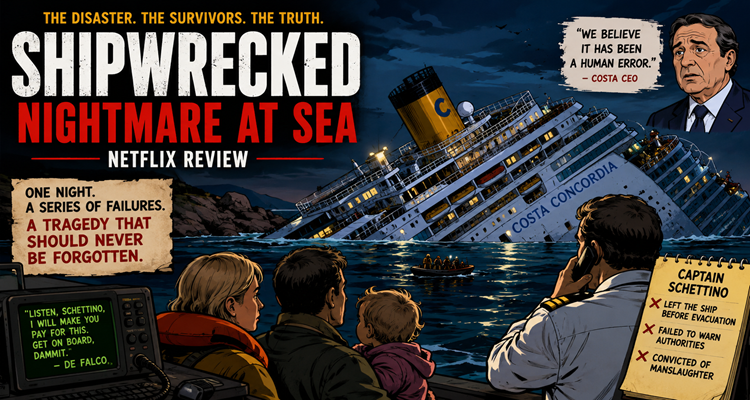
- Netflix’s Shipwrecked: Nightmare at Sea revisits the Costa Concordia disaster through survivor testimonies and archival evidence.
- The documentary effectively recreates the terror of the sinking but spends limited time examining its deeper causes.
- Captain Francesco Schettino’s actions remain central to the tragedy, yet broader organizational failures receive comparatively little scrutiny.
- Survivor stories reveal extraordinary resilience, highlighting the human capacity to endure fear, uncertainty, and loss.
- The film raises important questions about accountability, safety culture, and how disasters are remembered years later.
Introduction
Disaster documentaries have become one of the most compelling forms of modern storytelling. Audiences are drawn not only to dramatic events but also to the human experiences hidden behind headlines. Netflix’s Shipwrecked: Nightmare at Sea enters this space by revisiting one of the most infamous maritime disasters of the twenty-first century, the sinking of the Costa Concordia off the Italian coast in January 2012.
The documentary succeeds in transporting viewers into the chaos and confusion experienced by thousands of passengers and crew members during a night that quickly transformed from a luxury vacation into a fight for survival. Yet the story of the Costa Concordia is larger than a single catastrophic mistake. It is also a story about leadership, corporate culture, risk management, and the lasting psychological scars left on those who survived.
While the film captures the emotional intensity of the disaster, its greatest significance may lie in the questions it leaves unresolved. Understanding those questions offers a deeper perspective on why this tragedy continues to resonate more than a decade later.
Understanding the Disaster Beyond the Headlines
On January 13, 2012, the Costa Concordia struck a submerged rock formation near Giglio Island in the Mediterranean Sea. The impact ripped open the vessel’s hull and triggered a chain of events that would eventually lead to the deaths of 32 people.
More than 4,000 individuals were on board, including passengers and crew. What should have been a routine voyage quickly became a crisis marked by confusion, delayed communication, and increasingly dangerous conditions as the ship began to list.
The documentary reconstructs these events primarily through firsthand accounts. Survivors describe dark hallways, failing systems, contradictory instructions, and growing panic as the seriousness of the situation became impossible to ignore.
This approach creates a deeply personal narrative. Rather than presenting the disaster as a sequence of technical failures, the film places viewers alongside families, workers, and travelers who suddenly find themselves navigating a life-threatening emergency.
The Power of Eyewitness Memory
One of the documentary’s strongest elements is its use of survivor recollections combined with archival footage, emergency communications, and onboard recordings.
These accounts reveal an important reality often overlooked in discussions of disasters: people rarely experience crises with perfect information.
Passengers did not know the extent of the damage.
Crew members did not fully understand what was happening.
Many individuals spent critical moments trying to determine whether the situation was serious at all.
This uncertainty is what makes disasters psychologically devastating. Fear is amplified when people are forced to make life-altering decisions without reliable information.
Why This Matters Beyond Maritime History
At first glance, the Costa Concordia disaster may seem like a singular event tied to one captain and one ship. However, its lessons extend far beyond maritime transportation.
Major disasters often reveal vulnerabilities that existed long before the triggering event. Rarely does a catastrophe occur because of one mistake alone.
Instead, crises tend to emerge when multiple failures overlap.
In the Concordia case, questions emerged regarding leadership decisions, emergency preparedness, communication systems, training standards, and organizational oversight.
The Accountability Challenge
Public attention often gravitates toward individuals because assigning blame to a single person creates a simple narrative.
Francesco Schettino became the face of the disaster. His actions, particularly leaving the ship before all passengers had been evacuated, generated global outrage and earned him lasting notoriety.
Yet complex disasters seldom fit neatly into a single-villain framework.
Focusing exclusively on one individual can obscure deeper structural problems that may have contributed to the conditions in which failure became possible.
This distinction matters because systemic issues tend to persist unless they are thoroughly examined and corrected.
What the Documentary Gets Right
Despite its limitations, Shipwrecked: Nightmare at Sea succeeds in several important ways.
It Restores the Human Dimension
Large-scale tragedies often become statistics over time.
Thirty-two deaths.
Thousands evacuated.
One ship lost.
Numbers communicate scale but rarely communicate experience.
The documentary gives survivors the opportunity to reclaim their stories and reminds audiences that every disaster affects real people with families, ambitions, and futures.
The accounts involving parents protecting children, crew members assisting passengers, and trapped survivors waiting for rescue are among the film’s most powerful moments.
It Demonstrates How Quickly Normality Can Collapse
One recurring theme is the speed at which certainty disappears.
Passengers who were dining, socializing, or relaxing suddenly found themselves confronting a completely different reality.
This transformation from comfort to crisis underscores an important lesson about modern risk: many systems appear safe until they fail.
When failure occurs, preparedness becomes more important than confidence.
The Missing Conversation About Systems
Where the documentary becomes less satisfying is in its exploration of the broader forces that may have contributed to the tragedy.
The sinking was not merely a story about navigation errors.
It was also connected to larger questions involving organizational decision-making, safety practices, and operational culture.
The Risk of Individualizing Failure
One of the most common mistakes in disaster analysis is treating a catastrophe as the result of isolated human error.
Research across aviation, healthcare, engineering, and transportation consistently shows that accidents often emerge from layers of small weaknesses.
These weaknesses can include:
- Insufficient training
- Poor oversight
- Communication breakdowns
- Incentives that prioritize efficiency over safety
- Organizational complacency
When systems function well, these vulnerabilities remain hidden.
When disaster strikes, they become visible all at once.
The documentary touches on some of these issues but never fully investigates them.
As a result, viewers receive a vivid account of what happened without gaining the same depth of understanding regarding why it happened.
The Bigger Picture of Disaster Storytelling
The popularity of disaster documentaries reflects a broader cultural trend.
Audiences increasingly seek explanations rather than simple retellings.
People want to understand:
- How failures occur
- Why warning signs are missed
- What institutions learned afterward
- Whether similar events could happen again
This shift mirrors growing public interest in accountability and transparency.
Modern viewers are not satisfied with narratives that merely identify a culprit. They increasingly expect investigations that uncover the underlying mechanisms behind failure.
Why Survivors Matter More Than Ever
Another important trend involves the role of survivor testimony.
Historically, disaster coverage often focused on officials, investigators, and institutions.
Today, survivors occupy a central place in storytelling.
This change reflects a broader recognition that lived experience contains valuable insights.
Survivors can reveal how policies, decisions, and systems affect people in real-world conditions.
Their stories help transform abstract failures into tangible human consequences.
Opportunities and Challenges in Telling True Tragedies
Creating a documentary about a real disaster presents unique challenges.
Filmmakers must balance emotional storytelling with investigative rigor.
Too much emphasis on technical details can feel detached.
Too much emphasis on emotion can leave important questions unanswered.
The Opportunity
The greatest opportunity lies in connecting personal experiences with structural analysis.
When audiences understand both what people endured and why those conditions emerged, documentaries become educational as well as emotional.
Such films contribute to public understanding and can even influence future safety improvements.
The Challenge
The challenge is time.
Complex disasters often involve years of investigations, legal proceedings, regulatory reviews, and organizational reforms.
Condensing those layers into a relatively short runtime inevitably requires difficult choices.
The result can be a compelling narrative that captures attention while leaving deeper exploration for viewers to pursue elsewhere.
What Comes Next for Disaster Documentaries
The future of documentary storytelling is likely to move toward greater depth and interdisciplinary analysis.
Viewers increasingly expect content that combines:
- Human stories
- Investigative journalism
- Expert analysis
- Historical context
- Future implications
Streaming platforms face growing competition not only from traditional media but also from independent creators producing detailed long-form investigations.
This evolution is raising audience expectations.
A visually engaging documentary is no longer enough. Many viewers now want explanations that illuminate systems, institutions, and decision-making processes.
For filmmakers, that represents both a challenge and an opportunity.
The most influential documentaries of the future may be those that successfully connect emotional narratives with deeper societal lessons.
Conclusion
Shipwrecked: Nightmare at Sea delivers a gripping and emotionally intense account of the Costa Concordia disaster. Through survivor testimonies and archival evidence, it recreates the fear, confusion, and uncertainty experienced by thousands during one of the most infamous maritime tragedies in recent history.
Yet the story’s enduring significance extends beyond a single captain’s failures or a single night at sea. The disaster remains a case study in leadership, accountability, organizational culture, and the consequences of overlooked risks.
The documentary reminds viewers how fragile certainty can be when systems fail. At the same time, it highlights something equally important: the resilience of ordinary people confronting extraordinary circumstances.
Its greatest contribution may not be the answers it provides, but the questions it encourages audiences to keep asking long after the credits roll.
This content is published for informational or entertainment purposes. Facts, opinions, or references may evolve over time, and readers are encouraged to verify details from reliable sources.
Related News
- Netflix’s 2026 Book Options Reveal What Stories It May Be Betting On Next
- Why Video Game Adaptations Are Finally Winning Over Audiences
- From Fan Fiction to Blockbusters: How Online Communities Are Changing Storytelling
- The Death of Channel Surfing: How Streaming Changed the Way We Discover Entertainment