










When Convenience Replaces Effort: The Hidden Cultural Costs of a Frictionless World
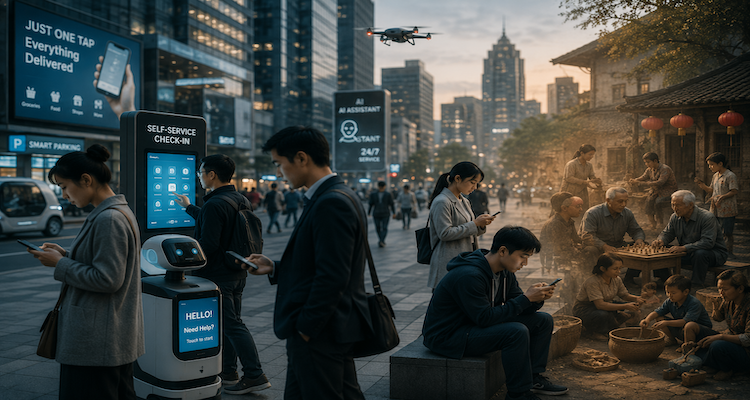
A few decades ago, many everyday tasks required patience, negotiation, memory, or human interaction. People asked strangers for directions, waited for letters, learned phone numbers by heart, browsed bookstores without algorithms, and developed routines around activities that demanded time and effort. Today, many of those moments have been compressed into a tap, swipe, or voice command.
The benefits are undeniable. Convenience saves time, reduces stress, and expands access to services that once felt difficult or exclusive. Yet as societies become increasingly optimized for speed and ease, a deeper question is emerging: what happens when friction disappears from daily life altogether?
The answer is not simply technological. It is cultural.
The Quiet Role Friction Has Always Played
Friction is often treated as a problem to eliminate. In business, reducing customer effort is considered a competitive advantage. In technology, seamless experiences are celebrated. In urban design, digital services, entertainment, and retail, convenience has become a defining measure of success.
But friction has historically served purposes beyond inconvenience.
Waiting, searching, practicing, and navigating uncertainty have helped people develop patience, resilience, social skills, and local knowledge. Many cultural traditions evolved through processes that were not efficient but meaningful. Rituals, apprenticeships, family customs, and community gatherings often depended on effort and participation rather than instant access.
When societies remove friction, they may also remove some of the experiences that give activities their depth.
A handwritten letter takes longer than a text message, yet the effort involved often communicates emotional significance. Cooking a family recipe from memory requires more work than ordering food through an app, but it can also preserve cultural identity across generations.
The value lies not only in the outcome but in the process itself.
Convenience Is Changing How Communities Form
One of the less discussed consequences of convenience is its effect on social interaction.
Many services that once required human contact now operate through automated systems. Self-checkout kiosks, delivery platforms, digital banking, and online customer support have reduced the need for face-to-face exchanges. While this can improve efficiency, it also reduces the number of casual interactions that help create social familiarity.
Historically, communities were strengthened through repeated encounters in public spaces. Local shops, libraries, markets, and neighborhood gathering places functioned as informal social infrastructure. Even brief conversations contributed to a sense of belonging.
As more activities move into personalized digital environments, people gain convenience but may lose some opportunities for spontaneous connection. The result is not necessarily isolation, but a shift toward more intentional and often narrower forms of interaction.
This subtle change can influence how people build trust, understand different perspectives, and participate in civic life.
The Rise of Algorithmic Culture
Convenience increasingly shapes what people watch, read, listen to, and buy.
Recommendation systems help users find content quickly, reducing the effort required to search through overwhelming choices. Streaming platforms suggest movies, music services build playlists, and social media feeds curate information based on past behavior.
These systems are useful, but they also change how cultural discovery happens.
In previous generations, discovery often involved exploration and chance encounters. People stumbled across unfamiliar books in libraries, heard unexpected music on the radio, or encountered viewpoints outside their preferences.
Today, algorithms frequently prioritize relevance and personalization. While this improves user satisfaction, it can also reduce exposure to the unexpected.
The cultural consequence is subtle but significant: societies may become more efficient at delivering what people already like while becoming less effective at introducing them to what they did not know they needed.
Friction, in this context, often served as a gateway to discovery.
Skills Fade When Systems Take Over
Another hidden cost of convenience is the gradual outsourcing of human capability.
Navigation apps have transformed travel, but many people rely less on spatial memory. Predictive text speeds communication, yet may reduce attention to spelling and language structure. Search engines provide instant answers, diminishing the need to retain certain kinds of information.
This does not mean technology is making people less intelligent. Rather, it is changing which skills are practiced and which are delegated to systems.
Throughout history, societies have adapted to new tools. The printing press reduced the need to memorize large amounts of information. Calculators changed mathematical workflows. Digital tools continue this pattern.
The important question is not whether skills are being lost but whether enough attention is being paid to what replaces them.
When convenience removes effort, it can also remove opportunities for mastery, reflection, and learning.
Why Younger Generations May Experience Culture Differently
For many younger people, frictionless systems are not innovations they are the default environment.
Streaming replaces ownership. Instant delivery replaces anticipation. AI tools increasingly reduce the time required to create, search, or organize information.
As a result, cultural expectations may be shifting.
Experiences that require patience can feel unusually demanding. Activities with delayed rewards may compete with systems designed for immediate gratification. Long-term commitment, deep expertise, and traditional craftsmanship can become harder to sustain in environments optimized for speed.
Yet there is growing evidence of a countertrend.
The popularity of vinyl records, handmade products, slow travel, analog hobbies, and long-form learning suggests that many people still seek experiences that involve effort and engagement. These activities often provide something convenience cannot easily replicate: a sense of participation.
People are not simply consuming experiences; they are helping create them.
The Emerging Value of Meaningful Friction
Perhaps the most important insight is that not all friction is bad.
Some friction is wasteful and deserves to disappear. Few people miss standing in long lines or navigating unnecessary bureaucracy. Removing barriers can improve accessibility, productivity, and quality of life.
However, societies may need to distinguish between harmful friction and meaningful friction.
Meaningful friction is the effort that creates understanding, connection, skill, or purpose. It is the challenge involved in learning a language, mastering an instrument, maintaining relationships, or contributing to a community. These experiences are valuable precisely because they are not instantaneous.
As artificial intelligence, automation, and digital services continue to advance, the ability to identify and preserve meaningful friction may become increasingly important.
The future may not belong to societies that eliminate effort entirely. It may belong to those that learn which forms of effort are worth keeping.
What Happens Next?
The pursuit of convenience is unlikely to slow down. Businesses will continue competing to make services faster, smoother, and more personalized. Consumers will continue embracing tools that reduce time and complexity.
Yet a growing cultural conversation is emerging beneath that trend.
People are beginning to ask whether efficiency alone is enough. As more aspects of life become frictionless, questions about identity, community, creativity, and meaning become harder to ignore.
The challenge for the coming decades may not be deciding how much convenience society wants. It may be deciding what should remain intentionally difficult.
Because some of the experiences that shape cultures, relationships, and personal growth were never meant to be effortless in the first place.
This content is published for informational or entertainment purposes. Facts, opinions, or references may evolve over time, and readers are encouraged to verify details from reliable sources.