










How Netflix’s 2026 Production Boom Is Reshaping Global Entertainment
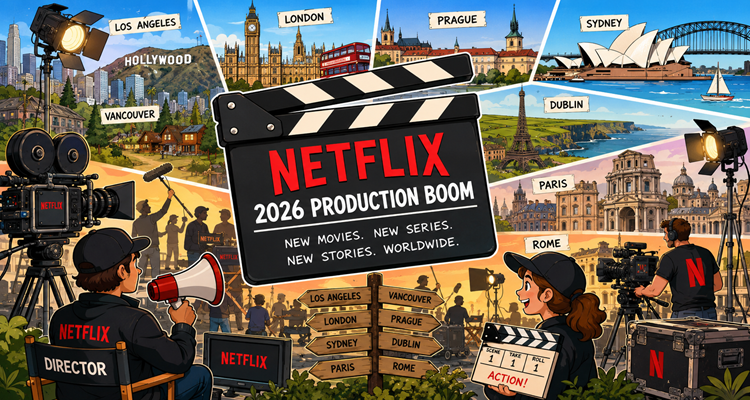
Key Takeaways
- Netflix is simultaneously filming dozens of movies and series across North America, Europe, Australia, and New Zealand.
- Major franchises, bestselling book adaptations, and star-led originals dominate the platform’s upcoming production pipeline.
- Production activity is increasingly spreading beyond Hollywood into regional filming hubs with growing economic influence.
- The streaming giant is investing heavily in long-term intellectual property that can sustain audience engagement for years.
- The scale of current filming signals a strategic shift toward globally relevant stories with local production footprints.
Introduction
While audiences typically focus on what arrives on Netflix each month, a more revealing story is unfolding behind the scenes. Across multiple continents, cameras are rolling on an extraordinary number of films and television series that offer clues about where the streaming industry is heading next.
From Australia’s Gold Coast and Ireland’s countryside to New York, Paris, and Prague, Netflix has assembled one of the most geographically diverse production slates in entertainment. The projects range from action blockbusters and prestige dramas to literary adaptations, romantic series, historical thrillers, and globally recognized franchises.
This surge in production is about more than content volume. It reflects changing audience behavior, intensifying competition among streaming platforms, and the growing importance of international storytelling. For viewers, the upcoming slate offers a glimpse into future entertainment trends. For cities, studios, and creative industries, it represents jobs, investment, and cultural influence.
The bigger question is not simply what Netflix is filming. It is why the company is building such a vast production ecosystem and what it reveals about the future of global entertainment.
Understanding the Scale of Netflix’s Current Production Strategy
The traditional entertainment model once centered around a handful of major production hubs, particularly Los Angeles and New York. Today, Netflix operates more like a global media network than a conventional studio.
Its current production schedule includes large-scale action films, fantasy projects, prestige dramas, historical adaptations, romantic comedies, crime thrillers, and family-oriented programming. Many productions are underway simultaneously across Europe, North America, Australia, and other emerging production regions.
Several notable projects demonstrate the breadth of this approach:
Franchise Expansion Remains a Priority
Returning series continue to occupy a central place in Netflix’s strategy. Popular titles such as Wednesday, Bridgerton, Emily in Paris, The Night Agent, Virgin River, and The Lincoln Lawyer remain active parts of the platform’s future roadmap.
These shows already possess established fan communities, reducing audience acquisition costs while increasing subscriber retention. In an increasingly competitive streaming environment, familiar franchises provide stability.
Big-Budget Films Still Matter
Netflix is also investing in major cinematic productions. Action sequels, large-scale science-fiction projects, historical dramas, and star-driven comedies remain essential to attracting global attention.
Projects involving actors such as Chris Hemsworth, Adam Sandler, Meryl Streep, Sydney Sweeney, Jonathan Bailey, Oscar Isaac, and Aaron Taylor-Johnson demonstrate Netflix’s continued commitment to high-profile talent.
The objective is clear: create events that generate conversation beyond the streaming platform itself.
Why This Matters Beyond Entertainment
At first glance, a list of productions may appear relevant only to film enthusiasts. In reality, the implications extend far beyond viewers.
The Streaming Economy Is Becoming a Major Employer
Every large-scale production generates employment opportunities for actors, technicians, editors, costume designers, visual effects artists, transportation providers, hospitality businesses, and local vendors.
A single television season can support hundreds of direct jobs and thousands of indirect economic activities.
As Netflix expands production across multiple countries, local economies increasingly benefit from entertainment investment that was once concentrated in a few cities.
Regional Production Hubs Are Gaining Influence
Cities such as Vancouver, Calgary, Brisbane, Prague, Dublin, and Queenstown are becoming increasingly important to global entertainment.
These locations offer attractive tax incentives, diverse landscapes, experienced crews, and lower operational costs compared with traditional Hollywood centers.
For governments and local industries, hosting international productions can boost tourism, infrastructure investment, and long-term creative-sector development.
Audience Expectations Have Changed
Modern viewers expect a continuous stream of fresh content. The days when audiences waited years between major releases are rapidly disappearing.
Streaming platforms now compete based on consistency. Large production pipelines help ensure that viewers always have something new to watch.
What Is Changing in Netflix’s Content Strategy
A closer examination of current productions reveals several notable shifts.
Literary Adaptations Are Dominating Development
Many upcoming projects originate from bestselling novels, podcasts, or established intellectual property.
Adaptations based on authors such as Harlan Coben, Jonathan Franzen, André Aciman, Dan Brown, Liz Moore, and Carley Fortune illustrate a broader industry trend.
Studios increasingly prefer stories with proven audiences because they reduce uncertainty.
For Netflix, recognizable source material creates built-in awareness while attracting readers who may become viewers.
Romance Is Experiencing a Strong Revival
One of the most noticeable developments is the growing number of romance-focused productions.
BookTok-driven adaptations, young adult romances, coming-of-age stories, and relationship-centered dramas are becoming major investments.
This reflects changing audience demand. Streaming analytics consistently show strong engagement for emotionally driven narratives that encourage repeat viewing and social sharing.
Global Stories Are Replacing Region-Specific Thinking
Netflix increasingly develops projects with international appeal from the outset.
Rather than producing content solely for domestic markets, creators are designing stories that can resonate across cultures and languages.
This strategy helps maximize return on investment while expanding audience reach.
The Bigger Picture Behind the Production Surge
The current production boom reflects deeper transformations within the entertainment industry.
Streaming Has Entered a Maturity Phase
The first era of streaming focused on subscriber growth. The current phase emphasizes retention and long-term engagement.
Platforms must continually justify recurring subscription fees. That requires a steady flow of original programming capable of appealing to diverse demographics.
Netflix’s production volume suggests confidence that exclusive content remains its strongest competitive advantage.
Intellectual Property Is Becoming More Valuable
The entertainment industry increasingly revolves around franchises, recognizable brands, and adaptable story worlds.
A successful series can generate multiple seasons, spin-offs, merchandise opportunities, and long-term audience loyalty.
This explains why Netflix continues investing heavily in established books, beloved characters, and recognizable creative properties.
International Production Is Now a Strategic Asset
Global filming is no longer simply a cost-saving measure.
Producing content in multiple countries helps Netflix build stronger relationships with local governments, production partners, creative communities, and audiences.
It also reduces dependence on any single market while expanding storytelling possibilities.
Opportunities and Challenges Ahead
Opportunities
Netflix’s broad slate creates several advantages.
First, it diversifies risk. A platform supported by numerous genres and demographics is less vulnerable to individual project failures.
Second, it strengthens international reach. Local productions often perform unexpectedly well in global markets.
Third, it enables creative experimentation. With a larger portfolio, Netflix can support both blockbuster projects and niche storytelling.
Challenges
The strategy also carries significant risks.
Rising Production Costs
Large-scale productions require substantial investment. Inflation, labor costs, location expenses, and visual-effects budgets continue to rise.
Even successful streaming platforms face pressure to justify spending.
Content Saturation
The abundance of available content creates discoverability challenges.
Producing more shows does not automatically guarantee audience attention. Viewers have limited time and increasingly fragmented entertainment habits.
Franchise Fatigue
While established intellectual property offers security, overreliance on familiar brands can reduce creative innovation.
Balancing original storytelling with recognizable franchises will remain a critical challenge.
What Comes Next for Netflix and the Streaming Industry
The current production slate offers insight into the future direction of streaming.
Several trends appear likely to accelerate.
Cross-Media Adaptations Will Expand
Books, podcasts, graphic novels, and online communities will continue serving as content pipelines for future productions.
Audiences increasingly discover stories across multiple formats before they reach television screens.
Global Talent Networks Will Grow
The distinction between domestic and international productions is becoming less meaningful.
Actors, writers, directors, and production teams now collaborate across borders with greater frequency than ever before.
Data and Creativity Will Become More Interconnected
Streaming platforms possess unprecedented insight into audience behavior.
Future content decisions will likely blend creative instincts with increasingly sophisticated audience analytics.
Success will depend on finding stories that satisfy both artistic ambitions and measurable viewer demand.
Conclusion
Netflix’s extensive 2026 filming slate is more than a collection of upcoming releases. It represents a snapshot of an entertainment industry undergoing profound transformation.
The company’s investment in international locations, literary adaptations, franchise expansion, and diverse storytelling reflects changing audience expectations and a more interconnected global media landscape.
For viewers, the result will be a steady stream of new stories arriving over the next several years. For creative industries worldwide, it signals growing opportunities as production becomes increasingly decentralized.
Perhaps the most significant takeaway is that streaming has evolved beyond a distribution model. It is now a global production ecosystem, one capable of influencing economies, cultural trends, and the future direction of storytelling itself.
This content is published for informational or entertainment purposes. Facts, opinions, or references may evolve over time, and readers are encouraged to verify details from reliable sources.
Related News
- Netflix’s 2026 Book Options Reveal What Stories It May Be Betting On Next
- Why Video Game Adaptations Are Finally Winning Over Audiences
- From Fan Fiction to Blockbusters: How Online Communities Are Changing Storytelling
- The Death of Channel Surfing: How Streaming Changed the Way We Discover Entertainment