









Why More Students Are Building Personal Knowledge Systems Instead of Taking Notes
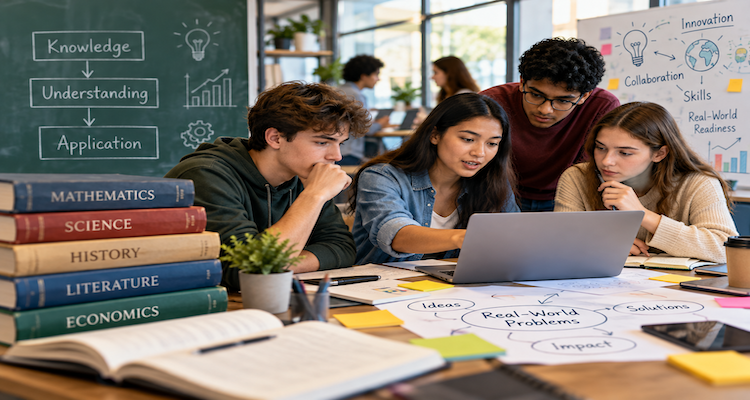
For generations, students were taught a familiar routine: attend class, write notes, highlight important passages, and review everything before an exam. Yet a quiet shift is unfolding across classrooms, universities, online learning platforms, and self-directed learning communities. A growing number of students are no longer treating note-taking as the end goal. Instead, they are building something far more ambitious a personal knowledge system.
This change is subtle enough to escape headlines, but significant enough to reshape how people learn. Rather than collecting information in notebooks or scattered documents, students are organizing ideas into interconnected systems that help them think, remember, and create long after a course ends.
The trend reflects a deeper realization: information is abundant, but understanding is not. In a world where facts are instantly searchable, the ability to connect knowledge may matter more than the ability to store it.
From Information Storage to Knowledge Building
Traditional notes are often linear. Students record what a teacher says, summarize textbook chapters, and file everything away for future review. While this approach can be effective for short-term learning, it frequently creates isolated pieces of information that are difficult to revisit months or years later.
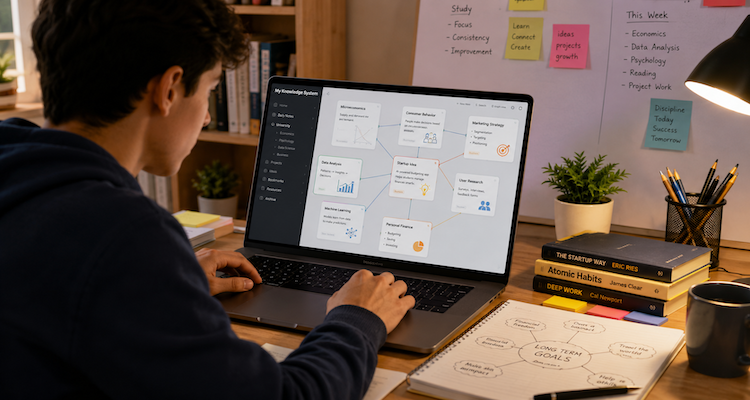
Personal knowledge systems operate differently. They focus on relationships between ideas rather than simple information capture. Students link concepts across subjects, add personal observations, create summaries in their own words, and continuously refine their understanding.
The goal is not merely to remember content for an examination. The goal is to build a knowledge network that becomes more useful over time.
This mindset has been encouraged by the growing popularity of digital tools that allow users to connect notes, create knowledge databases, and organize information dynamically. However, the underlying shift is behavioral rather than technological. Students are changing how they think about learning itself.
Why Traditional Note-Taking Feels Less Effective
Many students experience a common frustration. They spend hours taking detailed notes only to discover later that they cannot easily retrieve or apply what they learned.
Part of the problem lies in the nature of modern education. Students are exposed to enormous volumes of information across multiple subjects, digital resources, videos, articles, podcasts, and online discussions. Capturing everything becomes nearly impossible.
As a result, some learners are questioning whether more notes actually lead to better understanding.
Instead of asking, “How do I record this information?” they are asking, “How does this connect to what I already know?”
That shift changes everything.
When knowledge becomes interconnected, learning becomes cumulative. Concepts learned in economics may inform business decisions. Ideas from psychology may influence marketing strategies. Scientific principles may inspire entrepreneurial thinking. Learning stops being divided into separate subjects and begins functioning as a broader intellectual framework.
The Influence of the Creator Economy
Another factor driving this trend is the rise of the creator economy.
Students today are not simply preparing for exams. Many are building blogs, YouTube channels, newsletters, portfolios, freelance careers, startups, and personal brands while still studying.
In these environments, information has value only when it can be transformed into insights, content, products, or decisions.
A student who maintains a personal knowledge system can quickly retrieve ideas, combine concepts, and generate original work. Notes become assets rather than archives.
This mirrors how professionals increasingly operate in modern workplaces. Knowledge workers are often expected to synthesize information from multiple sources, identify patterns, and communicate insights. Personal knowledge systems help students develop these capabilities early.
Learning in the Age of Artificial Intelligence
The growing presence of artificial intelligence has added another dimension to this shift.
When AI tools can summarize articles, generate explanations, and answer factual questions within seconds, the competitive advantage of memorizing information alone becomes less clear.
What remains uniquely valuable is context, judgment, interpretation, and creativity.
Students are beginning to recognize that their personal knowledge systems can serve as intellectual foundations that AI cannot fully replicate. While an AI system can generate information, it cannot automatically possess a student’s unique experiences, interests, goals, and understanding.
The most effective learners are increasingly combining AI-assisted information gathering with human-driven knowledge organization.
This creates an important distinction: AI can help collect information, but personal knowledge systems help create meaning.
The Hidden Skill Schools Rarely Teach
One of the most interesting aspects of this trend is that it highlights a skill rarely emphasized in traditional education: knowledge management.
Schools teach subjects. They teach problem-solving. They teach research techniques.
Yet few institutions explicitly teach students how to manage what they learn over an entire lifetime.
As careers become more dynamic and industries evolve faster, lifelong learning is becoming a necessity rather than a choice. Professionals frequently need to acquire new skills, adapt to emerging technologies, and navigate changing workplace demands.
Students who build personal knowledge systems are, in effect, practicing lifelong learning before entering the workforce.
They are creating structures that can grow alongside their careers rather than disappear after graduation.
Beyond Academic Success
The benefits extend beyond grades and examinations.
Personal knowledge systems can support better decision-making, stronger creativity, improved writing, and deeper critical thinking. They encourage learners to revisit ideas repeatedly, strengthening understanding through reflection rather than repetition.
This process often leads to unexpected discoveries.
A student reviewing old notes may recognize a connection between two seemingly unrelated topics. A business concept may suddenly align with a technological trend. An idea captured months earlier may become relevant to a new project.
These moments of synthesis are difficult to achieve when information remains trapped inside disconnected notebooks or forgotten folders.
The value emerges not from the quantity of information collected but from the quality of connections created.
What This Trend Reveals About the Future of Education
The rise of personal knowledge systems points to a broader transformation in how learning is perceived.
For much of modern educational history, success often depended on accessing information. Today, information is everywhere. The challenge is making sense of it.
This reality may gradually push educational institutions to place greater emphasis on knowledge integration, critical thinking, and long-term intellectual development.
Future learners may be evaluated less on what they can recall and more on how effectively they can connect ideas, solve problems, and generate new insights.
Personal knowledge systems align naturally with that future because they encourage active engagement rather than passive consumption.
A Quiet Revolution in Learning
Most educational trends attract attention through new technologies, curriculum reforms, or policy debates. The rise of personal knowledge systems is different. It is largely happening beneath the surface, driven by individual learners seeking better ways to think.
Students are discovering that learning does not end when a lecture finishes or an exam is completed. Knowledge becomes most valuable when it remains accessible, connected, and useful over time.
What appears to be a simple change in note-taking habits may actually represent something much larger: a shift from collecting information to building personal intelligence.
As information continues to expand at unprecedented speed, that ability may become one of the defining skills of modern education—and one of the most important advantages students can carry into the future.
The information presented in this article is based on publicly available sources, reports, and factual material available at the time of publication. While efforts are made to ensure accuracy, details may change as new information emerges. The content is provided for general informational purposes only, and readers are advised to verify facts independently where necessary.