










When AI Becomes Your Personal Historian: The Rise of Digital Life Documentation
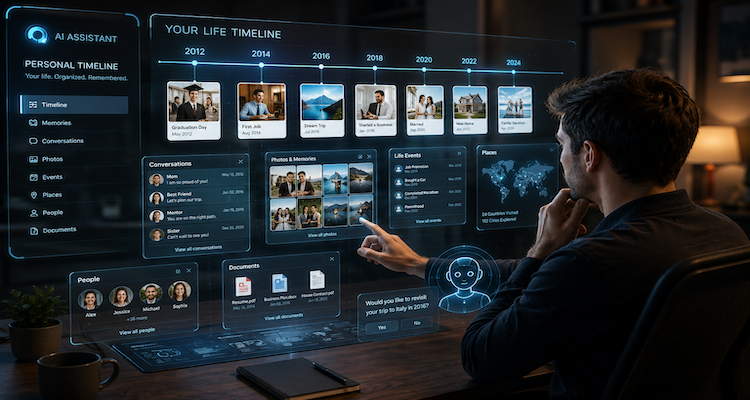
A curious shift is happening in the background of everyday digital life. For years, technology helped people capture moments through photos, videos, social media posts, and messages. Today, a new generation of artificial intelligence systems is beginning to do something more ambitious: documenting entire lives.
The change is subtle but significant. AI is no longer limited to responding to questions or automating tasks. Increasingly, it is becoming a persistent observer of digital activity remembering conversations, organizing experiences, tracking preferences, and connecting events across time. In effect, some AI systems are evolving into personal historians.
What makes this development remarkable is not the technology itself, but what it reveals about how humans are starting to interact with their own memories.
The Evolution from Storage to Storytelling
For decades, digital platforms have stored vast amounts of personal information. Smartphones record locations, cloud services archive photographs, email platforms preserve conversations, and social networks maintain years of posts and interactions.
Yet most of this information remains fragmented.
A person may have thousands of photos, countless messages, and years of browsing history, but turning those scattered records into a meaningful narrative has traditionally required effort. Finding a specific memory often meant searching through folders, timelines, or archives.
AI changes that equation.
Instead of merely storing information, advanced systems can identify patterns, connect events, summarize experiences, and surface relevant memories. The technology begins transforming raw data into something closer to a life story.
A future AI assistant might not simply remind someone about a meeting they attended three years ago. It could explain how that meeting influenced later decisions, projects, relationships, or career changes by recognizing connections across multiple sources of information.
The transition from digital storage to digital storytelling may become one of the most important shifts in personal technology.
Why Interest Is Growing Now
Several trends are converging at the same time.
First, people are generating more digital records than ever before. Everyday activities leave trails across messaging apps, calendars, productivity tools, wearable devices, photos, videos, and online services.
Second, AI systems have become dramatically better at understanding context. Modern models can interpret language, recognize themes, summarize long conversations, and identify recurring patterns.
Third, technology companies are increasingly exploring memory-based features in AI assistants. Rather than treating each interaction as isolated, these systems can retain context over time and personalize responses based on past conversations and behaviors.
The combination creates a powerful possibility: an AI that gradually builds an evolving understanding of a person’s experiences, preferences, milestones, and habits.
In many ways, digital memory is becoming an infrastructure layer rather than a standalone feature.
The Unexpected Human Appeal
At first glance, the idea of AI documenting human lives sounds highly technical. Yet its appeal is deeply emotional.
Human memory is imperfect.
People forget details, misremember timelines, and lose track of experiences that once seemed important. Major life events are often remembered, but the smaller moments that shape identity frequently disappear.
AI-based life documentation offers something different. It creates the possibility of preserving not only major milestones but also the everyday patterns that reveal who someone was at a particular point in time.
Imagine asking an AI:
- How did my interests change over the past five years?
- What topics was I most passionate about last year?
- When did I first start working toward a particular goal?
- What habits consistently improved my productivity?
These questions are less about information retrieval and more about self-understanding.
That distinction helps explain why interest in AI memory systems extends beyond productivity and convenience.
A New Form of Personal Reflection
One of the most overlooked implications of AI historians is their potential role in personal reflection.
Historically, people relied on journals, diaries, letters, and photo albums to document life experiences. These tools captured moments but rarely analyzed them.
AI introduces interpretation.
A future system might identify recurring themes across years of personal records. It could reveal how priorities changed, how relationships evolved, or how specific decisions influenced later outcomes.
This represents a subtle but important shift.
Instead of serving only as a repository of memories, technology begins acting as a mirror that reflects patterns humans might otherwise miss.
The insight opportunity here is significant: AI may become less valuable as a source of answers and more valuable as a source of perspective.
Many people already use technology to understand finances, health metrics, and productivity trends. Personal history may become the next area where digital analysis helps individuals understand themselves.
The Privacy Question Cannot Be Ignored
The rise of AI historians also introduces complex concerns.
A system that understands someone’s life in detail inevitably requires access to sensitive information. Personal conversations, schedules, locations, interests, and behaviors may all contribute to building a comprehensive digital history.
This creates difficult questions.
Who controls that information?
How long should it be retained?
Can users selectively forget events?
What happens when AI-generated interpretations are inaccurate?
Unlike traditional archives, AI systems do not simply preserve information. They actively organize, summarize, and prioritize it. Those processes introduce judgment, whether intentional or not.
As memory features become more sophisticated, transparency and user control will likely become essential design priorities.
The challenge is not merely protecting data. It is protecting personal narratives.
Businesses Are Paying Attention
The concept of AI as a personal historian is attracting attention far beyond consumer technology.
Organizations increasingly recognize the value of preserving institutional memory.
Employees leave companies. Projects change direction. Teams evolve. Critical knowledge is often lost during transitions.
AI systems capable of documenting decisions, discussions, and project histories could help organizations maintain continuity. Instead of searching through endless documents and emails, teams could access contextual explanations of why specific choices were made.
The same principle that helps individuals understand their past may help businesses preserve organizational knowledge.
This broader application suggests that digital historians may eventually become common across workplaces, educational institutions, and professional networks.
What Makes This Moment Different
Technology has documented human activity for years, but previous systems mostly acted as passive archives.
Today’s AI systems introduce active interpretation.
That distinction changes everything.
A photo gallery stores images. An AI historian explains connections between them.
A calendar records events. An AI historian identifies patterns behind them.
A message archive preserves conversations. An AI historian uncovers recurring themes across years of communication.
The shift is not simply about memory. It is about meaning.
For the first time, digital systems are beginning to organize life experiences in ways that resemble human reflection.
Looking Ahead
The idea of AI documenting human lives remains in its early stages, and its future is far from certain. Technical limitations, privacy concerns, ethical debates, and user preferences will all influence how these systems evolve.
Yet the direction appears increasingly clear.
As AI becomes more capable of retaining context and understanding personal information, it will likely play a larger role in helping people navigate their own histories.
The most interesting outcome may not be that machines remember more than humans. It may be that they help humans see patterns in their lives that were always there but remained invisible.
If that happens, AI will become something far more significant than a digital assistant.
It will become a collaborator in the ongoing process of remembering, understanding, and documenting what it means to be human.
This content is published for informational or entertainment purposes. Facts, opinions, or references may evolve over time, and readers are encouraged to verify details from reliable sources.