










When AI Remembers Everything: The New Era of Persistent Digital Assistants
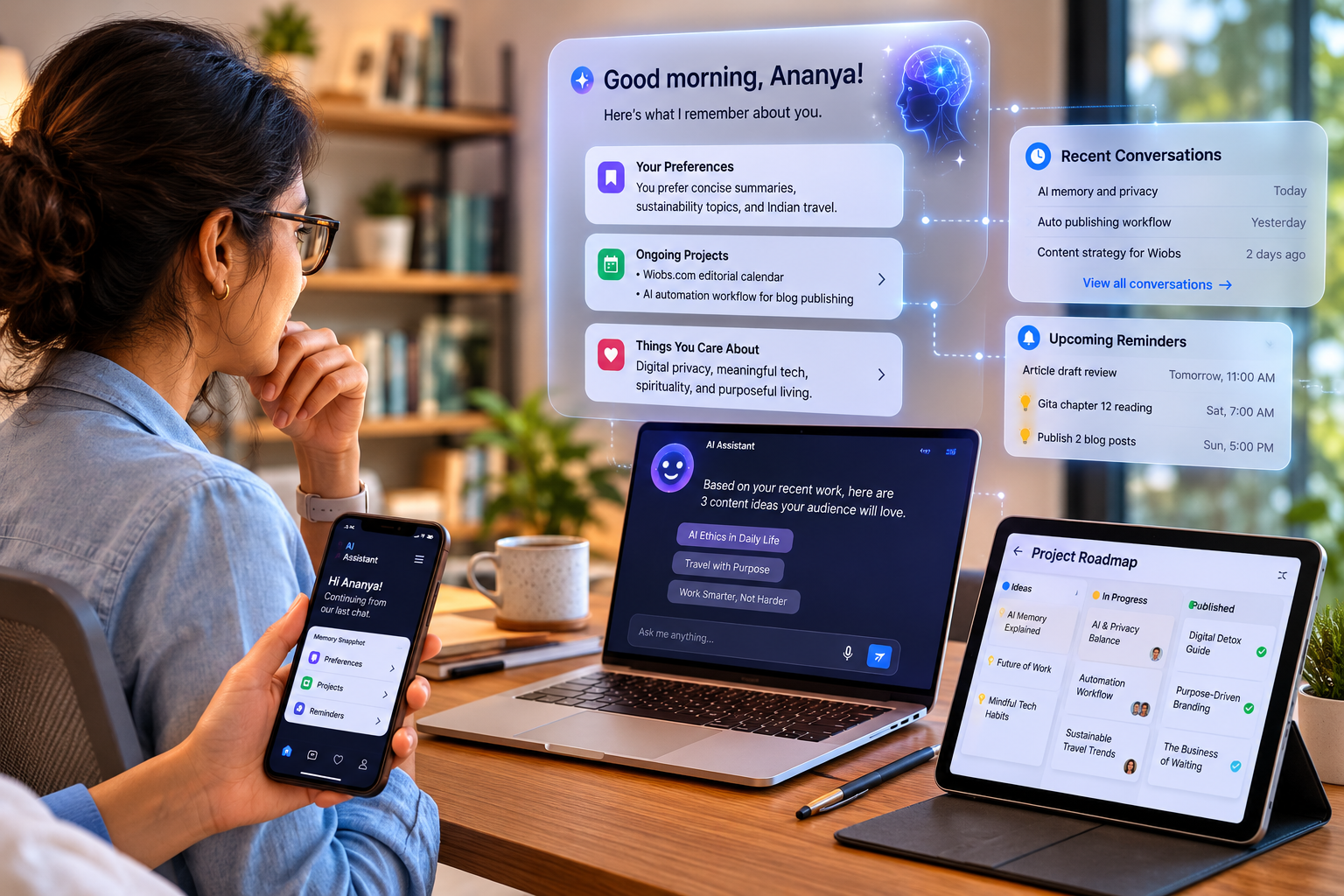
For years, digital assistants have suffered from a familiar limitation: every conversation began with a blank slate. Users repeatedly explained their preferences, restated past decisions, and reintroduced personal context. Whether interacting with a chatbot, virtual assistant, or productivity tool, the experience often felt less like a relationship and more like a series of disconnected encounters.
That is beginning to change.
A growing number of artificial intelligence systems are being designed with memory an ability to retain information across conversations, recall previous interactions, and build a more personalized understanding of users over time. What may seem like a simple convenience represents a much deeper shift in how humans interact with technology. The rise of AI memory is not just making digital assistants smarter; it is changing expectations about what software should know, remember, and perhaps eventually forget.
From Tools to Relationships
Most software historically functioned as a tool. Users opened an application, completed a task, and moved on. The relationship was transactional.
AI assistants with memory introduce something different. They create continuity.
Instead of asking a user to repeat preferences, goals, interests, or ongoing projects, a memory-enabled assistant can remember them. A student may continue a long-term learning journey without re-explaining educational objectives. A business owner might receive recommendations based on past discussions about customers, products, and growth plans. A traveler could receive suggestions aligned with previous destinations and travel styles.
This continuity makes interactions feel less mechanical and more conversational.
The shift is subtle but significant. The value of the assistant increasingly comes not only from its intelligence but also from its accumulated understanding of the individual using it.
Why AI Memory Matters More Than Better Answers
Much of the public discussion around artificial intelligence focuses on model capabilities how accurately systems answer questions or generate content.
Memory changes the equation.
A highly capable AI without memory can still produce useful responses. However, an AI that remembers relevant context can often produce more meaningful responses because it understands the user’s broader situation.
Imagine two assistants helping someone manage a business.
One assistant answers questions based solely on the current prompt. The other remembers ongoing projects, marketing strategies, previous challenges, and long-term goals. The second assistant may provide recommendations that are not necessarily smarter in isolation but are more relevant in context.
This suggests an important insight: the future competitive advantage of many AI systems may depend as much on memory quality as on raw intelligence.
As AI models become increasingly capable, context may become the true differentiator.
The Emergence of Digital Personalization at Scale
Personalization has existed online for years.
Streaming platforms recommend shows. Retail websites suggest products. Social media feeds adapt to user behavior.
AI memory extends personalization beyond content consumption and into direct interaction.
Instead of adapting what users see, memory-enabled assistants adapt how they communicate.
This creates a more customized experience across a wide range of activities:
- Learning and education
- Workplace productivity
- Customer support
- Personal organization
- Health and wellness tracking
- Creative projects
- Professional development
The assistant gradually develops a contextual understanding of the user rather than merely responding to isolated requests.
For businesses, this opens opportunities to create services that feel more attentive and responsive. For users, it reduces friction and repetition.
The Hidden Trade-Off: Convenience Versus Control
The benefits of AI memory are easy to understand. The risks are more complicated.
Memory inevitably raises questions about privacy, data ownership, and user control.
When an assistant remembers personal preferences, work projects, financial goals, or communication habits, the quality of assistance improves. Yet the same information can also become sensitive.
The challenge is not simply whether AI should remember. The challenge is determining what it should remember, how long it should remember it, and who controls that memory.
Unlike human memory, digital memory can be nearly perfect. Information may remain available indefinitely unless intentionally deleted or modified.
This creates a new responsibility for technology companies. Memory systems must offer transparency, user control, and clear mechanisms for reviewing, updating, or removing stored information.
As AI becomes more personal, trust becomes more important than capability.
A New Form of Digital Dependency
An underappreciated consequence of AI memory is the possibility of growing dependency.
As assistants become better at remembering details, users may become less inclined to remember them themselves.
This phenomenon already exists in limited forms. People rely on smartphones to store phone numbers, calendars to track schedules, and navigation apps to remember routes.
AI memory could expand this pattern further.
Professionals may increasingly depend on assistants to recall meeting histories. Students may rely on AI to remember learning progress. Consumers may outsource decision-making context to digital systems.
This does not necessarily represent a negative outcome. Human history is filled with technologies that extend cognitive capabilities. However, it raises questions about how much personal knowledge people should delegate to machines.
The most successful future systems may not simply replace memory but augment it, helping users remain informed rather than making them passive recipients of remembered information.
Businesses Are Paying Attention
The commercial implications of AI memory are substantial.
Companies increasingly recognize that long-term customer relationships depend on continuity. A customer who feels understood is often more satisfied than one who repeatedly starts from scratch.
Memory-enabled AI could reshape customer service by reducing repetitive interactions. It may transform sales processes through personalized engagement. It could support employee productivity by maintaining awareness of ongoing projects and organizational context.
The broader business trend is clear: organizations are moving from transactional interactions toward persistent relationships.
AI memory is becoming an infrastructure layer for that transition.
The Cultural Shift Nobody Is Talking About
Perhaps the most interesting development is cultural rather than technical.
People have traditionally expected software to forget.
A calculator does not remember previous calculations. A search engine generally does not recall every prior conversation. Most applications operate independently from one session to the next.
Memory-enabled AI changes that expectation.
For the first time, large numbers of people are interacting with software that accumulates familiarity over time.
This introduces a new social dynamic. Users may begin to treat digital assistants less like tools and more like ongoing companions, advisors, collaborators, or knowledge partners.
Whether that shift proves beneficial will depend on how responsibly the technology evolves. But the psychological impact is already becoming visible as people grow accustomed to systems that remember preferences, habits, and personal context.
What Happens Next?
The future of AI memory is unlikely to be defined by whether assistants can remember. Increasingly, they can.
The more important question is how memory will be managed.
The next generation of AI systems will likely offer more sophisticated controls, allowing users to decide what information should be retained, forgotten, updated, or prioritized. Organizations will face growing pressure to establish clear standards around transparency and data stewardship.
At the same time, users may come to expect memory as a default feature rather than a premium capability.
Just as internet access, cloud storage, and personalization became standard expectations, persistent memory may soon become a defining characteristic of digital assistance.
The rise of AI memory signals a broader transformation in human-computer interaction. Technology is moving beyond answering questions and executing commands. It is beginning to build context, maintain continuity, and develop a persistent understanding of the people who use it.
Whether that future feels empowering or unsettling may depend less on what AI remembers and more on who ultimately controls the memory.
This content is published for informational or entertainment purposes. Facts, opinions, or references may evolve over time, and readers are encouraged to verify details from reliable sources.