









Why “Decision-Light” Products Are Winning Over Overwhelmed Consumers
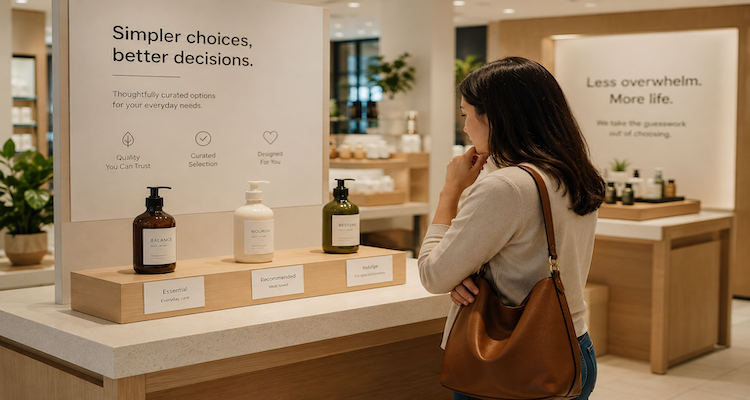
The biggest challenge facing many consumers today is no longer access to choices. It is surviving them.
A person shopping for a mattress can compare hundreds of models. Streaming subscribers scroll through thousands of shows before selecting one. Grocery stores offer endless variations of products that once came in only a handful of options. What was once considered consumer empowerment has increasingly become a source of fatigue.
As a result, a subtle but important shift is emerging across industries: the rise of “decision-light” products and services. These offerings are designed to reduce the mental effort required to make choices. Rather than presenting customers with dozens of alternatives, they simplify, curate, recommend, and sometimes make decisions on behalf of the user.
What appears to be a minor design preference may actually signal a deeper transformation in how businesses compete for attention in an age of cognitive overload.
The Growing Cost of Too Many Choices
For decades, conventional business wisdom suggested that more choice was better. More flavors, more subscription plans, more customization options, and more product variants were seen as signs of customer-centric thinking.
Yet consumers increasingly live in environments saturated with decisions.
Every day involves selecting apps, managing notifications, choosing content, evaluating purchases, comparing prices, and responding to a constant stream of information. While each individual choice may seem small, the cumulative effect can be mentally exhausting.
Behavioral researchers have long explored the concept of decision fatigue—the decline in decision-making quality after prolonged periods of choice-making. While consumers may not consciously recognize it, many are seeking relief from the burden of constant evaluation.
This creates an opportunity for businesses that can simplify the experience rather than expand it.
What Makes a Product “Decision-Light”?
A decision-light product is not necessarily simpler in function. Instead, it is simpler in the number of decisions required from the customer.
These products often share common characteristics:
- Limited but carefully curated options
- Personalized recommendations
- Automated selections
- Subscription-based replenishment
- Guided purchasing experiences
- Simplified pricing structures
The goal is not to eliminate choice entirely but to remove unnecessary complexity.
Meal kit services, for example, often provide a small selection of weekly recipes rather than overwhelming customers with endless possibilities. Streaming platforms increasingly push algorithmically selected content. Software tools offer recommended settings instead of requiring users to configure every feature manually.
The product becomes valuable not only because of what it delivers but because of the mental effort it saves.
The Rise of Convenience as a Psychological Benefit
Businesses traditionally marketed convenience in terms of time savings.
Today, convenience is increasingly psychological.
Consumers are not merely looking to save minutes. They are looking to reduce mental load.
This distinction matters because mental bandwidth has become a scarce resource. Many people feel continuously connected, continuously informed, and continuously required to make judgments.
In that environment, products that reduce uncertainty and streamline decisions can feel disproportionately valuable.
A customer who avoids spending thirty minutes comparing options may perceive greater satisfaction than one who technically receives a wider range of choices.
This helps explain why curated subscription boxes, recommendation engines, and simplified service packages continue to attract attention despite offering fewer customization opportunities.
Why Businesses Are Embracing the Trend
Decision-light products are not only beneficial for customers. They can also create advantages for companies.
Offering fewer options can reduce operational complexity. Inventory becomes easier to manage. Product development becomes more focused. Marketing messages become clearer.
Some of the most successful modern brands have built their identities around simplicity rather than abundance.
In many industries, companies are discovering that helping consumers choose can be more valuable than simply giving them more choices.
The shift reflects a broader evolution in customer expectations. Businesses are increasingly expected to act as trusted guides rather than neutral providers of endless alternatives.
Consumers often reward brands that demonstrate confidence, expertise, and curation.
The Hidden Insight: Trust Is Becoming a Product Feature
One of the most interesting aspects of decision-light products is that they depend heavily on trust.
When customers allow algorithms, brands, or platforms to narrow choices on their behalf, they are effectively outsourcing part of the decision-making process.
This changes the relationship between businesses and consumers.
Historically, companies competed by offering superior products. Increasingly, they may compete by offering superior judgment.
A recommendation system, a curated product selection, or an automated service only works if customers believe the underlying decision-maker has their interests in mind.
This suggests that trust itself is becoming a core product feature.
Companies that successfully reduce decision burden without appearing manipulative may gain a significant competitive advantage. Those that prioritize their own interests at the expense of users risk undermining the very trust that decision-light experiences require.
How Artificial Intelligence Is Accelerating the Movement
Artificial intelligence is likely to make decision-light experiences even more common.
AI systems can analyze preferences, behaviors, and historical choices to generate increasingly personalized recommendations. Instead of presenting twenty possible solutions, future platforms may present one or two highly relevant options.
The appeal is obvious. Less searching, less comparison, and less uncertainty.
However, this evolution also introduces new questions.
When recommendations become highly effective, consumers may become less aware of alternative options. The balance between helpful guidance and excessive influence becomes increasingly important.
The future of decision-light products may therefore depend not only on technological capability but also on transparency and user control.
Consumers may welcome assistance while still wanting the ability to override recommendations when necessary.
A Cultural Shift Away From Endless Optimization
The popularity of decision-light products may reveal something larger about contemporary culture.
For years, consumers were encouraged to optimize everything careers, productivity, finances, entertainment, fitness, and purchasing decisions. The assumption was that more information and more options would lead to better outcomes.
Many people are beginning to question whether constant optimization is worth the effort.
In some cases, the pursuit of the perfect choice creates more stress than benefit.
Decision-light products offer an alternative philosophy. Instead of maximizing options, they prioritize clarity. Instead of endless comparison, they emphasize confidence and forward movement.
This represents a subtle cultural shift from optimization toward simplification.
What Happens Next?
The demand for decision-light experiences is likely to expand beyond retail and digital platforms.
Education providers may offer more guided learning pathways. Financial services could simplify investment decisions through intelligent automation. Healthcare systems may increasingly use personalized guidance tools to help patients navigate complex choices.
At the same time, consumers are unlikely to abandon choice entirely.
The future may involve a hybrid approach in which businesses provide strong recommendations while preserving meaningful control. The winning products may not be those that offer the most options or the fewest options, but those that strike the right balance between freedom and simplicity.
As information continues to grow and attention becomes more fragmented, one thing appears increasingly clear: reducing cognitive effort is becoming a form of value in its own right.
In overwhelmed consumer markets, helping people make fewer decisions may be one of the most powerful products a company can offer.
The information presented in this article is based on publicly available sources, reports, and factual material available at the time of publication. While efforts are made to ensure accuracy, details may change as new information emerges. The content is provided for general informational purposes only, and readers are advised to verify facts independently where necessary.