










The Real AI Divide Is No Longer Access, It’s Knowing What to Ask
A few years ago, conversations about artificial intelligence focused on access. Who had the technology? Which companies could afford it? Which countries were leading the race? The assumption was that AI would create a new digital divide between those who could use advanced tools and those who could not.
That assumption is becoming outdated.
Today, powerful AI systems are available to millions of people through smartphones, web browsers, workplace software, and everyday apps. The barrier to entry has fallen dramatically. Yet a different divide is emerging—one that may prove even more significant. The people gaining the most value from AI are not necessarily those with the best technology. They are the ones who know how to question it effectively.
This shift is changing how people learn, work, solve problems, and make decisions. Access is becoming widespread. The real advantage increasingly lies in understanding how to interact with intelligence rather than simply possessing it.
From Information Scarcity to Information Abundance
For decades, digital literacy meant knowing how to find information online. Search engines rewarded users who could identify the right keywords and navigate a growing web of content.
AI changes that dynamic.
Instead of searching through dozens of sources, people can now ask a question and receive an immediate response. The challenge is no longer locating information. The challenge is framing the right question.
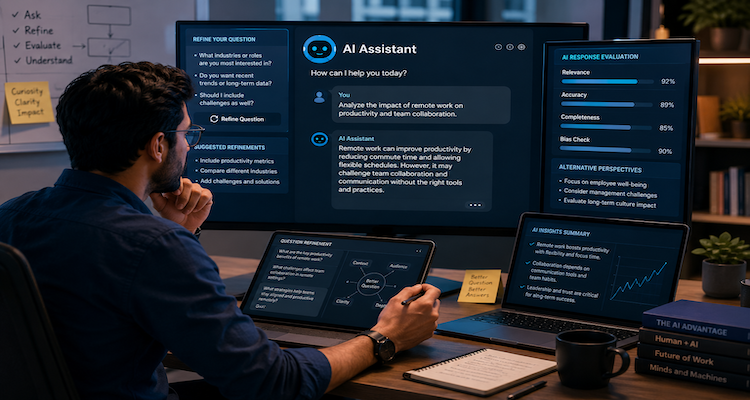
Ask a vague question and receive a vague answer. Ask a narrow question and receive a narrow perspective. Ask a thoughtful question that considers context, assumptions, and objectives, and the quality of the response often improves dramatically.
In many ways, AI is turning questioning into a critical skill. The better the question, the more valuable the outcome.
Why Prompting Is About More Than Prompts
The popular discussion around AI often focuses on “prompt engineering,” as though success comes from learning a collection of technical tricks.
The reality is more interesting.
Effective questioning is not primarily a technical skill. It is a thinking skill.
People who consistently get useful results from AI tend to demonstrate qualities that existed long before artificial intelligence arrived. They know how to define problems clearly. They recognize ambiguity. They understand context. They can distinguish between assumptions and facts.
A business manager asking an AI tool to analyze customer behavior, a student seeking help with research, and a developer debugging software all benefit from the same underlying capability: the ability to frame meaningful questions.
The technology may be new, but the cognitive skill behind it is not.
The Hidden Advantage of Critical Thinkers
One of the most overlooked consequences of widespread AI adoption is that critical thinking may become more valuable rather than less.
There is a common fear that AI will reduce the need for human reasoning. Yet many real-world experiences suggest the opposite.
AI can generate ideas, summarize information, and accelerate workflows. However, it can also misunderstand context, present incomplete perspectives, or produce convincing but flawed conclusions. Users who accept every output at face value may gain speed but lose accuracy.
Those who challenge responses, request alternative viewpoints, test assumptions, and ask follow-up questions often achieve far better outcomes.
This creates an unexpected shift in the value of human skills. In an environment where answers are abundant, judgment becomes increasingly important.
The future may reward people who know how to interrogate information rather than simply consume it.
Education May Face a Bigger Challenge Than Technology
Schools and universities have spent years integrating digital tools into learning environments. Yet AI introduces a deeper challenge.
Traditional education often emphasizes answers. Students are taught to solve problems correctly, complete assignments, and demonstrate knowledge.
AI changes the equation because answers are now easier to obtain.
What becomes more important is the ability to formulate meaningful questions, evaluate responses, identify weaknesses, and explore multiple perspectives.
Some educators are already discussing how learning may shift from memorization toward inquiry. Instead of asking whether students can find an answer, the more important question may become whether they can ask the questions that lead to better understanding.
If that transition occurs, questioning could become a core literacy skill alongside reading, writing, and digital competence.
Businesses Are Discovering the Same Reality
Organizations investing heavily in AI are encountering a similar lesson.
Many executives initially viewed AI as a technology challenge. The assumption was that success depended on selecting the right platform or software provider.
Increasingly, companies are discovering that implementation depends just as much on people as technology.
Two employees may use the same AI system and achieve dramatically different results. One generates generic outputs. The other uncovers insights, identifies opportunities, and accelerates decision-making.
The difference often lies in how they engage with the tool.
Businesses are beginning to recognize that AI training is not only about software usage. It is also about developing curiosity, analytical thinking, and effective questioning habits.
The organizations that cultivate these capabilities may gain a larger advantage than those that simply deploy the latest technology.
A New Form of Digital Inequality
Historically, digital divides were visible.
People either had internet access or they did not. They owned computers or they did not. They had broadband connections or relied on limited alternatives.
The emerging AI divide is more subtle.
Two individuals may have access to exactly the same AI platform. Yet one may use it to learn new skills, improve productivity, and expand opportunities, while the other gains only limited value.
This disparity is harder to identify because the technology itself appears equally available.
The difference exists in the interaction.
Those who understand how to explore, challenge, refine, and guide AI systems may develop significant advantages in education, employment, entrepreneurship, and personal development. Those who do not may find themselves surrounded by powerful tools without fully benefiting from them.
The Rise of Question Literacy
Perhaps the most important insight emerging from the AI era is that questioning itself is becoming a form of literacy.
For centuries, societies valued reading because it unlocked access to knowledge. Today, knowledge is increasingly accessible through intelligent systems.
What matters more is knowing how to navigate that knowledge effectively.
Question literacy involves more than curiosity. It requires understanding objectives, recognizing biases, identifying gaps in information, and exploring problems from multiple angles.
These abilities influence not only AI interactions but also decision-making in everyday life.
The people who thrive in the coming years may not be those with the most advanced tools. They may be those who develop the strongest habits of inquiry.
What Happens Next?
As AI becomes embedded in workplaces, schools, creative industries, and consumer technology, the conversation about access will not disappear entirely. Reliable connectivity, affordable devices, and digital inclusion will remain important issues.
But a new layer has been added to the discussion.
The next digital divide may not be defined by who has AI. It may be defined by who knows how to engage with it thoughtfully.
That distinction could shape educational outcomes, career opportunities, business competitiveness, and even public understanding of information.
The most valuable skill in an age of intelligent answers may turn out to be the ability to ask intelligent questions.
This content is published for informational or entertainment purposes. Facts, opinions, or references may evolve over time, and readers are encouraged to verify details from reliable sources.