










The AI Confidence Gap: Why Some People Gain Far More From AI Than Others
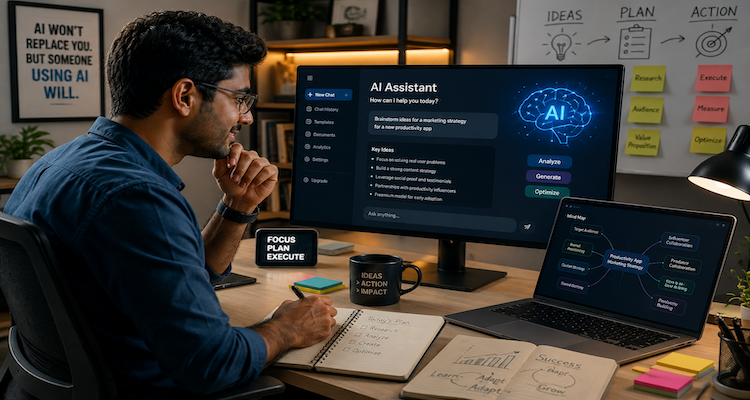
A curious pattern is emerging as artificial intelligence becomes part of everyday life. Two people can access the same AI tools, ask similar questions, and spend the same amount of time using them, yet one sees dramatic improvements in productivity, learning, and decision-making, while the other walks away disappointed.
The difference is not always technical skill. In many cases, it comes down to something less obvious: confidence.
As AI moves from a specialized technology into a mainstream utility, a growing gap is appearing between people who feel comfortable experimenting with AI and those who approach it with hesitation. This divide is shaping who learns faster, adapts more quickly, and captures the greatest value from the technology.
The implications extend far beyond technology itself. The emerging AI confidence gap may influence education, careers, entrepreneurship, and even everyday problem-solving in ways that are only beginning to become visible.
The Hidden Factor Behind AI Success
Much of the conversation around AI focuses on access. Do people have the right tools? Do they have internet connectivity? Are organizations investing in AI platforms?
These questions matter, but access alone does not guarantee results.
Many AI systems are now widely available. Popular platforms can help users brainstorm ideas, draft content, analyze information, learn new skills, write code, organize projects, and automate routine tasks. Yet adoption outcomes vary significantly from person to person.
One reason is that effective AI use often requires exploration.
People who view AI as a collaborative tool tend to ask follow-up questions, refine requests, test assumptions, and experiment with different approaches. They treat AI as an evolving conversation rather than a one-time search.
Others may stop after receiving an imperfect answer. If the first interaction feels confusing or disappointing, they conclude that AI is not useful for their needs.
The result is a widening difference in outcomes, even when both groups have access to the same technology.
Confidence Creates a Learning Advantage
The most valuable AI users are not necessarily experts in machine learning or software development. Often, they are simply comfortable learning through experimentation.
Confidence encourages curiosity.
A confident user may ask an AI assistant to explain a business concept, simplify a legal term, outline a marketing strategy, or teach a programming language. If the answer is unclear, they ask again from a different angle.
This process creates a powerful feedback loop. The more people experiment, the better they understand AI. The better they understand AI, the more useful it becomes. Increased usefulness then reinforces confidence.
Meanwhile, hesitant users may interact with AI less frequently. Because they gain fewer benefits, their uncertainty remains.
Over time, the gap grows.
Why the Gap Is Not About Intelligence
One common misconception is that people who benefit most from AI are inherently more intelligent or technically gifted.
In reality, AI often rewards behavior more than expertise.
The willingness to ask questions, challenge outputs, refine instructions, and continue exploring can be more important than prior technical knowledge.
Consider how people learn new skills online. Some individuals actively search for tutorials, compare resources, and practice regularly. Others consume information passively and stop when challenges appear.
AI amplifies this difference because it responds directly to user engagement.
The technology often performs best when users actively guide the conversation rather than expecting perfect answers instantly.
This means the AI confidence gap may have less to do with intellectual ability and more to do with mindset.
The Workplace Impact Is Becoming More Visible
Organizations across industries are exploring AI-powered workflows. Employees increasingly encounter AI tools for writing, research, customer support, software development, data analysis, and administrative tasks.
In this environment, confidence can become a competitive advantage.
Workers who actively experiment with AI may discover ways to save time, improve output quality, or reduce repetitive work. They often identify practical use cases before formal training programs are established.
Those who remain hesitant may continue working through traditional processes, potentially missing efficiency gains available to their peers.
This does not mean AI will replace every worker or eliminate the need for human judgment. In fact, human expertise becomes even more valuable when combined with effective AI usage.
However, confidence in working alongside AI may increasingly influence professional growth and adaptability.
Education May Face an Unexpected Challenge
Schools and universities are also encountering the confidence gap.
Students with strong AI literacy often use these tools to explore complex topics, generate study materials, clarify difficult concepts, and practice new skills. When used responsibly, AI can become a personalized learning companion.
Yet some students avoid AI entirely due to uncertainty, lack of guidance, or concerns about making mistakes.
This creates an interesting challenge for educators. Teaching students how to think critically about AI may become just as important as teaching them how to use it.
The goal is not blind trust. In fact, responsible AI use requires skepticism and verification.
The real objective is developing enough confidence to engage with AI thoughtfully while recognizing its limitations.
The Confidence Gap Is Also a Cultural Gap
Beyond workplaces and classrooms, AI adoption reflects broader cultural attitudes.
Some communities embrace experimentation and view new technologies as opportunities. Others approach emerging technologies more cautiously, often because of concerns around privacy, misinformation, employment disruption, or reliability.
These concerns are legitimate.
AI systems can make mistakes. Outputs require verification. Ethical and societal questions remain unresolved in many areas.
Yet an important distinction exists between healthy skepticism and complete avoidance.
People who learn how AI works, where it succeeds, and where it fails are often better positioned to navigate its risks than those who disengage entirely.
Ironically, understanding limitations frequently increases confidence rather than reducing it.
A Shift From Knowledge to Capability
One of the most significant insights behind the AI confidence gap is that society may be entering a period where access to information matters less than the ability to work with information effectively.
For decades, competitive advantage often came from possessing knowledge.
Today, vast amounts of information are instantly accessible. AI can summarize documents, explain concepts, compare options, and generate first drafts within seconds.
The new advantage increasingly comes from knowing how to direct these capabilities toward meaningful outcomes.
In other words, the future may reward people who can collaborate with intelligent systems rather than simply consume information.
That shift has implications for careers, education, entrepreneurship, and lifelong learning.
What Happens Next?
The AI confidence gap is unlikely to disappear on its own.
As AI becomes more integrated into daily life, the benefits experienced by confident users may compound over time. They will likely discover new applications, adapt faster to changing tools, and develop stronger digital problem-solving skills.
At the same time, organizations, educators, and policymakers may need to focus less on providing access alone and more on building practical AI literacy.
The most important question may no longer be whether people have access to AI.
Instead, it may be whether they feel capable of using it effectively.
That distinction could shape who thrives in the next phase of the AI era.
The future of AI may not be defined solely by technological breakthroughs. It may also be defined by something far more human: the confidence to explore, question, learn, and adapt.
This content is published for informational or entertainment purposes. Facts, opinions, or references may evolve over time, and readers are encouraged to verify details from reliable sources.