







Why Fast Adapters Are Pulling Ahead of Fast Learners
For decades, education rewarded a particular kind of success. The students who learned quickly, remembered information efficiently, and performed well on tests were often seen as the most likely to thrive later in life. Speed of learning became a widely accepted marker of intelligence and future potential.
Yet a quieter shift is changing that assumption.
Across workplaces, industries, and even everyday life, the people gaining an advantage are not always those who learn the fastest. Increasingly, they are the people who adapt the fastest. In a world where knowledge changes rapidly, tools evolve constantly, and career paths rarely follow predictable routes, adaptability has become a distinct and valuable skill of its own.
This emerging divide has created a hidden education gap, one that traditional systems often fail to recognize.
The Difference Between Learning and Adapting
Learning and adapting are closely related, but they are not the same thing.
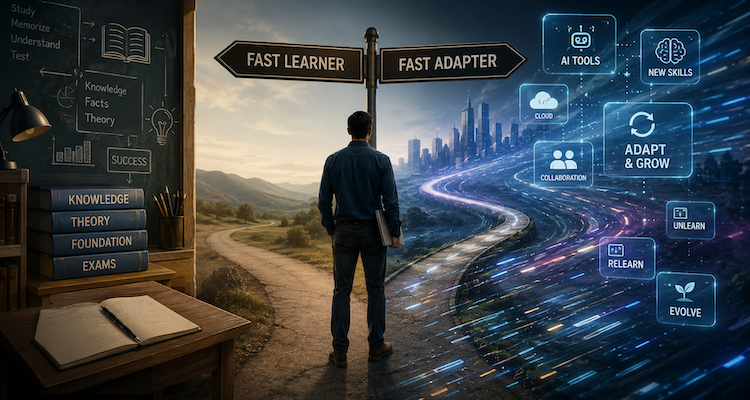
A fast learner can absorb new information quickly. They may master concepts, memorize processes, and understand systems faster than their peers.
A fast adapter, however, does something different. They adjust their behavior when circumstances change. They can work with unfamiliar tools, shift strategies when conditions evolve, and remain effective even when the rules are unclear.
The distinction matters because many of today’s challenges are not knowledge problems. They are adaptation problems.
A professional may know how to perform a task perfectly, only to discover that new software, automation tools, or market expectations have changed the process entirely. The challenge is no longer understanding the old system, it is adjusting to the new one.
In such situations, adaptability often becomes more valuable than accumulated expertise.
Why Traditional Education Misses This Gap
Most educational models were designed during a period when knowledge remained relatively stable.
Students were expected to learn established facts, master proven methods, and apply those skills throughout their careers. Success depended largely on acquiring knowledge and demonstrating competence.
That model still has value, but the environment surrounding it has changed dramatically.
Many industries now experience continuous disruption. Digital platforms evolve, workplace technologies update frequently, and entirely new roles emerge within a few years. Skills that were highly relevant yesterday may require significant revision tomorrow.
Traditional education still excels at teaching what is known. It is often less effective at preparing people for what is unknown.
As a result, many individuals leave school feeling educated but surprisingly unprepared when confronted with rapid change. They possess knowledge yet struggle with uncertainty. They can follow established procedures but find it difficult to adjust when those procedures disappear.
This is where the hidden education gap begins to appear.
The Rise of Adaptability as a Competitive Advantage
The modern workplace increasingly rewards individuals who can navigate ambiguity.
Employers frequently value employees who can learn new platforms, collaborate across disciplines, and adjust to shifting priorities. In many cases, the ability to respond effectively to change matters as much as technical expertise.
The growth of artificial intelligence provides a useful example.
AI tools are transforming workflows across writing, marketing, software development, design, customer service, and countless other fields. Professionals who insist on using only familiar methods may find themselves struggling to keep pace. Meanwhile, those willing to experiment, adapt, and integrate new tools often discover opportunities that others overlook.
Interestingly, this advantage does not always belong to the most technically skilled individuals.
Some people embrace new systems despite limited prior knowledge. Others possess deep expertise but resist change because existing methods have worked well for years. The result is a surprising reversal: adaptability can sometimes outperform experience.
The Emotional Side of the Education Gap
The discussion is not only about skills. It is also about mindset.
Many adults experience frustration when they realize that knowledge alone no longer guarantees confidence. They may feel highly educated yet uncertain about their ability to navigate new environments.
This helps explain why so many professionals describe a sense of being left behind despite strong educational backgrounds.
The issue is not necessarily a lack of intelligence. It is often a lack of adaptation practice.
Educational systems traditionally reward correct answers. Real-world adaptation, however, requires experimentation, mistakes, and continuous adjustment. These are very different experiences.
People who become comfortable with uncertainty often develop resilience alongside adaptability. They stop viewing change as a threat and begin seeing it as a normal condition of modern life.
That psychological shift can be more important than any individual skill.
What Fast Adapters Do Differently
Fast adapters tend to share several behaviors.
They focus less on mastering a single system and more on understanding how systems work. This allows them to transfer knowledge between different situations.
They are willing to be beginners again. Rather than protecting their expertise, they accept temporary discomfort while learning new approaches.
They prioritize flexibility over perfection. Instead of waiting until they fully understand every detail, they test ideas, gather feedback, and refine their methods.
Perhaps most importantly, they view learning as an ongoing process rather than a phase that ends after formal education.
This mindset enables continuous growth even when industries, technologies, and social expectations evolve.
The Broader Cultural Shift
The rise of adaptability reflects a larger cultural transformation.
For much of the twentieth century, stability was often considered the ideal outcome. Individuals trained for specific professions, built long-term careers within established structures, and relied on relatively predictable pathways.
Today’s environment is considerably different.
Career changes are more common. Digital tools reshape industries at unprecedented speed. New forms of work emerge while older roles evolve or disappear.
Under these conditions, adaptability becomes a form of security.
Rather than relying on one skill, one employer, or one industry, adaptable individuals develop confidence in their ability to navigate change itself. Their advantage comes not from knowing exactly what will happen next but from trusting their capacity to respond effectively when it does.
What This Means for the Future of Education
The hidden education gap suggests that future learning systems may need to evolve.
Knowledge will always matter. Foundational understanding remains essential for critical thinking, creativity, and professional competence.
However, education may increasingly need to teach skills that support adaptation alongside knowledge acquisition.
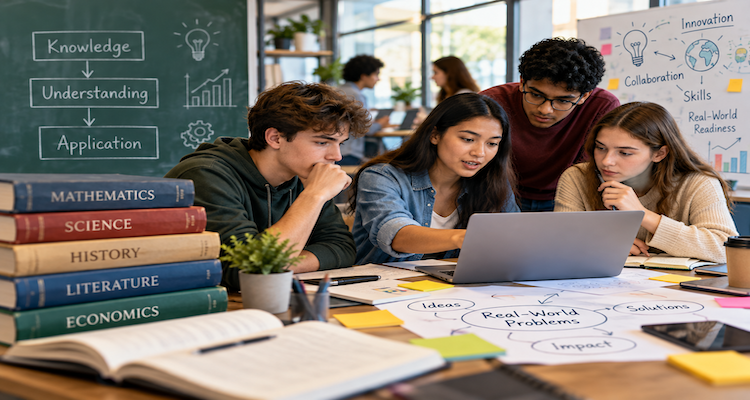
Students may benefit from greater exposure to problem-solving, interdisciplinary thinking, experimentation, and real-world uncertainty. Learning how to learn could become just as important as learning specific content.
Organizations may also need to rethink professional development. Instead of focusing exclusively on technical expertise, they may invest more heavily in adaptability, curiosity, and continuous learning capabilities.
The most successful individuals of the future may not be those who know the most. They may be those who can evolve the fastest when circumstances change.
A New Definition of Being Prepared
The hidden education gap between fast learners and fast adapters challenges a long-standing assumption about success.
Knowledge remains powerful, but knowledge alone is no longer enough. The pace of change means that preparation increasingly depends on the ability to adjust, experiment, and grow in unfamiliar situations.
Fast learners excel at understanding what exists today. Fast adapters excel at navigating what comes tomorrow.
As workplaces, technologies, and societies continue to evolve, that difference may become one of the most important educational realities of the modern age, not because learning matters less, but because adaptation matters more than ever before.
The information presented in this article is based on publicly available sources, reports, and factual material available at the time of publication. While efforts are made to ensure accuracy, details may change as new information emerges. The content is provided for general informational purposes only, and readers are advised to verify facts independently where necessary.