








Can AI Make Students Better Thinkers or More Dependent Learners?
Artificial intelligence has quietly become one of the most influential study tools in education. Students now use AI to summarize textbooks, explain complex concepts, generate essay outlines, solve math problems, and even brainstorm research topics in seconds. What once required hours of searching or discussion with teachers can now happen through a single prompt.
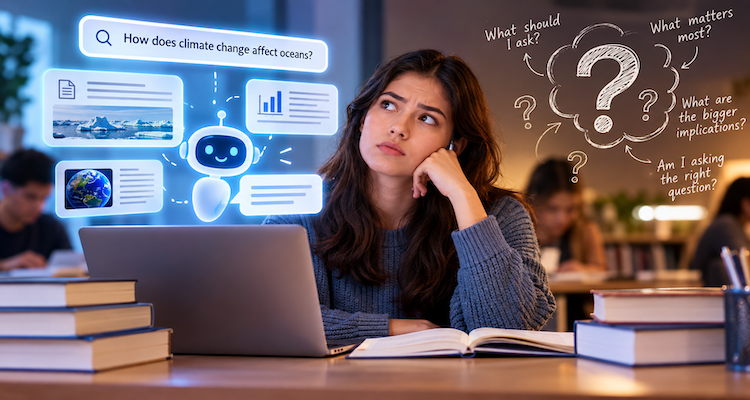
This rapid shift has sparked an important question that extends far beyond classrooms: Is AI helping students become stronger thinkers, or is it encouraging a new kind of intellectual dependence? The answer is more nuanced than the debate often suggests. AI has the potential to expand learning in remarkable ways, but only if students learn to use it as a thinking partner rather than a thinking replacement.
Learning Has Changed Faster Than Education
Every major technological advancement has reshaped education. Calculators changed mathematics. Search engines transformed research. Online courses opened classrooms to millions. AI represents another leap, but this one is fundamentally different because it can imitate reasoning itself.
Instead of simply retrieving information, modern AI systems can explain ideas, compare viewpoints, draft arguments, and adapt responses based on follow-up questions. For many students, this creates the feeling of having a personal tutor available at any hour.
Yet education has traditionally measured learning by observing how students reach conclusions. When AI performs much of the reasoning process, distinguishing genuine understanding from generated output becomes increasingly difficult.
The challenge is no longer whether students have access to information. It is whether they are still developing the mental habits needed to question, analyze, and evaluate that information independently.
AI Can Strengthen Thinking, When Used Well
The strongest argument in favor of AI is that it can make learning more accessible and personalized.
A student struggling with algebra can receive multiple explanations until one finally makes sense. Someone learning a new language can practice conversations without fear of embarrassment. Complex scientific ideas can be broken into simpler concepts suited to different learning styles.
Unlike static textbooks, AI responds to curiosity. Students can ask follow-up questions, request examples, or explore topics from different perspectives.
This interactive learning experience can encourage deeper engagement rather than passive memorization.
For motivated learners, AI also reduces the time spent on routine tasks. Instead of searching through dozens of websites, students can focus more energy on evaluating ideas, connecting concepts, and developing original insights.
In this sense, AI has the potential to shift education away from remembering facts and toward understanding relationships between ideas.
Where Dependence Begins
The same qualities that make AI useful can also create hidden risks.
When answers arrive instantly, students may become less willing to wrestle with difficult problems. Yet productive struggle is one of the most important parts of learning. It strengthens reasoning, builds persistence, and improves long-term understanding.
If AI consistently removes that struggle, students may complete assignments without fully developing the cognitive skills those assignments were designed to teach.
Essay writing illustrates this challenge clearly. Drafting an argument requires organizing thoughts, weighing evidence, anticipating counterarguments, and refining ideas through revision. When AI generates an entire draft from a short prompt, much of that intellectual work disappears.
The final submission may look polished, but appearance should not be confused with learning.
Over time, repeated reliance on AI for thinking tasks could weaken confidence in one’s own ability to solve unfamiliar problems independently.
The Hidden Shift Is From Knowing to Judging
Perhaps the biggest educational change is not that students know less. It is that they must become better judges.
AI can produce convincing explanations that are incomplete, outdated, or occasionally incorrect. It may present confident answers where genuine uncertainty exists or overlook important context.
As AI becomes more common, one of the most valuable skills will not be finding answers but evaluating them.
Students will increasingly need to ask questions such as:
- Does this explanation make logical sense?
- What assumptions is the AI making?
- Is there another perspective?
- Can reliable sources support this conclusion?
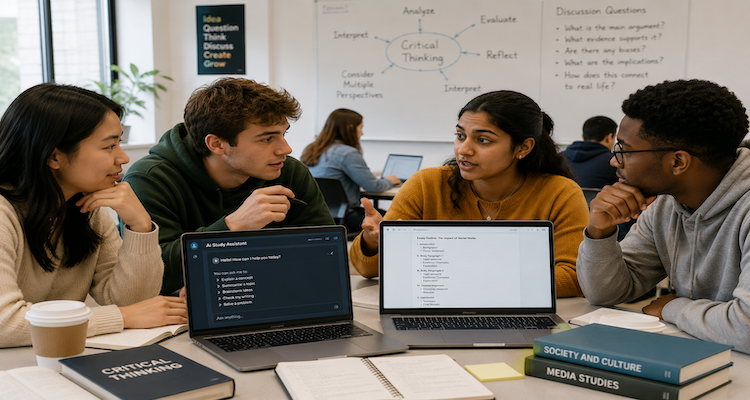
This represents a profound shift in education. Critical thinking is evolving from remembering information to questioning information—even when it sounds persuasive.
Ironically, AI may increase the importance of human judgment rather than reduce it.
Teachers Are Redefining Success
The rise of AI is also changing how educators think about assessment.
Assignments that simply ask students to summarize information or produce standard essays are becoming easier for AI to complete. As a result, many educators are experimenting with new approaches that emphasize reasoning over repetition.
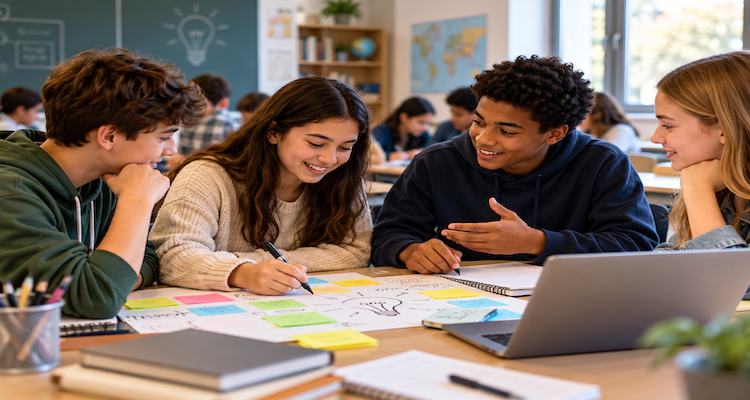
Discussions, presentations, collaborative projects, oral examinations, reflective writing, and problem-solving exercises all make it easier to observe how students think rather than what they can generate.
This does not necessarily mean traditional assignments will disappear. Instead, schools may place greater emphasis on demonstrating understanding throughout the learning process instead of evaluating only the final product.
In many ways, AI is encouraging education to focus more closely on skills that matter beyond the classroom.
Beyond School: Preparing for an AI Workplace
The implications extend well beyond education.
Many workplaces already expect employees to use AI tools to improve productivity. Professionals increasingly rely on AI to organize information, brainstorm ideas, draft reports, and automate repetitive work.
However, employers still value qualities AI cannot consistently replace: sound judgment, creativity, ethical decision-making, communication, and the ability to solve unfamiliar problems.
Students who learn only to generate AI-assisted answers may struggle when faced with situations requiring independent analysis.
Those who learn to question AI, improve its outputs, recognize its limitations, and combine its capabilities with their own expertise will likely be better prepared for the future of work.
The competitive advantage may no longer be simply knowing how to use AI. It may be knowing when not to trust it.
Parents Have a Role Too
Families often frame AI as either a dangerous shortcut or an educational breakthrough.
Neither extreme reflects reality.
Parents can help children develop healthier habits by asking them to explain ideas in their own words, discuss how they reached conclusions, and compare AI-generated answers with textbook explanations or classroom lessons.
These conversations reinforce understanding while encouraging healthy skepticism.
Rather than banning AI outright, guiding thoughtful use may prove far more effective in developing lasting learning habits.
The Future Belongs to Students Who Stay Curious
AI is unlikely to disappear from education. If anything, it will become more capable, more accessible, and more deeply integrated into learning.
The real question is not whether students will use AI but how they will use it.
Students who treat AI as a shortcut risk becoming dependent on technology for thinking they could develop themselves. Those who treat it as a tool for exploration, questioning, and refinement may strengthen the very skills that matter most.
Education has always been about more than producing correct answers. At its best, it teaches people how to ask better questions, challenge assumptions, and adapt to new ideas.
AI changes many aspects of learning, but it does not change that fundamental purpose.
If educators, students, and parents keep critical thinking at the center of learning, AI could become one of education’s most valuable assistants rather than its biggest distraction.
The information presented in this article is based on publicly available sources, reports, and factual material available at the time of publication. While efforts are made to ensure accuracy, details may change as new information emerges. The content is provided for general informational purposes only, and readers are advised to verify facts independently where necessary.