










How Soil Microbes Are Becoming the New Frontier of Climate Science
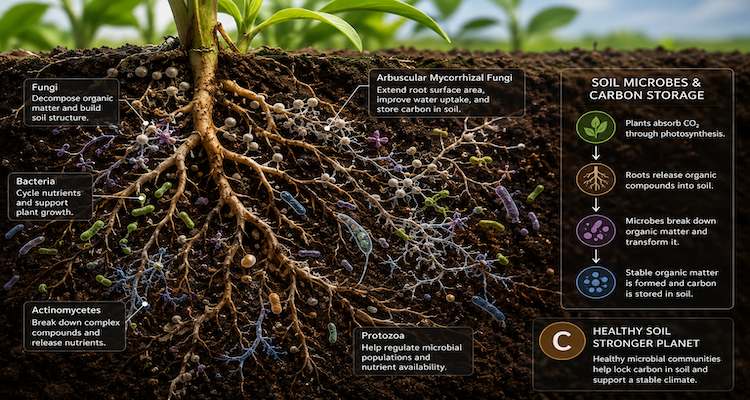
Beneath every forest, farm, grassland, and backyard lies an invisible community that may hold one of the biggest clues to Earth’s climate future. While discussions about climate change often revolve around renewable energy, carbon emissions, or melting glaciers, scientists are increasingly turning their attention underground to trillions of microscopic organisms that quietly regulate the planet’s carbon cycle.
These organisms, collectively known as soil microbes, have spent billions of years breaking down organic matter, recycling nutrients, and supporting plant life. Today, researchers are discovering that their influence extends far beyond healthy crops and fertile ecosystems. The activity of these microscopic communities can determine whether soil stores carbon for decades or releases it back into the atmosphere as greenhouse gases. That realization is reshaping climate science in ways that could influence conservation, agriculture, and carbon management for years to come.
The Hidden Workforce Beneath Our Feet
Soil is far more than dirt. A single teaspoon can contain billions of bacteria, thousands of fungal species, microscopic algae, archaea, and countless other organisms interacting in complex networks. Together, they form one of the most biologically diverse ecosystems on Earth.
These microbes perform essential tasks that most people never notice. They decompose fallen leaves, dead roots, and organic material, transforming them into nutrients that plants can absorb. At the same time, they help build stable organic matter that locks carbon into the soil.
This balance between storing and releasing carbon makes microbial activity especially important in the context of climate change. Healthy microbial communities can contribute to long-term carbon storage, while stressed or disrupted ecosystems may accelerate the release of carbon dioxide and methane.
Rather than acting as passive residents of the soil, microbes function as active participants in Earth’s climate system.
Why Scientists Are Paying Closer Attention
Climate models have traditionally focused on visible factors such as forests, oceans, and atmospheric processes. Although soil carbon has long been recognized as significant, the role of microbial communities has proven much harder to measure because of their immense diversity and rapidly changing behavior.
Advances in genetic sequencing, environmental DNA analysis, artificial intelligence, and high-resolution soil monitoring are making this hidden world easier to study. Researchers can now identify microbial communities with far greater precision and observe how they respond to changing temperatures, moisture levels, and land use.
These technologies are revealing that microbial responses are not uniform. Different species react differently to drought, warming, flooding, or agricultural practices. Understanding those responses helps scientists improve climate predictions and develop more realistic carbon models.
Instead of viewing soil simply as a carbon container, researchers increasingly see it as a living system whose biological activity constantly shapes climate outcomes.
Agriculture Could Benefit in Unexpected Ways
The growing interest in soil microbes is not limited to climate researchers. Farmers and agricultural scientists are exploring how healthier microbial ecosystems can improve productivity while supporting environmental goals.
Practices such as reduced tillage, cover cropping, compost application, and crop rotation encourage diverse microbial communities. These methods may improve soil structure, increase water retention, reduce erosion, and help crops tolerate environmental stress.
The result is a potential alignment between agricultural resilience and climate mitigation. Rather than relying solely on technological carbon removal strategies, improving soil health offers a natural approach that benefits both food production and ecosystem stability.
This shift also reflects a broader change in farming philosophy. Soil is increasingly viewed as a living ecosystem that requires biological care rather than simply a medium for growing crops.
Climate Solutions Are Becoming More Biological
Many climate strategies have traditionally focused on engineering solutions, including renewable energy, carbon capture technologies, and cleaner transportation. Those efforts remain important, but biological systems are receiving growing attention as complementary solutions.
Forests, wetlands, peatlands, and grasslands naturally absorb carbon. Soil microbes influence how effectively these ecosystems continue storing that carbon over time.
This does not mean microbes alone can solve climate change. Their behavior depends on countless environmental conditions, and scientists continue investigating how different ecosystems respond under changing climates. Nevertheless, understanding microbial processes could make existing conservation and restoration efforts more effective.
The emerging perspective is that protecting biodiversity below ground may be just as important as protecting biodiversity above it.
A New Way to Think About Carbon
One of the most interesting developments in climate science is the growing recognition that carbon storage is not simply about planting more trees or reducing emissions. It also depends on the invisible biological processes that determine whether carbon remains locked in ecosystems.
Healthy microbial communities help create stable forms of soil organic matter that can persist for long periods. Disturbances such as intensive land degradation, repeated soil disruption, or ecosystem damage can alter those microbial relationships and potentially reduce the soil’s ability to retain carbon.
This insight changes how scientists evaluate land management. The quality of the biological community may matter just as much as the quantity of vegetation growing above it.
For policymakers and land managers, this means climate planning increasingly requires understanding living ecosystems as interconnected systems rather than isolated components.
The Technology Behind the Discovery
Modern climate science is benefiting from tools that were unavailable only a few decades ago.
DNA sequencing allows researchers to identify thousands of microbial species from small soil samples. Machine learning helps detect complex biological patterns that would otherwise remain hidden. Satellite observations combined with ground-based measurements enable scientists to connect local microbial activity with regional environmental changes.
These technologies are accelerating discoveries while highlighting how much remains unknown. Scientists estimate that many soil microorganisms have yet to be fully identified, and their ecological roles are still being explored.
Rather than producing simple answers, new technologies are revealing an ecosystem of remarkable complexity.
Why This Matters Beyond Science
The renewed focus on soil microbes reflects a broader shift in environmental thinking. Climate solutions are becoming less about isolated interventions and more about understanding the relationships between biological systems.
For businesses, healthier soils may contribute to more resilient agricultural supply chains. For governments, soil restoration could become part of long-term climate adaptation strategies. For consumers, everyday choices that support sustainable agriculture may indirectly encourage practices that maintain healthier microbial ecosystems.
Perhaps the most valuable lesson is conceptual rather than technological. Some of the most powerful climate processes occur at scales invisible to the human eye. Recognizing the importance of these microscopic communities reminds us that environmental resilience often depends on systems that receive little public attention.
Looking Ahead
As climate research evolves, the spotlight is gradually shifting underground. Soil microbes are unlikely to replace renewable energy, emissions reductions, or ecosystem conservation as climate priorities. Instead, they are expanding our understanding of how Earth’s natural systems work together.
Future research may reveal new ways to restore degraded land, improve food security, and strengthen carbon storage through healthier ecosystems. While many questions remain unanswered, one conclusion is becoming increasingly clear: the smallest living organisms on Earth may play a far larger role in the planet’s future than their size suggests.
Climate science is no longer focused solely on what happens in the atmosphere. It is also uncovering the remarkable biological networks beneath our feet networks that quietly sustain ecosystems and may become an increasingly important part of humanity’s response to a changing climate.
This content is published for informational or entertainment purposes. Facts, opinions, or references may evolve over time, and readers are encouraged to verify details from reliable sources.