










Netflix’s Animated Midnight Sun Signals a New Era for the Twilight Universe
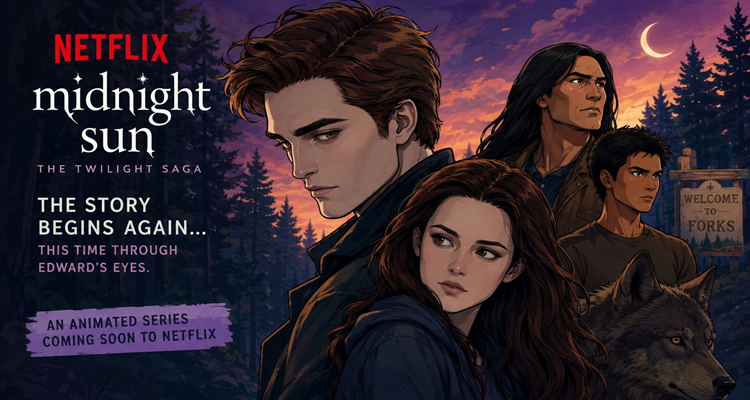
Key Takeaways
- Netflix’s animated adaptation of Midnight Sun has entered a significant development phase with casting now underway for major supporting characters.
- The project revisits the original Twilight story through Edward Cullen’s perspective, offering longtime fans a fresh narrative experience.
- Casting Native American actors for Jacob and Billy Black reflects renewed attention to authentic cultural representation in modern adaptations.
- Animation gives creators greater creative freedom to expand the supernatural world while introducing the franchise to younger streaming audiences.
- Although production is progressing, the series is unlikely to premiere before late 2027 due to the lengthy animation development process.
Introduction
Few young adult franchises have left a cultural footprint as enduring as Twilight. More than fifteen years after Bella Swan and Edward Cullen first captivated audiences on the big screen, the vampire romance continues to attract devoted fans while introducing itself to entirely new generations through streaming platforms and social media.
Netflix’s decision to adapt Midnight Sun as an animated series represents far more than another franchise revival. Instead of retelling familiar events in the same format, the project revisits the original story from Edward Cullen’s internal perspective—a version that explores emotional conflicts, supernatural instincts, and psychological complexity that audiences never fully experienced in the films.
Recent production developments suggest the series is steadily advancing behind the scenes. While viewers may still have a considerable wait before its release, the latest progress offers important clues about Netflix’s long-term strategy for established entertainment properties and the growing role of animation in premium storytelling.
Understanding the Development
Netflix’s animated adaptation of Midnight Sun continues to move through pre-production, marking one of the most closely watched projects within the streaming platform’s expanding animation portfolio.
The series is based on Stephenie Meyer’s companion novel, which retells the events of Twilight from Edward Cullen’s point of view rather than Bella Swan’s. This narrative shift transforms familiar scenes into a more psychologically layered story, revealing Edward’s internal struggles, heightened senses, and difficult choices.
Stephenie Meyer remains closely involved as an executive producer, helping preserve the novel’s original vision. The production team also includes experienced television producers and creative executives responsible for adapting large-scale literary properties for modern audiences.
One of the most notable recent developments is the beginning of voice casting for Jacob Black and Billy Black, two important members of the Quileute community whose roles become increasingly significant throughout the broader Twilight saga.
Rather than limiting auditions to established voice actors, producers are reportedly considering on-screen performers as well, indicating a focus on authentic character performances over traditional animation experience.
Why This Matters
The return of Twilight arrives at a moment when entertainment companies are increasingly revisiting successful franchises rather than creating entirely new fictional universes.
However, Midnight Sun offers something more substantial than simple nostalgia.
Unlike many remakes, this adaptation tells an already familiar story through a fundamentally different emotional lens. Edward’s perspective introduces themes of restraint, responsibility, immortality, and moral conflict that were only briefly explored in previous adaptations.
For longtime readers, the animated format provides an opportunity to experience scenes that were absent from earlier films.
For newer viewers who never experienced the original cultural phenomenon, the series offers a fresh entry point without requiring extensive knowledge of the franchise.
This dual appeal makes Midnight Sun attractive both as a continuation and as an accessible beginning.
What Is Changing
Animation Is Becoming a Premium Storytelling Medium
Animation is no longer viewed solely as children’s entertainment.
Streaming platforms increasingly use high-quality animated productions to adapt novels, comics, fantasy worlds, and mature stories that would be costly or technically restrictive in live action.
For Midnight Sun, animation offers several creative advantages.
Supernatural abilities, dream sequences, emotional symbolism, and atmospheric environments can be portrayed with greater artistic freedom than traditional filmmaking often allows.
This opens opportunities to visualize Edward’s heightened perception of the world, his thoughts, instincts, and vampire abilities- in ways unavailable during the original film series.
Greater Attention to Authentic Representation
The casting search for Native American actors to portray Jacob Black and Billy Black also reflects changing industry priorities.
Over the past decade, entertainment companies have faced increasing scrutiny regarding Indigenous representation and cultural authenticity.
By specifically seeking Native American performers for these central Quileute characters, the production acknowledges the importance of casting choices that respect both the source material and the communities represented on screen.
While casting alone does not guarantee authentic storytelling, it signals a broader industry movement toward more thoughtful adaptation practices.
The Bigger Picture
Netflix’s investment in Midnight Sun reflects a wider transformation occurring across the streaming industry.
Studios increasingly recognize that successful intellectual property extends beyond theatrical releases.
Instead, franchises evolve through television series, animated projects, interactive experiences, novels, games, and digital communities.
Animation has become one of the most effective ways to expand established fictional worlds while controlling production costs associated with large-scale visual effects.
At the same time, younger audiences consume entertainment differently than previous generations.
Many first encounter classic franchises through streaming recommendations, online discussions, short-form videos, or fan-created content rather than original theatrical releases.
This means Midnight Sun is positioned not only to satisfy existing fans but also to introduce Twilight to viewers who were too young or not yet born when the original films dominated popular culture.
Opportunities and Challenges
Opportunities
The project benefits from several strengths.
The original Twilight brand remains globally recognizable.
The companion novel provides a different narrative perspective rather than repeating familiar events.
Animation allows creative experimentation without the limitations of live-action production.
Streaming distribution also enables worldwide accessibility from launch, helping build international conversation around the series.
Challenges
Despite these advantages, expectations will be exceptionally high.
Fans often develop strong emotional attachments to beloved characters, making new interpretations difficult to satisfy universally.
The production must balance faithfulness to Stephenie Meyer’s novel with contemporary audience expectations regarding pacing, representation, and storytelling sophistication.
Animation production itself presents another challenge.
Unlike live-action television, animated series require extensive design, storyboarding, voice recording, editing, visual effects, and post-production, resulting in significantly longer development cycles.
This explains why viewers may wait until 2027 or even later before the series officially premieres.
What Comes Next
Current production activity indicates that Midnight Sun is moving steadily toward full development rather than remaining an early concept.
As casting expands beyond Jacob and Billy Black, attention will likely shift toward selecting voices for Edward Cullen, Bella Swan, Charlie Swan, Alice Cullen, and the broader supporting cast.
Future announcements may also reveal the animation style, episode count, composers, and additional creative talent.
For Netflix, the success of Midnight Sun could influence broader decisions about adapting bestselling novels into premium animated series.
Should the project resonate with audiences, it may encourage studios to revisit other literary franchises using animation as a primary storytelling format instead of treating it as a secondary option.
Conclusion
Netflix’s animated Midnight Sun represents more than a nostalgic return to Forks, Washington. It illustrates how established franchises can evolve by embracing different storytelling techniques while remaining connected to their original emotional core.
The project’s progress suggests careful planning rather than rushed production, giving creators time to build a thoughtful adaptation that respects longtime fans while welcoming newcomers.
Whether the series ultimately becomes another streaming success will depend not only on nostalgia but also on its ability to deliver richer characters, stronger emotional storytelling, and a compelling interpretation of a world millions of readers already know. If achieved, Midnight Sun could become an example of how classic literary franchises successfully reinvent themselves for the streaming generation.
This content is published for informational or entertainment purposes. Facts, opinions, or references may evolve over time, and readers are encouraged to verify details from reliable sources.
Related News
- Netflix’s 2026 Book Options Reveal What Stories It May Be Betting On Next
- Why Video Game Adaptations Are Finally Winning Over Audiences
- From Fan Fiction to Blockbusters: How Online Communities Are Changing Storytelling
- The Death of Channel Surfing: How Streaming Changed the Way We Discover Entertainment