










The Skill Schools Rarely Teach: Knowing When to Unlearn
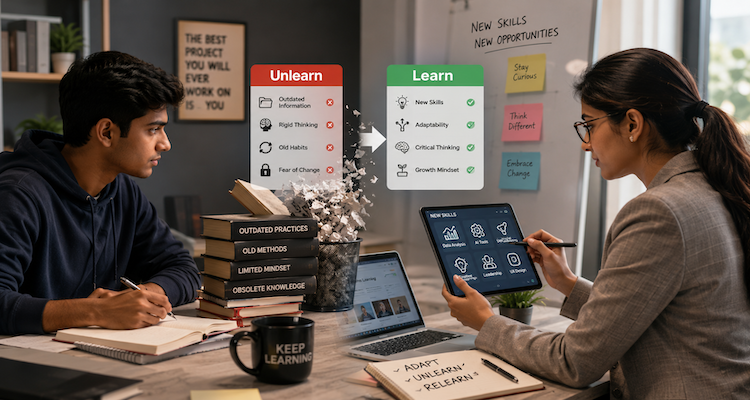
For generations, education has been built around a simple assumption: the more knowledge you accumulate, the better prepared you are for life and work. Degrees, certifications, and years of study have long served as markers of competence. Yet an increasingly complex reality is challenging that belief.
Many professionals discover that what helped them succeed five or ten years ago can quietly become an obstacle today. The challenge is no longer just learning new things. It is recognizing when old assumptions, habits, and mental models have stopped serving a useful purpose.
That shift is creating a new educational priority, one that receives far less attention than traditional learning. In a world defined by constant change, the ability to unlearn may be becoming one of the most valuable skills a person can develop.
Why More Knowledge Is Not Always an Advantage
Learning is often celebrated as an additive process. We gain information, acquire skills, and build expertise over time. But expertise can create an unexpected problem.
The more experience people have, the more likely they are to rely on established patterns. These patterns help us make decisions efficiently, but they can also make it harder to recognize when circumstances have changed.
History offers countless examples. Businesses that dominated their industries sometimes failed because leaders remained committed to outdated assumptions. Professionals who mastered a specific technology occasionally struggled when entirely new systems emerged. Educational institutions themselves have often been slow to adapt to changing workplace realities.
In many cases, the issue was not a lack of intelligence or effort. The problem was an inability to let go of ideas that once worked well.
Unlearning does not mean forgetting everything you know. It means questioning whether existing knowledge still applies to current conditions.
The Acceleration of Change
The importance of unlearning has grown because the pace of change has accelerated across nearly every field.
Artificial intelligence is reshaping workflows. Digital platforms continue to transform communication. New business models regularly disrupt established industries. Information that once remained relevant for decades can become outdated within a few years.
As a result, educational success can no longer be measured solely by how much information someone retains. The more important question may be how quickly they can update their understanding when new evidence appears.
This reality affects far more than technology professionals. Teachers, healthcare workers, marketers, managers, entrepreneurs, and even students face environments that evolve continuously.
The challenge is not keeping up with every trend. It is developing the flexibility to revise beliefs when circumstances change.
The Hidden Difference Between Learning and Adaptation
A common misconception is that lifelong learners automatically become adaptable people. The two qualities are related, but they are not identical.
Someone can spend years acquiring new knowledge while still holding tightly to outdated assumptions. In contrast, an adaptable person regularly evaluates whether their existing understanding remains useful.
This distinction explains why some individuals navigate change more successfully than others.
Consider workplace transformation. Two employees may attend the same training sessions and gain access to the same information. Yet one quickly adjusts to new tools and processes while the other struggles. The difference often lies not in intelligence but in mindset.
The adaptable employee is willing to abandon familiar methods when evidence suggests a better approach. The struggling employee may continue defending older practices simply because they feel comfortable or proven.
Learning adds new capabilities. Unlearning creates space for those capabilities to take root.
Why Unlearning Feels So Difficult
If unlearning is so valuable, why do people resist it?
Part of the answer lies in human psychology.
Knowledge becomes intertwined with identity. People often take pride in their expertise and experience. Admitting that a long-held belief may no longer be accurate can feel uncomfortable, even threatening.
Organizations face similar challenges. Established procedures provide stability and predictability. Changing them introduces uncertainty, which many institutions naturally try to avoid.
There is also a practical issue. Educational systems frequently reward correct answers rather than intellectual flexibility. Students learn to seek certainty and mastery. Far fewer opportunities exist to practice revising assumptions when new information emerges.
As a result, many people become skilled at acquiring knowledge but receive little training in letting go of outdated ideas.
The Emerging Competitive Advantage
One of the most significant workplace shifts today is that knowledge itself is becoming more accessible.
Search engines, digital resources, and AI-powered tools can provide information almost instantly. This does not diminish the value of expertise, but it changes what makes expertise valuable.
The competitive advantage increasingly lies in interpretation, judgment, and adaptability.
People who can reassess assumptions, integrate new information, and adjust strategies often outperform those who simply possess large amounts of static knowledge.
Employers are beginning to recognize this reality. Beyond technical skills, many organizations now seek individuals who demonstrate curiosity, resilience, and openness to change. These qualities support continuous adaptation in environments where job requirements evolve rapidly.
In many ways, unlearning has become a form of intellectual agility.
Education May Be Facing Its Next Transformation
This trend raises important questions about the future of education itself.
Traditional systems have focused heavily on content delivery teaching students what to know. Increasingly, educators are also exploring how to help students evaluate information, challenge assumptions, and navigate uncertainty.
The goal is not to reduce the importance of foundational knowledge. Facts, concepts, and expertise remain essential. However, the future may require balancing knowledge acquisition with the ability to revise and update that knowledge over time.
Some educational programs are already emphasizing problem-solving, interdisciplinary thinking, and project-based learning. These approaches encourage students to adapt rather than simply memorize.
The broader shift reflects a changing understanding of what preparedness means. In an unpredictable world, preparation may involve developing the capacity to learn, unlearn, and relearn repeatedly.
A Cultural Shift Beyond the Classroom
The growing importance of unlearning extends beyond schools and workplaces. It reflects a broader cultural transformation.
People increasingly encounter new perspectives, technologies, and social changes throughout their lives. Career paths are becoming less linear. Industries evolve faster. Entire categories of work can emerge within a few years.
Under these conditions, success depends less on reaching a final state of expertise and more on maintaining an ongoing process of adaptation.
Perhaps the most valuable insight is that unlearning is not a sign of failure. It is evidence of growth.
Many people associate changing their minds with weakness or inconsistency. In reality, the willingness to revise beliefs based on new information is often a mark of intellectual maturity.
The future is unlikely to reward those who know the most at any single moment. It may reward those who remain most capable of updating what they know.
The Skill That Future-Proofs Learning
Education will always involve acquiring knowledge. That fundamental mission is unlikely to change. Yet the conditions surrounding knowledge are changing dramatically.
Information is expanding faster than any individual can absorb. Industries continue to evolve. New technologies challenge established practices with increasing frequency.
In this environment, learning alone may not be enough.
The individuals who thrive will likely be those who combine curiosity with flexibility, expertise with humility, and knowledge with the courage to question it.
The most valuable educational skill of the future may not be mastering more information. It may be knowing when to let go of what no longer serves you and making room for what comes next.
The information presented in this article is based on publicly available sources, reports, and factual material available at the time of publication. While efforts are made to ensure accuracy, details may change as new information emerges. The content is provided for general informational purposes only, and readers are advised to verify facts independently where necessary.