







Why Temporary Cities Are Becoming a Permanent Feature of Modern Culture
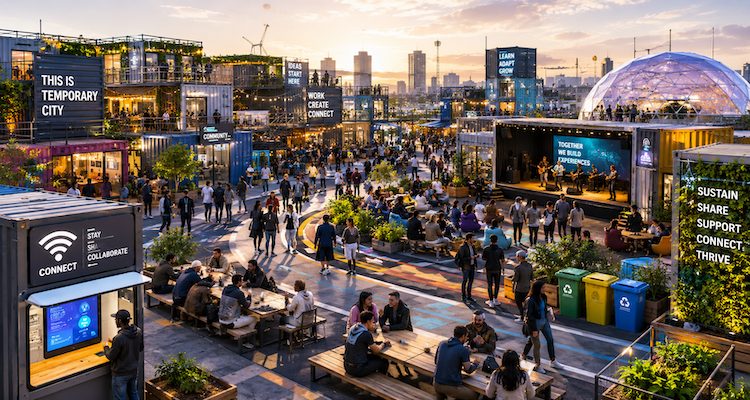
For a few days, a week, or sometimes a season, entire communities now appear almost out of nowhere. They arrive with housing, food systems, transportation, entertainment, workspaces, healthcare facilities, and social rules. Then, just as quickly, they disappear.
What once seemed like an unusual phenomenon associated with festivals, religious gatherings, sporting events, or emergency situations is becoming something much larger. Temporary cities are evolving from short-lived logistical solutions into influential cultural spaces that shape how people work, socialize, travel, learn, and even define community.
The rise of temporary cities reveals an important shift in modern society: people are becoming increasingly comfortable with belonging to places that are designed to be temporary. In many cases, these short-lived environments now serve purposes that traditional cities once fulfilled exclusively.
The Growing Appeal of Life Without Permanence
Historically, cities represented stability. People moved into communities, established roots, built institutions, and often remained connected to those places for decades.
Today, mobility has become a defining characteristic of modern life. Remote work, digital communication, global travel, project-based careers, and online communities have reduced the need for permanent geographic attachment.
Temporary cities fit naturally into this reality. They allow people to gather around a shared purpose rather than a shared address.
Examples can be found across many sectors. Large cultural festivals create sophisticated urban environments for attendees. Religious gatherings attract millions and require extensive temporary infrastructure. Major sporting events transform host locations into temporary urban ecosystems. Even business conferences increasingly resemble miniature cities complete with networking spaces, dining districts, entertainment zones, and dedicated transportation systems.
The attraction is not simply convenience. Temporary cities offer something many permanent cities struggle to provide: intense focus and shared identity.
For a limited period, everyone is there for a reason.
More Than Events: The Rise of Purpose-Built Communities
One of the most significant changes is that temporary cities are no longer merely supporting events. Increasingly, the city itself becomes part of the experience.
Participants often describe these environments as more socially connected than everyday urban life. People interact more frequently with strangers, engage in collaborative activities, and experience a stronger sense of belonging.
This may seem surprising in an era often characterized by digital isolation. Yet temporary cities create conditions that encourage interaction. The limited timeframe encourages people to participate rather than postpone. The shared purpose creates immediate social connections. The physical design often prioritizes gathering spaces over private isolation.
In many cases, temporary cities function as experimental communities where new ideas about sustainability, transportation, technology, governance, and social organization can be tested.
Because they are not expected to last forever, organizers have greater freedom to innovate.
The Technology Behind the Temporary Urban Boom
Advances in technology have made modern temporary cities far more sophisticated than their historical counterparts.
Digital ticketing, mobile payments, satellite connectivity, renewable energy systems, modular construction, portable sanitation, and AI-assisted logistics have dramatically improved the ability to create functional urban environments in short periods.
Companies involved in modular housing and prefabricated infrastructure have demonstrated how buildings, offices, healthcare facilities, and accommodation can be assembled and removed much faster than traditional construction projects.
The result is a new model of urban flexibility.
Instead of spending years building permanent infrastructure for occasional demand, organizers can deploy temporary systems precisely when and where they are needed.
This approach is becoming increasingly attractive for industries dealing with fluctuating populations, seasonal demand, or large-scale gatherings.
What Temporary Cities Reveal About Modern Behavior
Perhaps the most interesting insight is that temporary cities are not primarily about buildings. They are about changing attitudes toward community.
For generations, people often inherited communities through geography. Today, many individuals actively choose communities based on interests, values, careers, hobbies, or experiences.
Temporary cities represent the physical expression of this shift.
A person may spend most of the year connected to professional networks online, then travel to a temporary gathering where those digital relationships become real-world interactions. The temporary city becomes a bridge between virtual and physical community.
This reflects a broader cultural trend: people increasingly seek meaningful experiences and purposeful connections rather than permanent membership in traditional institutions.
In that sense, temporary cities are less about mobility and more about intentional belonging.
Business, Tourism, and Economic Opportunities
The economic implications are significant.
Cities and regions that successfully host temporary urban experiences often attract tourism, investment, media attention, and business activity. Event-driven economies can benefit from large inflows of visitors without necessarily supporting the same population year-round.
Industries ranging from hospitality and transportation to entertainment and technology increasingly depend on temporary population surges.
At the same time, businesses are beginning to recognize temporary cities as valuable testing grounds. New products, services, digital platforms, and customer experiences can be introduced to highly engaged audiences in concentrated environments.
The appeal lies in speed. Organizers can observe behavior, gather feedback, and refine concepts much faster than in traditional urban settings.
The Challenges Beneath the Excitement
Despite their growing popularity, temporary cities are not without challenges.
Environmental concerns remain an important issue. Large gatherings can generate waste, increase resource consumption, and place pressure on local ecosystems if poorly managed.
Questions about accessibility and inclusion also emerge. Some temporary communities can become exclusive spaces accessible primarily to those with financial means.
There are also practical concerns related to safety, infrastructure resilience, and governance. Creating a functioning city, even temporarily, requires careful planning and coordination.
As temporary cities become more common, expectations for sustainability, transparency, and responsible management are likely to increase.
Could Temporary Cities Influence Permanent Ones?
Perhaps the most fascinating possibility is that temporary cities may eventually reshape how permanent cities operate.
Urban planners are increasingly interested in flexibility. Traditional city development often struggles to adapt quickly to changing economic conditions, population shifts, or technological advances.
Temporary urban models offer lessons in adaptability.
Features such as modular infrastructure, mixed-use spaces, walkability, shared resources, and rapid deployment systems may become more influential in future urban design.
Some experts already view temporary cities as living laboratories where new approaches can be tested before broader implementation.
In this way, temporary cities may not be alternatives to permanent cities. Instead, they could become innovation engines that help permanent cities evolve.
A New Definition of Place
The growing presence of temporary cities suggests a deeper cultural transformation.
For much of human history, place was defined by permanence. A city existed because it endured. Its identity came from its longevity.
Today, value increasingly comes from experience, participation, and purpose. A place does not necessarily need to last for decades to have cultural significance. It only needs to create meaningful connections during the time it exists.
Temporary cities embody this new reality. They are becoming spaces where people gather not because they must, but because they choose to.
As mobility, technology, and changing social expectations continue to reshape everyday life, temporary cities may become one of the defining cultural forms of the twenty-first century proving that even the most short-lived places can leave a lasting impact.
This content is published for informational or entertainment purposes. Facts, opinions, or references may evolve over time, and readers are encouraged to verify details from reliable sources.
Related News
- Why Communities Are Rediscovering Their Forgotten Local Legends
- When Language Becomes Invisible: How Translation Technology Is Reshaping Cultural Identity
- When Convenience Replaces Effort: The Hidden Cultural Costs of a Frictionless World
- Why Shared Experiences Are Replacing Shared Beliefs as the New Social Glue