










When Language Becomes Invisible: How Translation Technology Is Reshaping Cultural Identity
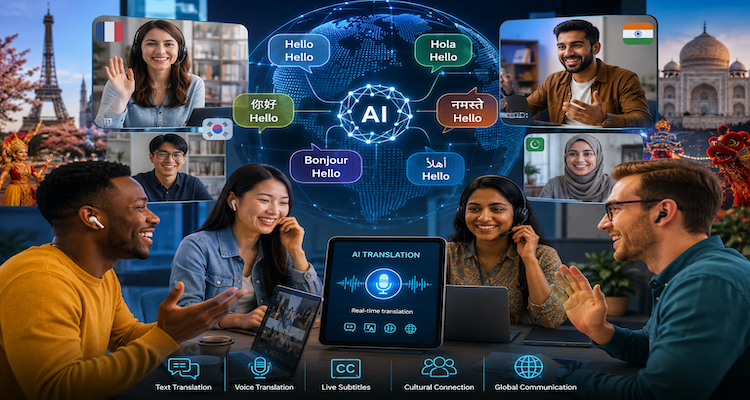
A teenager in Brazil watches a Korean creator, comments in Portuguese, receives a reply translated from Korean, and joins a community where language barriers barely exist. Neither participant may realize that multiple layers of translation technology made the interaction possible. What once required years of language study now happens in seconds.
The most remarkable aspect of this transformation is not the technology itself. It is the quiet cultural shift happening beneath it. As translation tools become increasingly seamless, they are changing how people experience language, culture, identity, and belonging in ways that few anticipated.
For centuries, language acted as both a bridge and a boundary. It connected people within communities while creating natural distinctions between cultures. Today, artificial intelligence-powered translation systems are steadily weakening those boundaries, opening new opportunities for communication while raising important questions about what happens when cultural differences become easier to cross and sometimes easier to overlook.
The End of Language as a Barrier
Translation technology has advanced far beyond simple word-for-word conversion. Modern systems can interpret context, tone, intent, and even conversational nuances with growing accuracy.
Real-time translation is increasingly embedded into social media platforms, video content, messaging applications, business tools, and online communities. A user can consume content from creators across the world without understanding a single word of the original language.
This accessibility has expanded the global flow of ideas. Independent artists can reach international audiences. Small businesses can communicate with overseas customers. Students can access educational content from different countries. Communities that were once isolated by language can now interact directly.
The result is a world where cultural exposure is becoming less dependent on linguistic ability.
Yet this convenience carries deeper implications than simply making communication easier.
Culture Is More Than Words
Translation can convert language, but culture is often embedded in meanings that words alone cannot fully capture.
Humor, traditions, historical references, social norms, and emotional expressions are deeply influenced by cultural context. A phrase that resonates strongly within one culture may lose much of its significance when translated into another language.
As translation technology improves, users increasingly consume foreign content without necessarily understanding the cultural frameworks behind it.
This creates an interesting paradox. People are gaining unprecedented access to global cultures while sometimes experiencing them through simplified or filtered interpretations.
The challenge is not that translation technology fails. In many cases, it succeeds remarkably well. The challenge is that understanding culture often requires more than understanding vocabulary.
The Rise of Hybrid Cultural Identities
One of the most significant but underreported effects of translation technology is the emergence of hybrid cultural identities.
Younger generations increasingly participate in global digital communities that transcend national and linguistic boundaries. Fans of international music, gaming, entertainment, education, and online creators often engage with cultural influences from multiple regions simultaneously.
Translation tools accelerate this process.
Someone may adopt expressions from another culture, follow influencers from several countries, consume international media daily, and develop interests that reflect a blend of global influences rather than a single cultural tradition.
Identity is becoming less tied to geography and more connected to digital participation.
This does not necessarily mean local cultures are disappearing. Instead, many individuals are building layered identities that combine local traditions with global influences.
The result is a cultural landscape that is increasingly interconnected and difficult to define through traditional national boundaries alone.
What Happens When Everyone Can Speak to Everyone?
Historically, language differences shaped how societies developed. Distinct languages often preserved unique worldviews, traditions, and ways of thinking.
As translation technology reduces communication barriers, cultures influence one another more rapidly than ever before.
This can encourage innovation, collaboration, and greater understanding. Ideas move faster. Creative trends spread globally. Educational resources become more accessible.
However, greater connectivity may also create pressure toward cultural standardization.
When global platforms prioritize content that performs well across multiple regions, creators may unconsciously adapt their communication styles to appeal to broader audiences. Over time, certain expressions, storytelling formats, and cultural references can become more dominant while highly localized forms receive less visibility.
Translation technology does not directly cause cultural homogenization, but it may accelerate existing forces that encourage global cultural convergence.
The Business of Global Communication
Companies have been among the biggest beneficiaries of translation advances.
Businesses can now market products, provide customer support, and operate across international markets with fewer language-related obstacles. Educational platforms can reach broader audiences. Entertainment companies can distribute content worldwide more efficiently.
The global success of streaming platforms, online courses, podcasts, and creator-driven media demonstrates how powerful language accessibility has become.
Interestingly, many organizations are no longer treating translation as a secondary service. Instead, multilingual accessibility is increasingly part of core product design.
This shift reflects a larger reality: audiences are becoming global by default.
Consumers now expect access regardless of language, and companies that meet that expectation gain significant advantages.
The Subtle Losses We Rarely Discuss
Public conversations about translation technology often focus on what is gained. Less attention is paid to what might gradually be lost.
Languages carry unique ways of interpreting reality. Certain concepts exist in one language but have no perfect equivalent elsewhere. Traditional expressions often reflect centuries of cultural experience.
When interactions increasingly occur through automated translation, some of these subtleties may become less visible.
The concern is not that languages will suddenly disappear. Rather, there is a possibility that cultural nuances become compressed into more universally understandable forms.
This raises an important question: if technology allows everyone to understand one another, how do societies preserve the distinctive perspectives that make cultures unique?
The answer may depend on whether translation is treated as a substitute for cultural understanding or as a gateway to deeper exploration.
Why This Moment Feels Different
Translation technology has existed for decades. What makes the current moment unique is its growing invisibility.
Users no longer actively seek translation. It increasingly operates in the background.
A video appears with automatic subtitles. A comment is translated instantly. A meeting includes real-time interpretation. A customer receives support in their native language without realizing the system behind it.
As translation becomes frictionless, its influence becomes easier to overlook.
Yet the technology is shaping how people discover information, form relationships, build communities, and understand cultures around the world.
That makes it more than a communication tool. It is becoming a cultural infrastructure layer for the internet itself.
The Future of Cultural Identity in a Translated World
The future is unlikely to be defined by a single global culture replacing local traditions. Human identity is too complex for such a simple outcome.
Instead, translation technology may create a world where cultural participation becomes more fluid. People will continue to belong to local communities while simultaneously engaging with global networks that influence their values, interests, and perspectives.
The most important challenge may not be preserving language barriers but preserving cultural depth.
Translation can help people understand what others are saying. Understanding why they say it, what historical experiences shaped it, and what cultural meanings lie beneath it remains a distinctly human responsibility.
As language barriers fade, cultural curiosity may become more important than ever. The future of cultural identity will likely depend not on how well machines translate words, but on how willing people remain to explore the worlds those words represent.
This content is published for informational or entertainment purposes. Facts, opinions, or references may evolve over time, and readers are encouraged to verify details from reliable sources.