










Why Familiar Franchises and True Crime Keep Winning on Netflix
Key Takeaways
- Netflix added 35 new titles this week, reflecting a broad mix of originals, licensed content, and international productions.
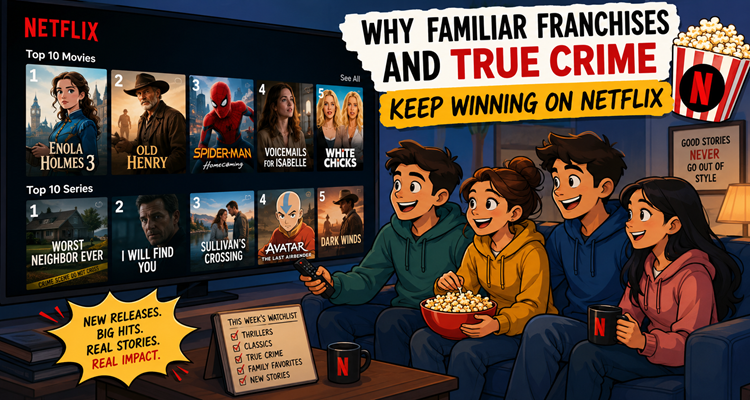
- Viewer rankings show that established franchises and recognizable brands continue to outperform many newer releases.
- True crime remains one of streaming’s most reliable genres, leading television charts despite growing competition.
- Nostalgia-driven reboots and literary adaptations are gaining traction as audiences seek both comfort and quality storytelling.
- The platform’s latest releases reveal how streaming services are balancing riskier originals with proven audience favorites.
Introduction
Every week, streaming platforms release dozens of new titles, but only a handful manage to capture widespread attention. The latest batch of additions to Netflix’s U.S. library offers more than just entertainment recommendations—it provides a revealing snapshot of how audience behavior is evolving in the streaming era.
This week’s collection spans historical drama, science fiction, true crime, family entertainment, stand-up comedy, and international productions. While variety remains one of Netflix’s greatest strengths, the platform’s most-watched lists reveal a deeper trend: viewers continue to gravitate toward familiar stories, trusted franchises, and emotionally engaging narratives.
The contrast between new arrivals and the titles dominating Netflix’s Top 10 rankings highlights a challenge facing every streaming company today. Audiences have more choices than ever, yet they often return to recognizable characters, established genres, and proven storytelling formats. Understanding why that happens offers valuable insight into the future of streaming entertainment.
Understanding the Development
Netflix expanded its catalog this week with 35 new releases, including 22 films and 13 television series. The additions cover a wide spectrum of genres and audience segments, demonstrating the platform’s ongoing strategy of appealing to multiple viewing preferences simultaneously.
Among the most notable additions are the literary adaptation Hamnet, the science-fiction thriller I.S.S., the romantic comedy-drama Don Jon, and a new adaptation of Little House on the Prairie. Together, these titles represent four very different storytelling approaches.
A Blend of Old and New
One striking aspect of this week’s lineup is the balance between original productions and established intellectual properties.
Streaming services once prioritized original content as their primary differentiator. Today, however, audiences increasingly respond to familiar worlds, beloved stories, and recognizable brands. This explains the continued investment in reboots, sequels, and adaptations alongside entirely new productions.
The arrival of Little House on the Prairie illustrates this strategy perfectly. By reintroducing a well-known story to modern audiences, Netflix gains both nostalgic viewers and younger generations discovering the narrative for the first time.
The Rise of Prestige Adaptations
At the same time, films such as Hamnet demonstrate the continuing appeal of literary adaptations. Audiences increasingly seek stories that combine emotional depth, historical context, and cinematic quality.
Prestige dramas often attract a different segment of viewers than blockbuster franchises, helping platforms diversify engagement across demographics.
Why This Matters
The streaming landscape in 2026 is significantly different from what it was just a few years ago.
As subscription costs rise and competition intensifies, platforms face greater pressure to justify their value. Success is no longer measured solely by the number of titles available but by the ability to consistently deliver content viewers actually watch.
Audience Attention Is Becoming Scarcer
Consumers now divide their entertainment time among streaming platforms, social media, gaming, podcasts, and short-form video.
In this environment, earning attention has become more challenging than producing content.
This week’s Netflix rankings demonstrate that audiences frequently choose content that offers familiarity and reliability. A known franchise requires less decision-making than an unfamiliar title, making it more likely to be selected during casual browsing sessions.
The Emotional Economics of Viewing
Entertainment choices are often emotional rather than purely rational.
When viewers feel overwhelmed by options, they tend to gravitate toward stories that provide predictable satisfaction. This psychological behavior helps explain why sequels, adaptations, and recognizable genres continue performing well.
For streaming companies, understanding these emotional drivers is becoming as important as understanding demographics.
What Is Changing
Several emerging shifts can be identified from both the new releases and viewing rankings.
True Crime Remains Exceptionally Powerful
The television rankings are once again led by a true-crime documentary series.
This is not an isolated occurrence. True crime has consistently remained one of streaming’s strongest categories because it combines suspense, real-world relevance, and social discussion.
Unlike scripted dramas, true-crime content often extends beyond the viewing experience. Audiences discuss theories, share reactions online, and consume related content across multiple platforms.
As a result, these programs generate engagement that extends far beyond their runtime.
Global Storytelling Continues Expanding
Netflix’s latest additions include productions from multiple countries and languages, including Japanese, Korean, Spanish, French, Hindi, Telugu, and Malayalam content.
This reflects a broader transformation in entertainment consumption.
International programming is no longer considered niche. Audiences increasingly evaluate content based on story quality rather than country of origin.
Streaming platforms have accelerated this shift by improving dubbing, subtitling, and recommendation systems.
Genre Diversity Is Becoming Essential
The week’s lineup also highlights the importance of genre diversification.
From historical drama to science fiction, family entertainment to documentary storytelling, platforms are recognizing that audience preferences are becoming increasingly fragmented.
Instead of relying on a few blockbuster hits, successful services now cultivate broad content ecosystems capable of serving many viewer segments simultaneously.
The Bigger Picture
The current streaming environment reflects broader changes occurring across the entertainment industry.
Franchises Are Becoming Strategic Assets
The success of titles connected to existing brands illustrates how intellectual property has become a critical competitive advantage.
Viewers already understand the world, characters, or themes associated with these properties. This familiarity reduces marketing costs and increases the likelihood of audience engagement.
Consequently, media companies continue investing heavily in adaptations, sequels, and franchise extensions.
Nostalgia Is Evolving
Nostalgia-driven content is often misunderstood as merely revisiting the past.
In reality, modern reboots increasingly serve two audiences at once: longtime fans seeking emotional connection and younger viewers experiencing the material for the first time.
The strongest reboots succeed not because they replicate the original but because they reinterpret it for contemporary audiences.
Streaming Has Become a Discovery Engine
While recognizable brands dominate headlines, streaming platforms also function as discovery engines.
Many viewers encounter older films, independent productions, or international series through recommendation algorithms rather than traditional marketing campaigns.
This dual role- serving both familiarity and discovery- has become one of streaming’s defining characteristics.
Opportunities and Challenges
Opportunities for Content Creators
The growing appetite for diverse storytelling creates significant opportunities.
International creators can reach global audiences more easily than ever. Documentary filmmakers can build substantial followings. Literary adaptations continue finding receptive viewers.
Success increasingly depends on compelling storytelling rather than geographic location.
Challenges for Streaming Platforms
However, balancing innovation and familiarity remains difficult.
Platforms must continue producing original content while also satisfying audience demand for established franchises and recognizable genres.
Investing too heavily in familiar properties risks creative stagnation. Focusing exclusively on originals increases commercial uncertainty.
The most successful platforms will likely maintain a careful balance between the two.
The Visibility Problem
Another challenge involves content discoverability.
With thousands of available titles, many quality productions struggle to gain attention regardless of merit.
This reality places greater importance on recommendation algorithms, promotional strategies, and audience engagement mechanisms.
What Comes Next
Several trends are likely to shape Netflix and the broader streaming industry over the coming years.
First, franchise-driven content will remain important, particularly as platforms seek predictable audience engagement.
Second, international programming will continue expanding its influence, creating a more globally interconnected entertainment ecosystem.
Third, documentary and true-crime storytelling are unlikely to lose momentum. Their ability to generate discussion and sustained interest gives them unique value within streaming libraries.
Finally, audience expectations will continue rising. Viewers increasingly demand both quality and variety, forcing platforms to refine how they commission, market, and recommend content.
The companies that best understand audience psychology, not just viewing statistics, will have the greatest advantage.
Conclusion
Netflix’s newest releases offer more than a list of weekend viewing options. They reveal a streaming ecosystem shaped by familiarity, curiosity, emotional connection, and evolving audience habits.
The continued dominance of franchises, true crime, and beloved stories suggests that viewers are not simply seeking more content; they are searching for content they can trust to deliver a meaningful experience.
As streaming competition intensifies, the platforms that successfully combine discovery with familiarity will be best positioned to capture audience attention. This week’s rankings suggest that while new ideas remain essential, recognizable stories and emotionally resonant narratives continue to hold remarkable power in the digital entertainment era.
This content is published for informational or entertainment purposes. Facts, opinions, or references may evolve over time, and readers are encouraged to verify details from reliable sources.
Related News
- Netflix’s 2026 Book Options Reveal What Stories It May Be Betting On Next
- Why Video Game Adaptations Are Finally Winning Over Audiences
- From Fan Fiction to Blockbusters: How Online Communities Are Changing Storytelling
- The Death of Channel Surfing: How Streaming Changed the Way We Discover Entertainment