










The Bhagavad Gita and Emotional Reactivity: Finding Calm in an Age of Constant Triggers
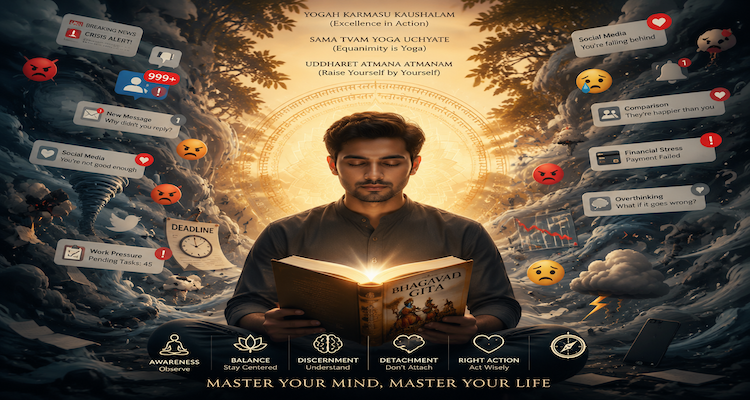
A single notification can change the mood of an entire day. A critical comment on social media, a delayed reply from a colleague, an unexpected setback at work, or even a passing remark from a loved one can trigger reactions that linger for hours. While digital technology has amplified these moments, the underlying pattern is far older than smartphones or social platforms.
The growing conversation around emotional reactivity reflects something deeper than everyday stress. Many people are beginning to recognize that the problem isn’t simply the number of challenges they face, it’s how quickly those challenges seize control of their thoughts, emotions, and decisions. This shift has sparked renewed interest in ancient philosophies that explore the workings of the human mind, including the timeless teachings of the Bhagavad Gita.
Rather than encouraging emotional suppression, the Bhagavad Gita offers a remarkably practical framework for understanding why mental triggers occur and how greater self-awareness can reduce their influence. Its insights remain surprisingly relevant in a world where attention is constantly interrupted and emotional responses are increasingly shaped by digital environments.
Understanding Emotional Reactivity
Emotional reactivity refers to the tendency to respond automatically and intensely to situations without conscious reflection. It often appears as anger, anxiety, frustration, defensiveness, jealousy, or impulsive decision-making.
Modern life presents countless opportunities for such reactions. Professional competition, social comparison, information overload, political polarization, and the pressure to constantly perform create an environment where the mind rarely experiences genuine rest.
The issue is not emotion itself. Emotions provide valuable information about our experiences. Problems arise when emotional impulses become the primary drivers of our behavior before reason has an opportunity to engage.
The Bhagavad Gita approaches this challenge from a different perspective. Instead of asking how to eliminate difficult emotions, it asks why external events possess such power over the inner self.
The Gita’s View: Triggers Begin Within
One of the central ideas in the Bhagavad Gita is that suffering is often intensified by attachment, expectation, and identification rather than by external circumstances alone.
According to the text, people become disturbed not simply because events occur, but because those events conflict with deeply held desires, fears, or assumptions about how life should unfold.
This insight remains strikingly relevant today.
A negative online comment may hurt because it challenges one’s identity. Workplace criticism may provoke anger because it threatens professional self-worth. Financial uncertainty may trigger anxiety because it disrupts expectations about security and success.
The external event becomes the trigger, but the reaction is shaped by internal conditioning.
Recognizing this distinction shifts the focus from controlling the world to understanding the mind.
Why Today’s Environment Amplifies Mental Triggers
Digital platforms reward speed rather than reflection.
Algorithms prioritize emotionally charged content because strong emotions encourage engagement. News headlines compete for attention through urgency. Social media encourages comparison. Instant messaging creates expectations of immediate responses.
As a result, many people spend large portions of the day reacting instead of responding thoughtfully.
This constant stimulation leaves little space for mental recovery.
The Bhagavad Gita repeatedly emphasizes steadiness of mind a quality described as remaining balanced amid success and failure, praise and criticism, pleasure and discomfort. While achieving such balance is not easy, the principle itself feels increasingly valuable in an economy built around distraction.
The Difference Between Reaction and Response
Perhaps the Gita’s most practical lesson is the distinction between automatic reaction and conscious action.
A reaction is immediate.
A response is intentional.
When emotions dominate decision-making, people often say things they later regret, make impulsive purchases, escalate workplace conflicts, or damage important relationships.
Responding, by contrast, creates a brief but powerful pause between stimulus and action.
That pause allows values, judgment, and long-term priorities to guide behavior instead of temporary emotional states.
This concept has gained renewed attention across leadership development, executive coaching, and workplace well-being programs, where emotional regulation is increasingly recognized as a critical professional skill.
Emotional Self-Mastery Is Not Emotional Suppression
One common misconception is that spiritual teachings encourage people to become emotionally detached or indifferent.
The Bhagavad Gita suggests something more nuanced.
Its ideal is not emotional numbness but emotional clarity.
The goal is to experience emotions without becoming completely controlled by them.
Fear can still exist.
Disappointment can still arise.
Joy remains meaningful.
The difference lies in whether these experiences determine every subsequent thought and action.
This perspective aligns with a broader understanding that resilience is not the absence of emotion but the ability to recover without losing direction.
The Workplace Lesson Hidden in Ancient Wisdom
Modern organizations increasingly value adaptability, emotional intelligence, and thoughtful leadership.
Technical expertise remains important, but many workplace challenges stem from interpersonal dynamics rather than technical limitations.
Managers who react defensively to feedback may discourage innovation.
Employees overwhelmed by constant comparison may experience burnout despite professional success.
Teams driven by fear rather than trust often struggle with collaboration.
The Bhagavad Gita’s emphasis on self-awareness offers an unexpected contribution to these conversations.
Leadership begins with governing one’s own mind before attempting to influence others.
This insight explains why many professionals are exploring mindfulness, reflective practices, and philosophical traditions alongside conventional productivity techniques.
The search is gradually shifting from maximizing output to improving inner stability.
The Hidden Cost of Living in Trigger Mode
Constant emotional reactivity affects more than mood.
It influences attention, relationships, creativity, and decision-making.
When the mind remains occupied with perceived threats or unresolved frustrations, it becomes harder to focus deeply, solve complex problems, or appreciate meaningful experiences.
People may mistakenly believe they need better time management when the deeper issue is emotional management.
The Bhagavad Gita encourages observing thoughts instead of immediately identifying with them.
This subtle shift creates psychological distance between the observer and the emotional impulse.
While the practice requires patience, it can gradually reduce the intensity of everyday triggers.
Why the Bhagavad Gita Continues to Resonate
The renewed interest in the Bhagavad Gita is not necessarily about religious identity.
For many readers, it represents a philosophical guide for navigating uncertainty.
Its teachings address universal questions:
How should we act when emotions cloud judgment?
How can we remain purposeful during adversity?
How do we avoid becoming controlled by external circumstances?
These questions feel increasingly relevant in societies where attention is fragmented and emotional stimulation is constant.
Rather than offering quick fixes, the Gita encourages ongoing self-examination a practice that remains valuable regardless of profession, age, or cultural background.
Looking Beyond the Trigger
Perhaps the most enduring lesson from the Bhagavad Gita is that freedom begins with awareness.
External events will continue to surprise, disappoint, inspire, and challenge us. Technology will likely become even more immersive, workplaces more demanding, and information more abundant.
The real question is whether our inner world becomes entirely dependent on those changing conditions.
Emotional reactivity may never disappear completely, nor should it. Emotions are part of being human. But learning to recognize triggers before they dictate our choices can transform both personal well-being and the quality of our relationships.
In an age where attention has become one of the world’s most valuable resources, mastering the mind may prove to be one of the most practical forms of wisdom. The Bhagavad Gita reminds us that true strength is not measured by how forcefully we react, but by how consciously we choose our response.
This content is published for informational or entertainment purposes. Facts, opinions, or references may evolve over time, and readers are encouraged to verify details from reliable sources.