









Why Soil Health Is Becoming a Frontline Climate Adaptation Strategy
A growing number of climate conversations are moving beneath our feet. While public attention often focuses on renewable energy, electric vehicles, and carbon emissions, another climate solution is gaining importance in farms, research institutions, and policy discussions: soil health.
The shift is happening for a practical reason. Extreme weather is becoming harder to predict. Some regions face prolonged droughts, while others experience intense rainfall and flooding. In both situations, the condition of the soil often determines whether landscapes remain productive and resilient or become increasingly vulnerable.
What was once viewed primarily as an agricultural concern is now being recognized as a critical climate adaptation strategy. Healthy soil is proving capable of helping communities withstand environmental stress, protect food production, and improve ecosystem resilience in ways that are often overlooked.
The Hidden Infrastructure Beneath Every Landscape
Most people think of infrastructure as roads, bridges, dams, or power grids. Yet soil performs equally essential functions.
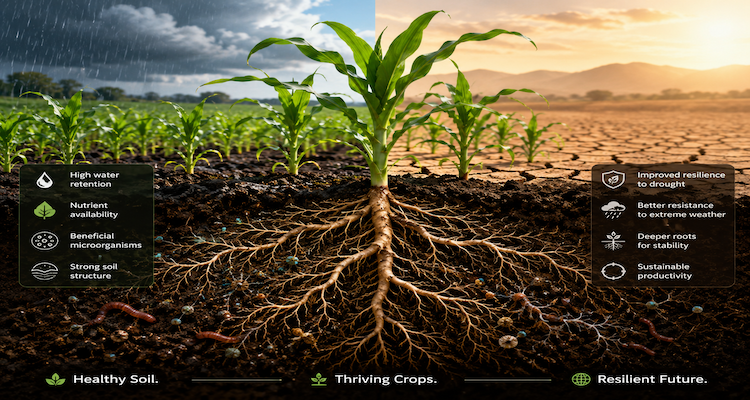
Healthy soil acts like a natural sponge. It absorbs rainfall, stores moisture, supports plant growth, and helps regulate water movement across landscapes. It also serves as a living ecosystem filled with microorganisms, fungi, insects, and organic matter that contribute to nutrient cycling and plant health.
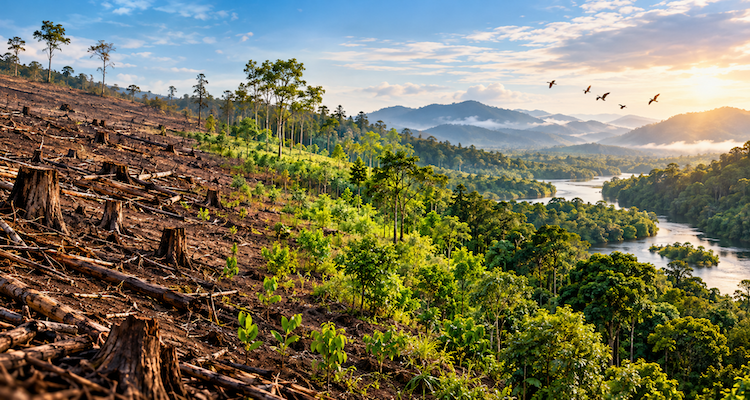
When soil becomes degraded through erosion, excessive chemical use, compaction, or loss of organic matter, its ability to perform these functions declines. The result can be reduced crop productivity, greater vulnerability to drought, increased flooding, and lower ecosystem stability.
Climate adaptation increasingly depends on strengthening this natural infrastructure rather than relying solely on engineered solutions.
Why Climate Change Is Making Soil More Important
Climate challenges often appear above ground, but many of their consequences begin below the surface.
During heavy rainfall events, healthy soils can absorb more water, reducing runoff and helping limit erosion. In drought conditions, soils rich in organic matter retain moisture longer, allowing plants to survive periods of limited rainfall.
This dual role is particularly significant because climate change is creating more weather extremes rather than simply altering average temperatures.
Farmers around the world are increasingly looking at soil management as a way to improve resilience. Practices such as cover cropping, reduced tillage, crop rotation, and compost application are receiving greater attention because they can strengthen soil structure and improve water retention.
The goal is no longer just maximizing yields. It is creating agricultural systems that can continue functioning under increasingly unpredictable conditions.
Food Security Starts with Soil Resilience
One reason soil health has become a major climate issue is its direct connection to food security.
Global agriculture depends on productive soils, yet many farming regions have experienced decades of degradation. As climate pressures increase, degraded soils can struggle to support stable food production.
Healthy soils offer multiple advantages. They improve nutrient availability, support stronger root systems, and help crops tolerate environmental stress. These benefits become especially valuable when weather conditions become less predictable.
For consumers, this may seem distant from everyday life. However, disruptions in agricultural productivity can influence food prices, supply chains, and availability. The resilience of soil systems ultimately affects everyone who relies on stable food markets.
The growing interest in soil health reflects a broader realization that climate adaptation is not only about protecting ecosystems, it is also about safeguarding essential economic and social systems.
The Emerging Shift from Carbon to Resilience
Much public discussion around soil focuses on carbon storage. Healthy soils can help capture and retain carbon, making them relevant to climate mitigation efforts.
However, an important shift is taking place.
Many experts and land managers are increasingly emphasizing resilience rather than carbon alone. The value of healthy soil is not limited to its role in storing carbon. Its immediate ability to improve water management, reduce erosion, and support agricultural productivity may be even more significant for communities facing climate impacts today.
This change in perspective represents a broader evolution in climate thinking.
Instead of treating environmental systems primarily as tools for reducing emissions, there is growing recognition that they are also essential assets for adapting to unavoidable climate challenges.
Beyond Farms: Soil Health and Urban Climate Adaptation
The importance of soil extends far beyond agriculture.
Urban planners and environmental designers are increasingly considering soil quality when addressing flooding, heat stress, and green infrastructure projects.
Parks, urban forests, community gardens, and green spaces all depend on healthy soils. Poor soil conditions can reduce vegetation growth and limit the effectiveness of climate adaptation initiatives.
Cities that invest in natural systems often discover that soil plays a foundational role in supporting cooling effects, stormwater management, and biodiversity.
As urban populations continue to grow, the connection between soil health and climate resilience may become increasingly important in city planning discussions.
A Cultural Change in How We View Land
One of the most interesting developments is the cultural shift surrounding soil itself.
For decades, soil was often treated as an unlimited resource. The focus was placed on what could be produced from the land rather than on maintaining the long-term condition of the land itself.
Today, a different perspective is emerging.
Farmers, conservation groups, researchers, and policymakers are increasingly discussing soil as a living system that requires stewardship. This mindset encourages long-term thinking and recognizes that environmental resilience depends on maintaining ecological foundations.
The change mirrors broader conversations about sustainability. Rather than extracting maximum short-term value, attention is shifting toward preserving systems that can continue delivering benefits over generations.
What This Trend Reveals About the Future of Climate Adaptation
The growing emphasis on soil health reveals an important lesson about climate adaptation.
Many of the most effective solutions may not come from entirely new technologies. Instead, they may emerge from a deeper understanding of natural systems that have supported human societies for centuries.
Healthy soils are not a silver bullet. They cannot eliminate droughts, prevent every flood, or solve all climate-related challenges. However, they can strengthen resilience across multiple sectors simultaneously, including agriculture, water management, biodiversity conservation, and food security.
That broad impact is precisely why interest is increasing.
As climate risks become more complex, adaptation strategies that deliver multiple benefits are likely to gain greater attention. Soil health fits that description remarkably well.
The future of climate resilience may depend not only on what societies build above ground but also on how effectively they protect and restore the living foundation beneath it. In that sense, soil is no longer just part of the environment—it is becoming one of the most important climate assets of the twenty-first century.
This content is published for informational or entertainment purposes. Facts, opinions, or references may evolve over time, and readers are encouraged to verify details from reliable sources.