










Why Neighborhood Energy Sharing Is Becoming a Major Energy Market
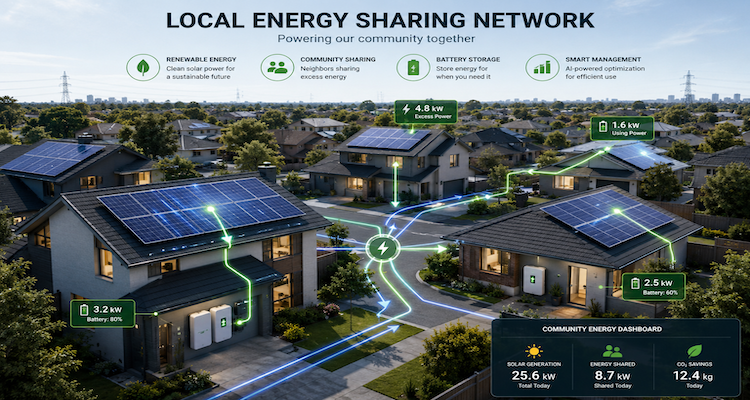
A quiet transformation is taking place in neighborhoods around the world. While much of the public conversation about energy focuses on massive solar farms, electric vehicles, and national power grids, a different trend is emerging much closer to home: people are beginning to share electricity with one another.
What once sounded like an experimental idea is increasingly becoming a practical business model. Homes equipped with solar panels, battery storage systems, and smart energy technologies are no longer just consuming electricity, they are becoming small energy producers. In some communities, excess power generated by one household can be transferred, traded, or shared with nearby homes, creating localized energy networks that operate alongside traditional utility systems.
This shift is giving rise to a growing market for neighborhood energy sharing, a concept that could reshape how communities think about energy ownership, resilience, and cost savings.
From Energy Consumers to Energy Participants
For more than a century, electricity has largely flowed in one direction: from centralized power plants to homes and businesses. Consumers paid their bills, utilities managed supply, and the relationship remained relatively simple.
The rapid adoption of rooftop solar systems has begun to challenge that model. Many households now generate more electricity than they use during certain hours of the day. Traditionally, excess power has been sent back to the grid through net metering programs. However, changes in energy policies and shifting compensation structures have encouraged homeowners to explore alternative ways of maximizing the value of their surplus energy.
Neighborhood energy sharing offers one such alternative. Instead of sending excess electricity far into the grid, communities can create systems that allow locally generated energy to benefit nearby households. The result is a more decentralized approach to power distribution that keeps energy—and potentially economic value closer to where it is produced.
Why Interest Is Growing Now
Several trends are converging to make neighborhood energy sharing more attractive than it was just a few years ago.
The first is the continued decline in the cost of solar panels and battery storage systems. As more households install renewable energy technologies, communities gain the capacity needed to support local energy exchanges.
The second factor is the rise of smart energy management technologies. Advanced meters, connected devices, and digital platforms make it easier to track production, consumption, and transfers of electricity in real time. What once required complex infrastructure can increasingly be coordinated through software.
A third driver is growing concern about energy reliability. Extreme weather events, aging infrastructure, and rising electricity demand have highlighted vulnerabilities within many power systems. Communities are looking for ways to improve resilience, and local energy networks offer one potential solution.
At the same time, consumers are becoming more interested in having greater control over their energy choices. Much like the rise of community-supported agriculture or local food movements, neighborhood energy sharing reflects a broader desire for participation rather than passive consumption.
The Economic Appeal of Local Energy Markets
One reason the concept is attracting attention from policymakers, technology companies, and utilities is its potential economic value.
When energy is generated and consumed within the same neighborhood, transmission losses can be reduced. Local energy exchanges may also help optimize existing infrastructure by easing pressure on centralized systems during periods of high demand.
For homeowners with solar installations, neighborhood sharing could create additional opportunities to monetize excess production. For households without solar panels, it may provide access to locally generated renewable energy without requiring major investments in equipment.
The market implications extend beyond individual consumers. Software developers, battery manufacturers, energy service providers, and infrastructure companies are increasingly exploring products designed specifically for localized energy ecosystems.
In many ways, neighborhood energy sharing represents the emergence of a new marketplace where electricity becomes a community-level resource rather than simply a utility service.
A Social Shift Hidden Inside an Energy Trend
One of the most overlooked aspects of neighborhood energy sharing is that it is not only an energy story, it is also a social story.
Historically, electricity has been largely invisible to consumers. Most people think about power only when they receive a bill or experience an outage. Local energy sharing changes that relationship by making energy production and consumption more visible within communities.
This creates an interesting behavioral shift. Neighbors become stakeholders in shared energy outcomes. Communities may begin coordinating energy use, investing collectively in renewable infrastructure, or participating in local energy programs that strengthen community resilience.
The deeper insight is that energy sharing mirrors broader trends in modern society. Across transportation, housing, finance, and digital platforms, people are increasingly participating in decentralized networks rather than relying exclusively on centralized institutions. Energy appears to be following a similar path.
The result could be a future in which communities play a larger role in managing essential resources rather than leaving all decisions to distant systems.
Challenges Still Stand in the Way
Despite growing interest, neighborhood energy sharing remains a developing market rather than a mainstream reality.
Regulatory frameworks vary significantly between regions, and many electricity markets were designed for centralized power distribution. Updating rules to support local energy exchanges can be a slow and complex process.
Technical integration presents another challenge. Local energy systems must operate safely while remaining compatible with broader grid infrastructure. Utilities and regulators must balance innovation with reliability and consumer protection.
Questions about pricing, ownership, cybersecurity, and equitable access also remain important. Communities with greater financial resources may adopt these systems more quickly, raising concerns about whether the benefits will be distributed evenly.
These challenges do not necessarily prevent growth, but they highlight why widespread adoption is likely to occur gradually rather than overnight.
What Makes This Moment Different
Neighborhood energy sharing has been discussed for years, but several developments make the current moment particularly significant.
Renewable energy adoption is reaching levels where localized exchanges are becoming increasingly practical. Digital technologies are reducing coordination barriers. Meanwhile, growing concerns about sustainability, energy costs, and resilience are creating strong incentives for experimentation.
Perhaps most importantly, public attitudes toward energy are evolving. Consumers increasingly expect flexibility, transparency, and participation in the services they use. The traditional one-way energy model no longer aligns with those expectations as neatly as it once did.
This combination of technological readiness, economic motivation, and changing consumer behavior is creating conditions that were largely absent in earlier decades.
Looking Ahead
The future of neighborhood energy sharing will likely vary from one region to another. Some communities may embrace peer-to-peer energy trading, while others may focus on shared batteries, microgrids, or community-owned renewable projects.
What seems increasingly clear is that the concept addresses several challenges simultaneously: renewable energy integration, grid resilience, local economic value creation, and consumer empowerment.
Whether neighborhood energy sharing becomes a dominant feature of future energy systems or remains a specialized solution, its growth reveals an important shift in how society views electricity. Energy is no longer seen solely as a commodity delivered by utilities. It is increasingly becoming something communities can produce, manage, and potentially share among themselves.
That change may prove to be one of the most significant developments in the evolving energy landscape, not because it transforms power generation, but because it transforms the relationship people have with energy itself.
The information presented in this article is based on publicly available sources, reports, and factual material available at the time of publication. While efforts are made to ensure accuracy, details may change as new information emerges. The content is provided for general informational purposes only, and readers are advised to verify facts independently where necessary.
Related News
- The Energy Paradox of Efficiency: Why Using Less Electricity Does Not Always Mean Using Less Energy
- Why Extreme Weather Is Turning Electricity Resilience Into an Everyday Consumer Issue
- Why Energy Independence Is Becoming a Household Decision, Not Just a National Strategy
- The Hidden Energy Cost of Keeping Everything Available Instantly